
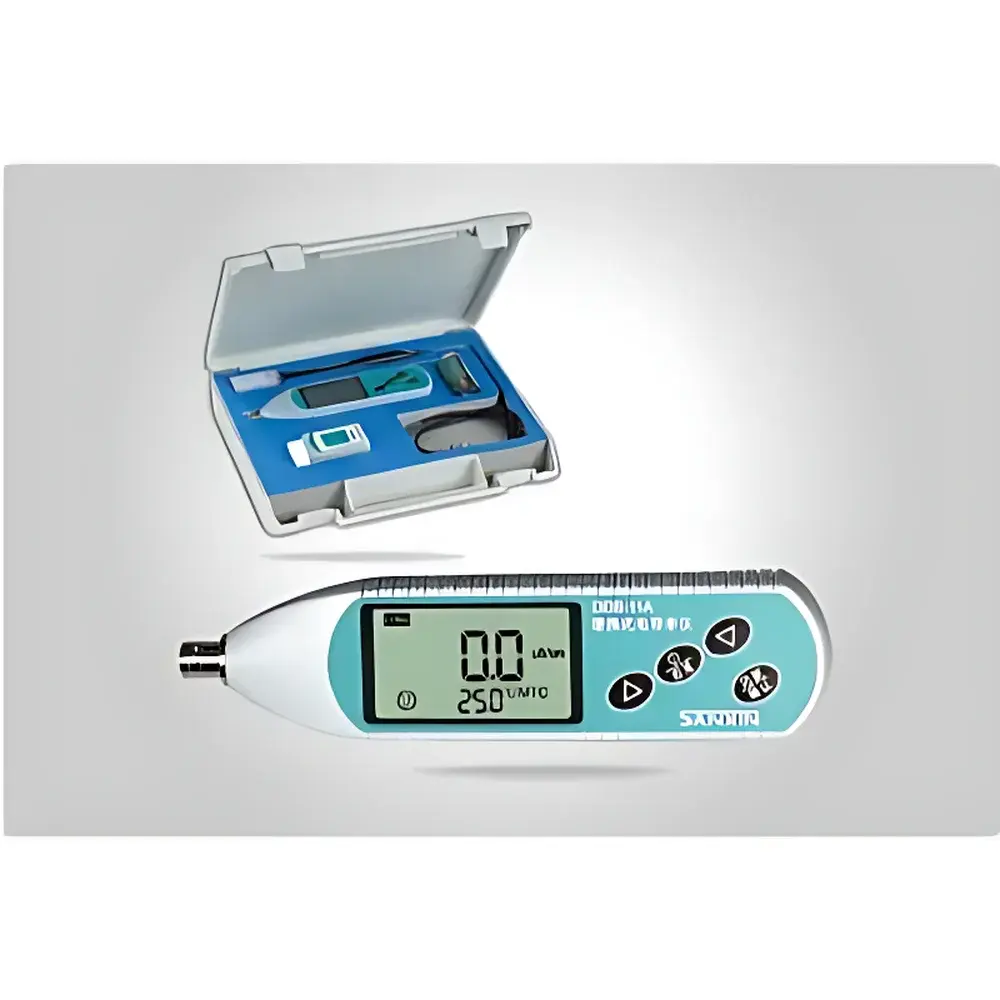
SANXIN DDB-11A Portable Conductivity Meter
| Brand | SANXIN |
|---|---|
| Origin | Shanghai, China |
| Manufacturer Type | Direct Manufacturer |
| Model | DDB-11A |
| Measurement Range | (a) 0.0–199.9 µS/cm (deionized water) |
| Accuracy | ±1% FS ±1 digit (basic error) |
| Power Supply | One 9V alkaline battery (6F22) or external 9V DC adapter |
| Dimensions (meter) | 162 × 43 × 25 mm |
| Electrode Dimensions | Ø12 × 130 mm |
| Weight | 210 g (including battery) |
| Operating Temperature | 5–35 °C |
| Compliance | Designed for field-deployable GLP-compliant conductivity measurements in environmental and industrial QA/QC workflows |
Overview
The SANXIN DDB-11A Portable Conductivity Meter is a compact, battery-operated electrochemical instrument engineered for rapid, on-site measurement of electrical conductivity in aqueous solutions. Based on the principle of two-electrode AC conductometric measurement—applying a low-frequency alternating current to minimize polarization effects and electrode fouling—the DDB-11A delivers stable readings across four user-selectable range segments optimized for distinct sample matrices. Its design adheres to fundamental metrological practices outlined in ASTM D1125 and ISO 7888, ensuring traceability and comparability in routine water quality assessment. The meter operates without temperature compensation by default but supports manual input of solution temperature (5–35 °C), enabling basic correction using the standard 2% per °C coefficient for NaCl-equivalent solutions. As a Class II portable device intended for non-laboratory environments, it meets IEC 61010-1 safety requirements for handheld electrical instrumentation used in field and plant-floor settings.
Key Features
- Four-range auto-scaling architecture: dynamically optimized ranges for deionized water (0.0–199.9 µS/cm), ultra-low-conductivity industrial effluents (0.00–19.99 µS/cm), potable and mineral waters (0–1999 µS/cm), and high-salinity media including seawater (0.0–199.9 µS/cm)
- High-stability graphite two-electrode sensor with fixed cell constant (K = 1.0 cm⁻¹), calibrated against certified KCl standards (e.g., 1413 µS/cm at 25 °C)
- Dual power mode: operation via single 9V alkaline battery (6F22) with >200 hours of continuous use, or optional 9V DC regulated external supply for extended benchtop deployment
- Compact ergonomic housing (162 × 43 × 25 mm) with integrated belt-clip and protective neoprene carry sleeve—designed for glove-compatible operation in industrial hygiene and environmental sampling scenarios
- Backlit LCD display with 3½-digit resolution, automatic polarity indication, and low-battery warning icon
- No internal memory or Bluetooth; designed for immediate read-and-record workflow compatible with paper-based or LIMS-integrated manual data logging
Sample Compatibility & Compliance
The DDB-11A is validated for use with clean to moderately contaminated aqueous samples—including drinking water, reverse osmosis permeate, boiler feedwater, municipal wastewater effluent, and coastal seawater—provided suspended solids remain below 50 mg/L and oil/grease content is negligible. It is not suitable for viscous, highly corrosive (e.g., concentrated acids/bases), or strongly oxidizing solutions. While not certified to IEC 60746-3 for metrological accreditation, its performance aligns with EPA Method 120.1 and APHA Standard Methods 2510B for field-grade conductivity verification. Device calibration follows a two-point protocol using NIST-traceable KCl standards (e.g., 1413 µS/cm and 12.88 mS/cm), supporting audit-ready documentation under GLP and ISO/IEC 17025-aligned QA programs.
Software & Data Management
The DDB-11A operates as a standalone analog-digital hybrid instrument with no embedded firmware update capability or USB connectivity. All configuration and calibration are performed manually via front-panel push-button interface. No proprietary software, drivers, or cloud synchronization is provided. Data integrity is maintained through direct visual readout and manual transcription into laboratory notebooks or electronic spreadsheets. For regulated environments requiring electronic records, users may integrate the DDB-11A into 21 CFR Part 11–compliant workflows by pairing it with validated third-party data capture tools (e.g., barcode-scanned entry into validated LIMS platforms) and maintaining contemporaneous handwritten calibration logs signed and dated by authorized personnel.
Applications
- Routine monitoring of conductivity in municipal water distribution systems and bottled water production lines
- Field screening of boiler and cooling tower water chemistry to detect scaling potential or chloride ingress
- Environmental compliance checks for discharge permits (e.g., NPDES) requiring conductivity limits
- Educational laboratories performing foundational electrochemistry experiments on electrolyte concentration gradients
- Preventive maintenance of reverse osmosis and deionization systems where conductivity serves as proxy for membrane integrity
- First-response assessment during water contamination incidents, including salinity intrusion or antifreeze leakage detection
FAQ
Does the DDB-11A support automatic temperature compensation (ATC)?
No. ATC is not implemented. Users must manually enter the measured sample temperature to apply approximate linear correction.
Can the electrode be immersed in hot water above 35 °C?
No. Continuous operation above 35 °C may damage the epoxy body and degrade electrode stability. Short-term exposure up to 45 °C is permissible if followed by thermal equilibration before measurement.
Is the electrode replaceable or serviceable?
Yes. The graphite two-electrode probe (model DJS-1C or equivalent) is field-replaceable and may be cleaned ultrasonically in mild detergent or soaked in 0.1 M HNO₃ for inorganic fouling.
What calibration standards are recommended?
NIST-traceable KCl solutions: 1413 µS/cm (25 °C) for low-range verification and 12.88 mS/cm (25 °C) for high-range validation.
Does the device meet IP rating requirements for outdoor use?
It carries no formal IP rating, but its sealed housing and rubberized keypad provide resistance to incidental splashes and dust—suitable for covered outdoor operation under ISO 9001 field inspection protocols.




