
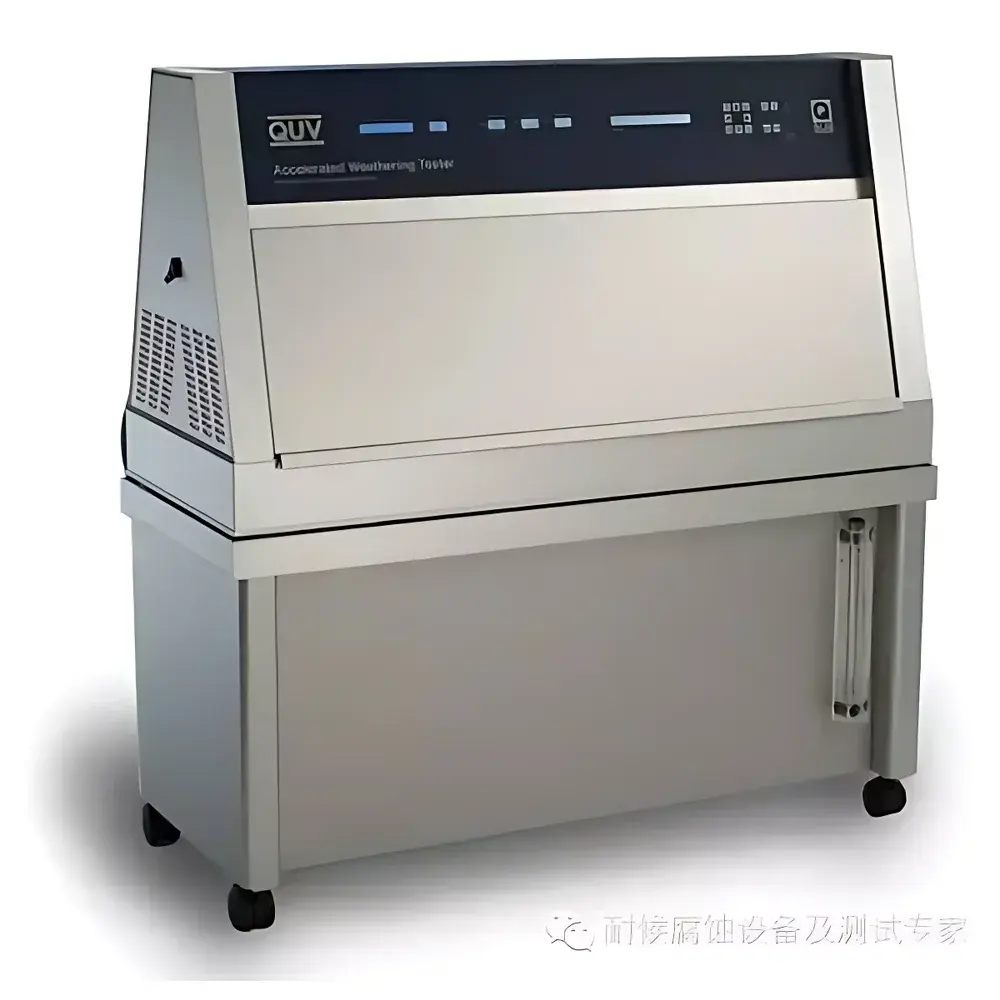
Q-LAB QUV/Spray UV Aging Test Chamber
| Brand | Q-LAB |
|---|---|
| Origin | USA |
| Manufacturer Type | Authorized Distributor |
| Import Status | Imported |
| Model | QUV/Spray |
| Chamber Internal Dimensions (L×W×H) | Configurable per standard specimen rack layout (supports 48 × 75 mm × 150 mm specimens) |
| UV Lamp Options | UVA-340, UVB-313 |
| Irradiance Control | Yes (calibrated broadband UV sensor) |
| Temperature Range | 45–80 °C (irradiation), 40–60 °C (condensation) |
| Humidity Simulation | Condensation (distilled water, ~8 L/day) + Spray Cycle (distilled water, ~7 L/min) |
| Power Supply | 230 V / 50 Hz, 1500 W |
| Weight | 136 kg |
| Compliance | ASTM G154, ISO 4892-3, JIS D0205, SAE J2020, FDA 21 CFR Part 11 (via optional software package) |
Overview
The Q-LAB QUV/Spray UV Aging Test Chamber is an engineered solution for accelerated weathering evaluation of polymeric materials, coatings, inks, and automotive components under controlled ultraviolet (UV) radiation, temperature, condensation, and water spray exposure. Based on the fundamental principle of photochemical degradation—where UV photons induce bond scission, oxidation, and chromophore alteration—the QUV/Spray replicates key environmental stressors responsible for yellowing, gloss loss, chalking, cracking, and embrittlement. Unlike xenon-arc systems that simulate full-spectrum sunlight, the QUV platform employs fluorescent UV lamps to deliver reproducible, high-intensity UV irradiance within biologically and chemically relevant spectral bands (295–400 nm). This targeted approach enables rapid, cost-effective screening of formulation stability while maintaining strong correlation with real-world outdoor exposure—particularly for applications where short-wavelength UV dominates degradation mechanisms.
Key Features
- Triple-stress exposure capability: simultaneous or sequential UV irradiation, thermal cycling, and moisture simulation via condensation and calibrated water spray cycles
- Dual UV lamp compatibility: UVA-340 lamps (peak at 340 nm; optimal for solar-spectrum fidelity) and UVB-313 lamps (peak at 313 nm; enhanced acceleration for severe durability testing)
- Precision black-panel temperature control (±0.5 °C) with independent irradiance monitoring using NIST-traceable broadband UV sensors
- Stainless steel chamber construction with quartz UV-transmitting lamp housings and corrosion-resistant spray nozzles
- Programmable test sequences supporting up to 99 cycles per test, including ramped irradiance profiles and variable condensation durations
- Compliance-ready architecture: supports audit trails, user access levels, and electronic signatures when integrated with Q-Lab’s optional QUV Software Suite
Sample Compatibility & Compliance
The QUV/Spray accommodates standardized flat specimens measuring 75 mm × 150 mm (up to 48 positions per rack), compatible with ASTM D6695, ISO 4892-3, and JIS K 7350 specimen holders. Its modular rack design allows direct mounting of coated panels, molded plastic parts, textile swatches, and automotive trim components without fixture modification. All operational parameters—including irradiance setpoint, black-panel temperature, spray frequency, and condensation duration—are traceable to internal calibration logs and externally verifiable via factory-certified UV radiometers. The system meets essential regulatory frameworks for quality assurance: ASTM G154 Class I/II protocols for non-metallic materials, ISO 4892-3 Annex A for UV fluorescent exposure, and SAE J2020 for automotive exterior component validation. When deployed with validated software and documented SOPs, it satisfies GLP and GMP requirements for stability-indicating method development and material qualification.
Software & Data Management
Control and data acquisition are managed through Q-Lab’s proprietary QUV Software Suite, a Windows-based application compliant with FDA 21 CFR Part 11 for electronic records and signatures. The software provides real-time graphing of irradiance, temperature, and cycle status; automatic generation of test reports in PDF/CSV formats; and secure database archiving with time-stamped audit trails. User roles are configurable (Administrator, Operator, Reviewer), with password protection and session timeout enforcement. All parameter changes—including lamp type selection, irradiance target, and spray timing—are logged with operator ID, timestamp, and pre/post values. Raw sensor data is stored at 1-second resolution and exportable for third-party statistical analysis (e.g., JMP, Minitab) or integration into enterprise LIMS platforms via ODBC drivers.
Applications
- Automotive: Accelerated evaluation of interior trim yellowness (ASTM D6695), paint clearcoat chalking, and headlamp lens haze
- Coatings & Inks: Correlation studies between QUV exposure and Florida/Miami field aging for architectural and industrial finishes
- Plastics & Polymers: Screening of UV stabilizers (HALS, benzotriazoles), antioxidant efficacy, and long-term color retention in PP, ABS, and PC
- Medical Devices: ISO 10993-12-compliant photostability assessment of polymer packaging and drug delivery components
- Textiles & Nonwovens: Lightfastness testing of dyed fabrics per AATCC TM16 and ISO 105-B02
FAQ
What is the difference between UVA-340 and UVB-313 lamps?
UVA-340 lamps emit energy closely matching terrestrial solar UV (295–365 nm) and are preferred for realistic outdoor correlation. UVB-313 lamps extend output to 280 nm, delivering higher photon energy for aggressive acceleration—ideal for quality control screening but less representative of natural exposure.
Can distilled water be substituted with deionized or tap water?
No. Only distilled or Type II reagent-grade water is permitted for condensation and spray functions to prevent mineral deposition, nozzle clogging, and optical interference with UV transmission.
Is calibration required before first use?
Yes. Initial calibration of the broadband UV sensor and black-panel thermocouple must be performed using Q-Lab’s certified reference standards (NIST-traceable) and documented per ISO/IEC 17025 guidelines.
How often should UV lamps be replaced?
UVA-340 and UVB-313 lamps are rated for 5,000 hours of operation; however, irradiance decay exceeds ±10% after ~1,500–2,000 hours, necessitating replacement to maintain test validity.
Does the QUV/Spray support multi-user network operation?
Yes—when configured with Q-Lab’s Network License Manager, up to 10 concurrent users can schedule, monitor, and retrieve data from multiple QUV units across a local area network.



