
Q-LAB QUV/spray UV Aging Test Chamber
| Brand | Q-LAB |
|---|---|
| Origin | USA |
| Model | QUV/spray |
| UV Wavelength Range | 280–400 nm |
| Compliance | ASTM G151, ASTM G154, ISO 4892-3, ISO 11507, JIS D 0205, SAE J2020, GM 9125P, NACE TM-01-84, and over 50 additional international standards |
| Irradiance Control | Solar Eye® closed-loop feedback system |
| Sample Capacity | 48 specimens (75 mm × 150 mm) |
| Condensation Cycle Temperature Range | 40–60 °C |
| UV Irradiation Cycle Temperature Range | 45–80 °C |
| Lamp Life | 5,000 hours (UVA-340 lamps) |
| Power Supply | 120 V/60 Hz, 20 A or 230 V/50–60 Hz, 9 A |
| Water Consumption | 8 L/day (deionized water for spray) |
Overview
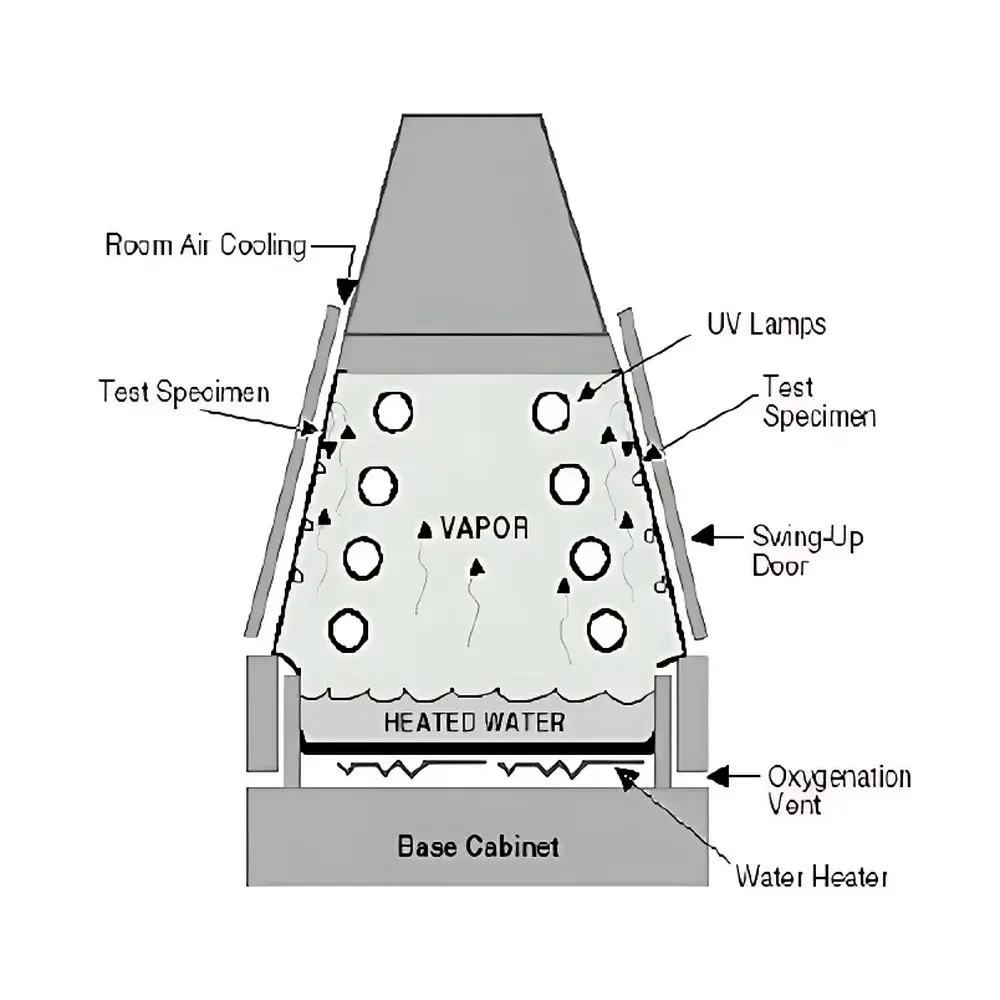
The Q-LAB QUV/spray UV Aging Test Chamber is an industry-standard accelerated weathering instrument engineered for precision simulation of solar ultraviolet radiation, moisture condensation, and controlled thermal cycling. Based on the fundamental principles of photochemical degradation, it employs fluorescent UV lamps—primarily UVA-340—to replicate the short-wave UV spectrum (280–400 nm) most responsible for polymer degradation, pigment fading, coating chalking, and adhesive bond failure. Unlike broad-spectrum xenon arc systems, the QUV/spray platform delivers high-intensity, spectrally stable UV exposure with exceptional repeatability across laboratories and over time. Its modular design integrates three critical environmental stressors—UV irradiation, condensation, and water spray—in a single, compact chamber, enabling users to execute standardized cyclic exposures per ASTM G154, ISO 4892-3, and other globally recognized methods. The system operates continuously under unattended conditions (24/7), making it suitable for long-term durability validation in R&D, quality assurance, and regulatory compliance workflows.
Key Features
- Solar Eye® Irradiance Control System: A closed-loop optical feedback mechanism that dynamically adjusts lamp output to maintain user-defined irradiance setpoints (e.g., 0.68 W/m²·nm at 340 nm), compensating for lamp aging, voltage fluctuations, and ambient temperature drift—ensuring metrological traceability to NIST via annual CR-10 radiometer recalibration.
- Triple-Mode Exposure Cycles: Independent programming of UV irradiation, condensation, and water spray phases enables precise replication of real-world wet/dry cycling—critical for evaluating blistering, corrosion under coatings, and hydrolytic degradation in automotive, aerospace, and architectural materials.
- Microprocessor-Based Controller: Intuitive touchscreen interface with preloaded test protocols (e.g., ASTM D4329, ISO 20340), real-time parameter logging, automatic error detection, audible/visual alarms, and programmable shutdown sequences—including weekend-safe termination with status reporting.
- ISO 9000-Compliant Calibration Architecture: Factory-calibrated CR-10 radiometer (traceable to NIST) supports ISO/IEC 17025-aligned internal audits; optional annual recalibration service ensures ongoing conformance with GLP and GMP data integrity requirements (21 CFR Part 11-ready when paired with Q-Lab’s Q-Support software).
- Robust Mechanical Design: Stainless steel chamber interior, anodized aluminum frame, and sealed lamp housing ensure long-term resistance to UV-induced oxidation and humidity corrosion—validated for >10 years of continuous operation in ISO Class 7 cleanroom-adjacent environments.
Sample Compatibility & Compliance
The QUV/spray accommodates up to 48 standard specimens (75 mm × 150 mm) mounted on Q-Panel® aluminum substrate plates—engineered to minimize batch-to-batch thermal and spectral variability, thereby enhancing inter-laboratory reproducibility. Non-standard geometries (e.g., curved automotive trim, thick composites, or textured roofing membranes) can be secured using custom fixtures without compromising chamber airflow uniformity. All operational modes comply with over 50 internationally harmonized test standards—including ASTM D4587 (coatings), ASTM D4674 (plastics), ASTM C1184 (structural silicone sealants), and ISO 20340 (offshore protective systems). Full compliance documentation—including test method cross-references, uncertainty budgets for irradiance control, and factory calibration certificates—is provided with each unit shipment and archived per ISO 17025 record retention guidelines.
Software & Data Management
When integrated with Q-Lab’s Q-Support™ software suite (Windows-based), the QUV/spray supports automated data acquisition, audit-trail generation, electronic signature capture, and export to CSV, PDF, or XML formats compatible with LIMS and ELN platforms. The system logs all critical parameters—including chamber temperature, irradiance deviation, cycle phase transitions, and fault events—with timestamps synchronized to UTC and immutable hash verification. For regulated environments, optional 21 CFR Part 11 modules enforce role-based access control, electronic signature workflows, and full revision history tracking—enabling seamless FDA, EMA, or PMDA audit readiness. Raw sensor data and controller event logs are stored locally on encrypted SD cards (user-replaceable) and optionally mirrored to secure network drives via Ethernet or USB.
Applications
The QUV/spray serves as a primary qualification tool across sectors where UV-driven material degradation directly impacts safety, longevity, or regulatory approval. In the automotive industry, it validates exterior trim durability per GMW14124 and Ford CETP 00.00-L-467. In aerospace, it supports MIL-STD-810H Method 505.6 UV exposure profiling for cockpit displays and composite fairings. Coating manufacturers rely on its ASTM D4587-compliant cycles to benchmark gloss retention and color shift in architectural acrylics and marine epoxies. Photovoltaic module suppliers use it for IEC 61215-2 MQT10 qualification of encapsulant yellowing and backsheet cracking. Additionally, it supports ASTM D7869 for automotive paint chip testing and ISO 11341 for evaluating anti-corrosion pretreatments under cyclic UV/condensation/spray conditions.
FAQ
What UV lamp types are supported, and how is spectral output verified?
The QUV/spray is optimized for UVA-340 fluorescent lamps (280–365 nm peak), with optional UVB-313 lamps for aggressive screening. Spectral output is verified annually using a NIST-traceable CR-10 radiometer calibrated for both UV-A and UV-B bands.
Is deionized water mandatory for spray and condensation functions?
Yes—deionized water (resistivity ≥1 MΩ·cm) is required for spray nozzles to prevent mineral deposition and nozzle clogging; condensation may use potable water, though DI water is recommended for extended calibration stability.
Can the QUV/spray operate unattended over weekends or holidays?
Yes—programmable end-of-test actions include audible alarm, automatic power-down, and on-screen status message retention for up to 72 hours post-cycle completion.
How does the Solar Eye® system differ from open-loop timer-based irradiance control?
Unlike fixed-timer systems, Solar Eye® uses real-time photodiode feedback to modulate lamp voltage—maintaining ±3% irradiance tolerance throughout lamp life and eliminating need for manual recalibration or lamp replacement scheduling based on hours alone.
What maintenance intervals are recommended for ISO-compliant operation?
Lamp replacement every 5,000 hours (UVA-340), CR-10 radiometer recalibration annually, chamber gasket inspection quarterly, and stainless-steel interior wipe-down after each test series using pH-neutral detergent.



