
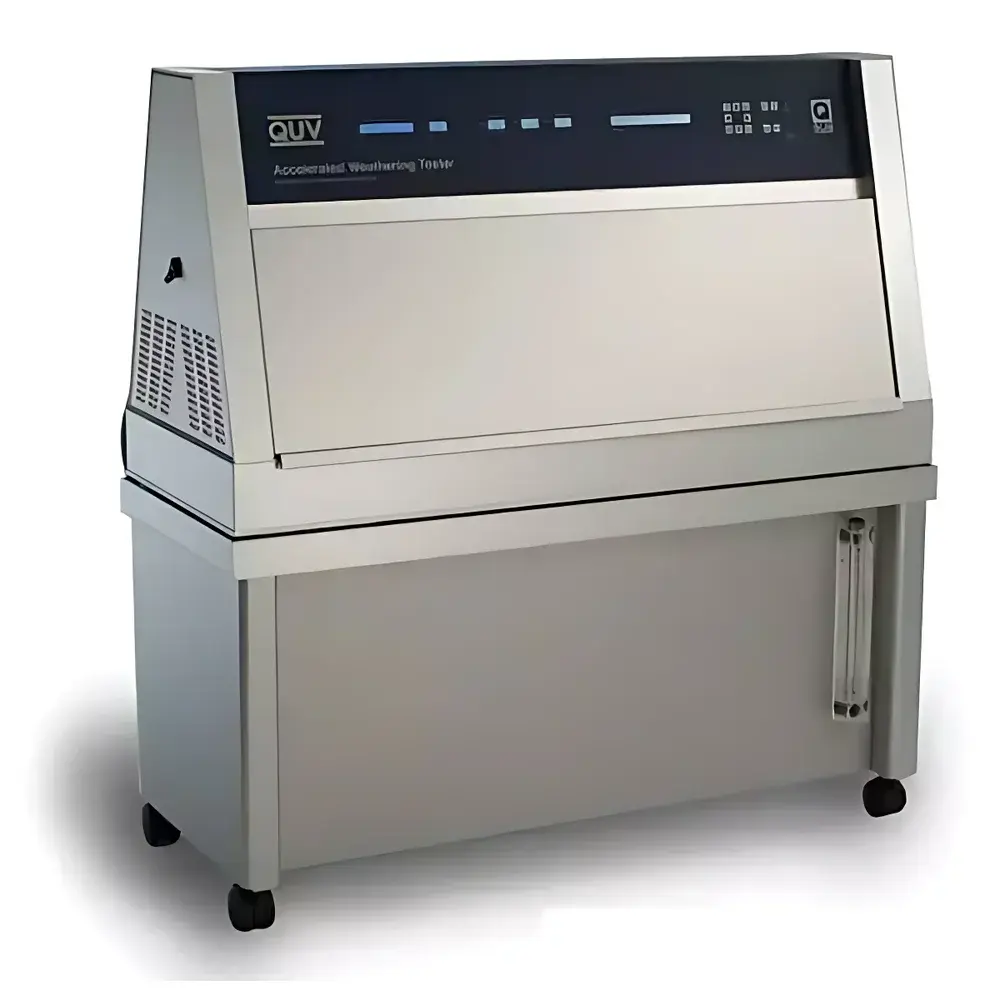
Q-LAB QUV/SP Accelerated UV Weathering Test Chamber
| Brand | Q-LAB |
|---|---|
| Origin | USA |
| Manufacturer Type | Authorized Distributor |
| Product Origin | Imported |
| Model | QUV/SP |
| Pricing | Upon Request |
| UV Irradiance Control | SOLAR EYE® Radiometric Feedback System |
| Black Panel Temperature Range | 35–80 °C (adjustable) |
| Cabinet Dimensions (L×W×H) | 1120 × 570 × 540 mm |
| Internal Chamber Volume | ~34 L |
| UV Lamp Type | UVA-340 or UVB-313 Fluorescent Lamps |
| Condensation Cycle | Automatic distilled-water condensation via heated water pan |
| Spray Function | Optional integrated water spray (deionized water recommended) |
| Compliance | ASTM G154, ISO 4892-3, SAE J2020, IEC 61215, GB/T 14522, MIL-STD-810G |
Overview
The Q-LAB QUV/SP Accelerated UV Weathering Test Chamber is an industry-standard benchtop instrument engineered for reproducible simulation of solar ultraviolet radiation, condensation humidity, and controlled thermal exposure. Based on the fundamental principles of photochemical degradation kinetics, the QUV/SP employs fluorescent UV lamps—specifically UVA-340 (mimicking terrestrial sunlight down to 295 nm) or UVB-313 (extending into more aggressive short-wave UV)—to induce photolytic bond scission in polymeric, coating, and composite materials. Unlike natural outdoor exposure, which subjects specimens to variable spectral distribution, intermittent irradiance, and uncontrolled thermal cycling, the QUV/SP delivers tightly regulated, repeatable UV flux calibrated via Q-LAB’s patented SOLAR EYE® radiometric feedback system. This closed-loop control continuously monitors spectral irradiance at 340 nm (or 313 nm) and dynamically adjusts lamp power to maintain setpoint intensity within ±2% tolerance—ensuring metrological traceability to NIST-traceable reference standards. The chamber integrates a heated water pan that generates saturated humid air, enabling automatic condensation on cooled specimen surfaces—a physically accurate representation of nocturnal dew formation, the dominant moisture mechanism in real-world outdoor aging.
Key Features
- Patented SOLAR EYE® irradiance control system with real-time UV monitoring and automatic lamp power modulation
- Black panel temperature control range: 35–80 °C, maintained via precision PID algorithm with ±0.5 °C stability
- Condensation cycle driven by purified distilled water generated in situ—no external deionized water supply required
- Modular lamp architecture supporting interchangeable UVA-340 and UVB-313 lamp banks; average lamp life exceeds 1,500 hours
- Intuitive touchscreen controller with five-language interface (English, French, Spanish, Italian, German) and embedded self-diagnostic routines
- Ethernet connectivity standard; supports remote monitoring, data logging, and audit-trail generation compliant with FDA 21 CFR Part 11 requirements
- Sample capacity: up to 48 standard specimens (75 × 150 mm); accommodates thicknesses up to 20 mm using adjustable mounting rails and retention rings
Sample Compatibility & Compliance
The QUV/SP is validated for use across diverse material classes including automotive clearcoats, architectural sealants, photovoltaic encapsulants, aerospace composites, medical device polymers, and textile finishes. Its operational parameters align with globally recognized test standards: ASTM G154 (Standard Practice for Operating Fluorescent Ultraviolet (UV) Lamp Apparatus for Exposure of Non-Metallic Materials), ISO 4892-3 (Plastics — Methods of Exposure to Laboratory Light Sources — Part 3: Fluorescent UV Lamps), SAE J2020 (Automotive Exterior Materials—Ultraviolet Exposure), and IEC 61215 (Terrestrial Photovoltaic (PV) Modules). All QUV/SP units ship with factory-installed calibration certificates traceable to Q-LAB’s ISO/IEC 17025-accredited calibration laboratory. For GLP/GMP-regulated environments, optional software modules provide electronic signatures, user access controls, and full change history logs—enabling full compliance with regulatory data integrity expectations.
Software & Data Management
The embedded controller records all critical exposure parameters—including irradiance (W/m² @ 340 nm), black panel temperature, chamber air temperature, condensation duration, and elapsed test time—at user-defined intervals (as frequent as every 30 seconds). Data export is supported via USB drive or Ethernet transfer to Windows-based systems. Optional “Virtual Strip Chart” PC software enables real-time graphical visualization, automated report generation (PDF/CSV), and direct integration with LIMS platforms. When enabled, the system logs every operator action, alarm event, and calibration activity—including timestamps, user IDs, and contextual metadata—satisfying ALCOA+ (Attributable, Legible, Contemporaneous, Original, Accurate, Complete, Consistent, Enduring, Available) data governance criteria. Remote diagnostic support is facilitated through secure email transmission of encrypted log files directly to Q-LAB’s global technical support team.
Applications
Material scientists and quality assurance engineers deploy the QUV/SP to quantify resistance to UV-induced embrittlement in thermoplastic elastomers used in cable jacketing; assess gloss retention and chalking propensity in exterior architectural paints per ASTM D4214; evaluate yellowing index shifts in polycarbonate lenses exposed to accelerated UV-humidity cycling; screen photostabilizer efficacy in agricultural films; and validate long-term durability of backsheet materials in bifacial solar modules per IEC 61215-2 MQT10. In R&D settings, the QUV/SP supports comparative ranking of formulation variants under identical, controlled stress conditions—eliminating inter-laboratory variability inherent in outdoor rack testing. Its compact footprint and low operating cost (fluorescent lamps consume <1.2 kW during UV phase) make it suitable for high-throughput screening in both academic and industrial laboratories.
FAQ
What UV spectra does the QUV/SP replicate?
The QUV/SP uses either UVA-340 lamps (peak emission at 340 nm, closely matching solar UV down to 295 nm) or UVB-313 lamps (emitting down to 270 nm for highly accelerated, worst-case stress testing).
Is deionized water required for condensation?
No—the condensation system purifies tap water via in-situ distillation; only deionized water is recommended if the optional spray function is installed.
How often must lamps be replaced?
UVA-340 lamps are rated for 1,500 hours of operation; UVB-313 lamps for 1,000 hours. The controller tracks cumulative lamp hours and alerts users prior to end-of-life.
Can the QUV/SP perform cyclic testing with dark periods?
Yes—programmable multi-step cycles support alternating UV irradiation, condensation, and dark (non-irradiated) phases, enabling simulation of diurnal thermal relaxation and oxidative post-irradiation effects.
Does the QUV/SP meet ISO/IEC 17025 requirements for accredited testing labs?
While the instrument itself is not certified, its SOLAR EYE® system, factory calibration documentation, and traceable lamp spectral data enable laboratories to establish measurement uncertainty budgets and fulfill ISO/IEC 17025 clause 6.4.10 (equipment verification) when combined with internal procedural controls.



