
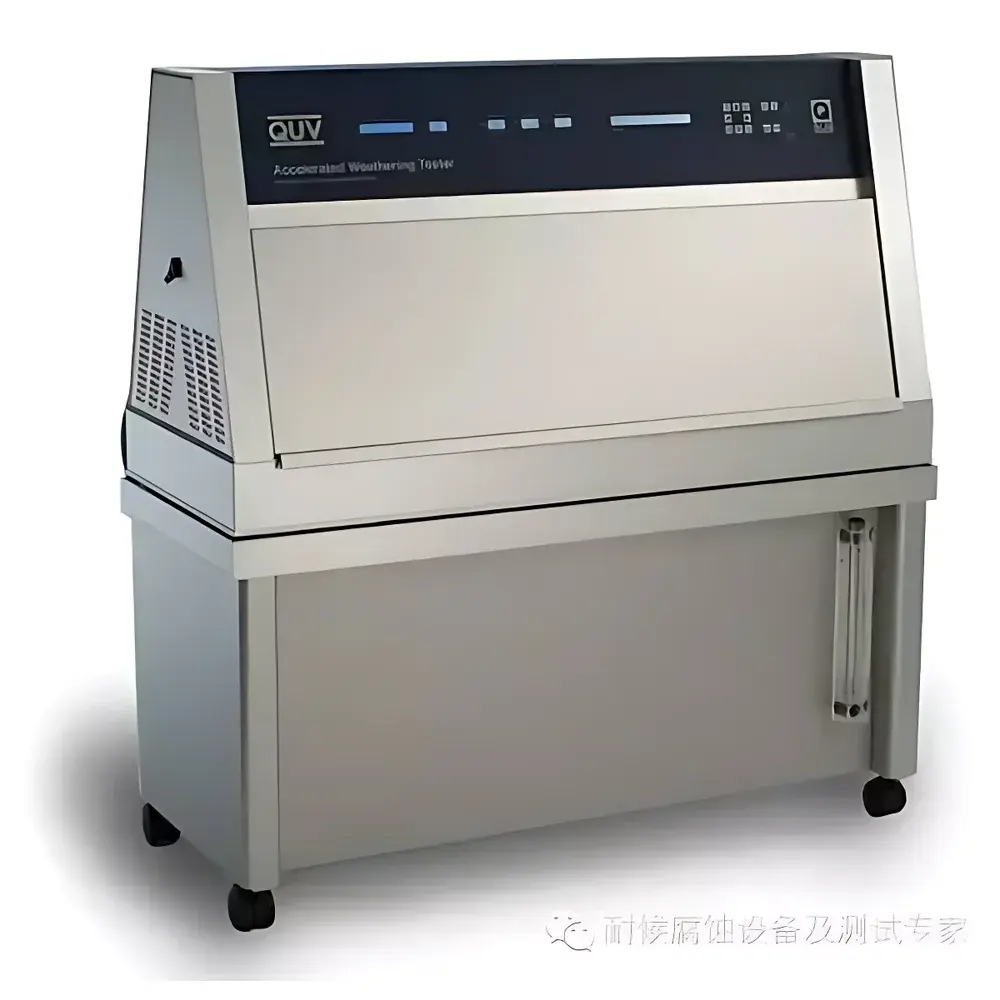
Q-LAB QUV/Spray UV Aging Test Chamber
| Brand | Q-LAB |
|---|---|
| Origin | USA |
| Model | QUV/Spray |
| Compliance | ASTM G154, ASTM G151, ISO 4892-3, JIS D0205, SAE J2020, ISO 11507, ASTM D4587, ASTM D4329 |
| Sample Capacity | 48 × 75 mm × 150 mm specimens |
| UV Lamp Options | UVA-340 (295–365 nm), UVB-313 (280–365 nm) |
| Irradiance Control | Yes |
| Condensation & Spray Cycles | Integrated |
| Temperature Range | 30–80 °C (black panel) |
| Humidity Control | Not applicable (non-hygrometric) |
Overview
The Q-LAB QUV/Spray UV Aging Test Chamber is an industry-standard accelerated weathering instrument engineered for precision simulation of solar ultraviolet (UV) radiation effects on polymeric materials, coatings, adhesives, and plastics. Unlike full-spectrum xenon arc systems, the QUV platform employs fluorescent UV lamps to deliver controlled, repeatable irradiance in the critical 280–400 nm spectral region—where photochemical degradation initiates most rapidly. Its core design follows the principles of accelerated photodegradation testing: high-intensity UV exposure combined with cyclic condensation (simulating nighttime dew) and optional water spray (mimicking rain-induced surface erosion and thermal shock). This tri-modal stress combination enables laboratory replication of outdoor aging mechanisms—including chalking, gloss loss, color shift, microcracking, and embrittlement—in days or weeks rather than years. The system operates without active humidity control; instead, it relies on condensation generated by cooling the specimen backplate while maintaining elevated chamber air temperature—a method standardized in ASTM G154 and ISO 4892-3.
Key Features
- Modular UV lamp architecture supporting interchangeable UVA-340 and UVB-313 lamp types—UVA-340 replicates terrestrial sunlight UV below 365 nm with high fidelity; UVB-313 delivers aggressive short-wave UV for rapid screening and failure-mode acceleration.
- Integrated water spray system compliant with ASTM D4587 and ISO 11507 Annex A, enabling synchronized UV exposure, condensation, and aqueous surface wetting to assess resistance to hydrolytic degradation and blistering.
- Black panel thermometer (BPT) temperature control (30–80 °C range) ensures accurate surface temperature monitoring per ASTM G151, eliminating reliance on ambient air readings which poorly correlate with actual specimen thermal loading.
- Programmable cycle sequencing via intuitive touchscreen interface—users define UV intensity, condensation duration, spray frequency, and temperature setpoints independently per phase.
- Rugged stainless-steel chamber construction with quartz UV-transmitting lamp housings and corrosion-resistant sample racks designed for long-term stability under continuous UV exposure.
- Compliance-ready architecture: supports audit trails, user access levels, and parameter lockout features required for GLP and ISO/IEC 17025 environments (when configured with optional data logging and software).
Sample Compatibility & Compliance
The QUV/Spray accommodates up to 48 flat specimens measuring 75 mm × 150 mm, mounted vertically on corrosion-resistant aluminum racks. Specimen thickness is unrestricted within mechanical clearance limits (max. ~13 mm). It is validated for use with rigid and semi-rigid substrates including painted metal panels, plastic injection-molded parts, architectural coatings, automotive trim, roofing membranes, and pressure-sensitive adhesives. Regulatory alignment includes full conformance with ASTM G154 (practice for fluorescent UV exposure), ASTM G151 (exposure apparatus calibration), ISO 4892-3 (plastics—laboratory light sources), and JIS D0205 (automotive exterior materials). Additional material-specific standards supported include ASTM D4329 (plastics), ASTM D4587 (coatings), SAE J2020 (automotive), and ISO 11507 (paints and varnishes). All test methods are implemented without modification to chamber hardware—no external retrofitting or third-party add-ons required.
Software & Data Management
Control and data acquisition are managed through Q-Lab’s proprietary SOLAR EYE™ software (v5.x), available as a Windows-based desktop application. SOLAR EYE enables real-time monitoring of irradiance (W/m² @ 340 nm), black panel temperature, cycle stage progression, and lamp hour accumulation. It supports automated report generation in PDF or CSV format, complete with timestamped metadata, operator ID, and calibration certificate references. For regulated laboratories, optional 21 CFR Part 11 compliance packages provide electronic signature capability, audit trail logging (including parameter changes and user logins), and role-based permission controls. Raw sensor data is stored locally with configurable backup intervals and can be exported for secondary analysis in MATLAB, Python, or statistical process control (SPC) platforms. Firmware updates are delivered directly from Q-Lab’s secure portal and verified via cryptographic checksum prior to installation.
Applications
- Automotive OEMs validating UV resistance of interior trims, exterior clearcoats, and headlamp polycarbonate lenses per GM 9125P and Ford CETP.
- Coating manufacturers qualifying weatherability claims for architectural acrylics and fluoropolymer topcoats under ISO 20340 and ASTM D3794.
- Polymer compounders assessing stabilization package efficacy in PVC, ABS, and polyolefins using ASTM D4674 and DIN 53384 protocols.
- Adhesive formulators evaluating bond-line durability in structural glazing systems per ASTM C1442 and ASTM D904.
- Roofting membrane producers conducting qualification testing against ANSI/RMA IPR-1 and ASTM D4799 for long-term solar reflectance retention.
- Academic and government research labs performing mechanistic studies on photo-oxidation kinetics using calibrated UVA-340 irradiance profiles traceable to NIST standards.
FAQ
What is the difference between UVA-340 and UVB-313 lamps?
UVA-340 lamps emit energy closely matching the solar UV spectrum down to 295 nm and are recommended for correlation with real-world outdoor exposure. UVB-313 lamps emit shorter-wavelength UV (down to 280 nm) at higher intensities, producing accelerated degradation useful for comparative ranking and failure-mode identification—but with reduced field correlation.
Does the QUV/Spray meet FDA or ISO 17025 requirements?
The base instrument meets mechanical and optical specifications referenced in ISO/IEC 17025 Clause 6.4. Full accreditation readiness requires documented calibration procedures, uncertainty budgets, and implementation of SOLAR EYE’s Part 11-compliant software module—both available through Q-Lab’s Validation Support Services.
Can I test non-flat or three-dimensional samples?
Standard fixtures support only flat, planar specimens. Custom rack adapters are available for limited 3D geometries (e.g., small molded parts), but irradiance uniformity and condensation distribution must be verified per ASTM G151 Annex A prior to data submission for certification purposes.
How often do UV lamps require replacement?
Lamp service life is rated at 1,600–2,000 hours under typical operating conditions. Q-Lab recommends replacement based on irradiance decay monitoring—not calendar time—to ensure consistent photon flux delivery across test campaigns.
Is calibration traceable to national standards?
Yes. Q-Lab’s UV radiometers are calibrated annually against NIST-traceable reference standards, and calibration certificates include measurement uncertainty values per ISO/IEC 17025 requirements.



