
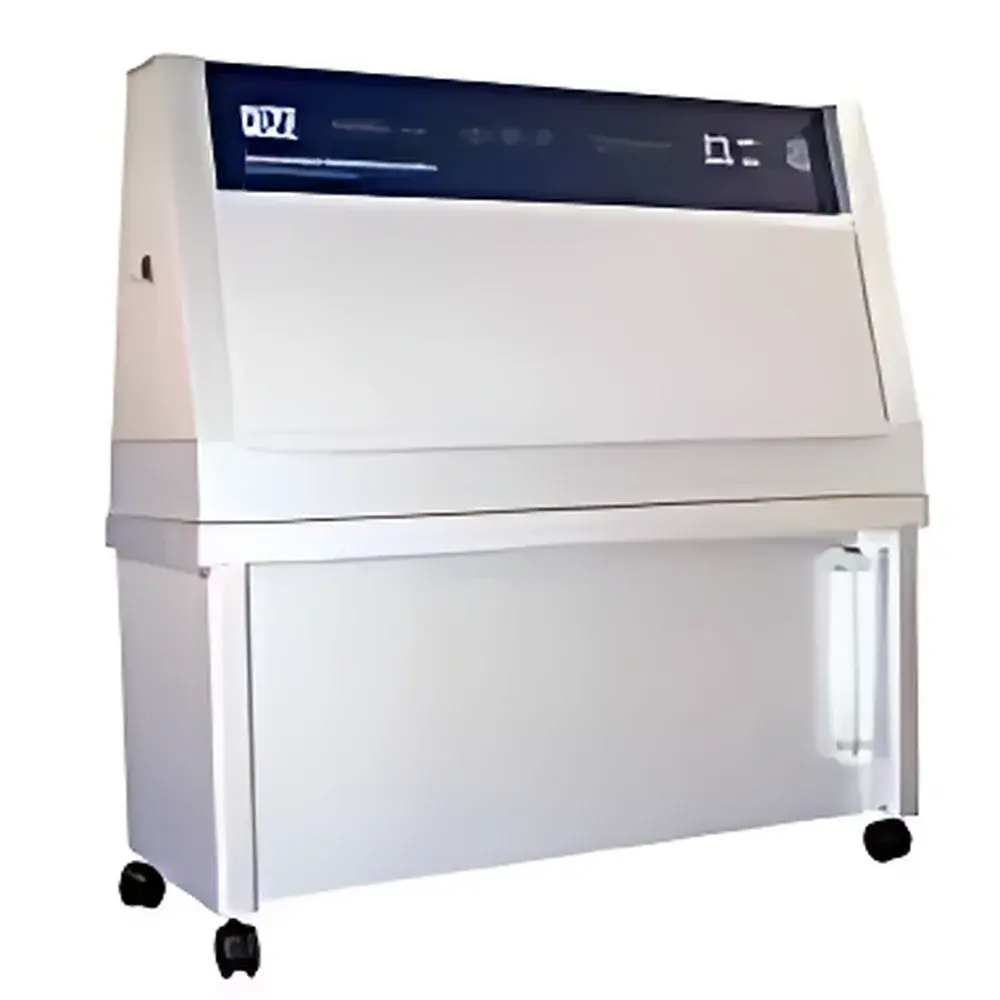
Q-LAB QUV/spray UV Aging Test Chamber
| Brand | Q-LAB |
|---|---|
| Origin | USA |
| Manufacturer Type | Authorized Distributor |
| Origin Category | Imported |
| Model | Q-LAB QUV/spray |
| Price | Upon Request |
| UV Wavelength Range | 290–400 nm (UVA-340 & UVB-313 lamp options) |
| Irradiance Control | Yes (SOLAR EYE sensor optional) |
| Black Panel Temperature Range | 35–80 °C |
| Chamber Temperature Range (Air) | 25–80 °C |
| Condensation Temperature Range | 35–60 °C |
| Chamber Dimensions (L×W×H) | 114 × 51 × 42 cm (45 × 20 × 16.5 in) |
| Sample Capacity | Up to 48 specimens (75 mm × 150 mm) |
| Spray Function | Integrated deionized water spray system with adjustable duration/frequency |
| Compliance | ASTM G154, ISO 4892-3, SAE J2020, GB/T 14522, JIS D0205 |
Overview
The Q-LAB QUV/spray UV Aging Test Chamber is an industry-standard accelerated weathering instrument engineered for precision simulation of solar UV radiation, condensation, and water spray exposure—key environmental stressors responsible for photodegradation in outdoor materials. Unlike xenon arc or carbon arc testers, the QUV/spray employs fluorescent UV lamps (UVA-340 or UVB-313) that replicate the most damaging short-wavelength portion of terrestrial sunlight (290–400 nm), enabling reproducible assessment of polymer degradation mechanisms including photooxidation, chain scission, and chromophore breakdown. Its design adheres to the fundamental principles of controlled photostability testing: consistent spectral output, calibrated irradiance, thermally stable black panel temperature control, and physiologically relevant moisture cycling via condensation and spray. This architecture ensures high inter-laboratory reproducibility and direct correlation with real-world field performance—validated across decades of ASTM G154, ISO 4892-3, and SAE J2020 interlaboratory studies.
Key Features
- Triple-Mode Exposure Cycling: Independent or combined operation of UV irradiation, condensation (via heated water pan and cooled chamber walls), and water spray—enabling simulation of dew formation, thermal shock, and mechanical erosion.
- Precision Black Panel Temperature Control: Dual-sensor feedback loop maintains black panel temperature within ±1.5 °C across 35–80 °C range; critical for accelerating secondary thermal-oxidative reactions without altering primary photochemical pathways.
- SOLAR EYE Irradiance Monitoring (Optional): Calibratable broadband UV sensor provides real-time irradiance measurement (W/m² @ 340 nm) and automatic lamp output compensation, ensuring test repeatability per ASTM G154 Section 7.3.
- AUTOCAL Calibration System: Patented self-calibration routine for black panel sensors using NIST-traceable reference thermometers; eliminates manual calibration drift and reduces metrological uncertainty.
- Robust Sample Handling: Adjustable standard racks accommodate specimens up to 20 mm thick; retention rings secure irregular or oversized samples (e.g., lenses, 3D-printed parts, coated panels) without trimming.
- Self-Diagnostic Controller: Embedded microprocessor continuously monitors lamp status, temperature sensors, spray solenoid, condensate level, and safety interlocks; displays actionable alerts and initiates fail-safe shutdown when thresholds are exceeded.
Sample Compatibility & Compliance
The QUV/spray accommodates rigid and semi-rigid flat specimens (75 × 150 mm standard), flexible films, molded components, and coated substrates—including automotive clearcoats, architectural sealants, PV module encapsulants, and aerospace composites. Its operational envelope meets the physical and procedural requirements of major international standards: ASTM G154 (Cycle 1–6), ISO 4892-3 (Method A & B), SAE J2020 (for automotive exterior plastics), GB/T 14522 (Chinese national standard), and JIS D0205 (Japanese automotive specification). All models include Ethernet connectivity for audit-ready data logging, supporting GLP/GMP-aligned validation protocols and FDA 21 CFR Part 11-compliant electronic records when paired with validated software.
Software & Data Management
Standard controller firmware stores exposure time, UV dose (kJ/m²), black panel temperature history, and cycle sequence for up to 100 test programs. Optional QUV Virtual Strip PC software enables automated acquisition of real-time parameters—including irradiance, temperature, and spray status—directly into Windows-based spreadsheets or LIMS databases. Data export supports CSV and XML formats; email-triggered diagnostics allow remote transmission of error logs to Q-LAB Technical Support for rapid root-cause analysis. For regulated environments, the system supports user access levels, electronic signatures, and immutable audit trails when integrated with validated third-party laboratory information management systems (LIMS).
Applications
- Evaluation of UV stabilizers and HALS additives in polyolefins, PVC, and engineering thermoplastics
- Correlation studies between accelerated QUV/spray cycles and outdoor Florida/Arizona exposure data
- Qualification of automotive interior/exterior trim for OEM specifications (e.g., GMW14124, Ford CETP)
- Photostability testing of medical device polymers per ISO 10993-12
- Weathering validation of photovoltaic backsheet materials under IEC 61215-2 MQT10
- Coating durability assessment for architectural paints, wood finishes, and marine antifoulings
FAQ
What UV lamp types are supported?
The QUV/spray accepts UVA-340 lamps (best match for solar UV below 365 nm) and UVB-313 lamps (enhanced degradation for aggressive screening); lamp replacement intervals are typically 1,600–2,000 hours.
Is deionized water mandatory for spray operation?
Yes—only deionized or distilled water is permitted in the spray system to prevent nozzle clogging and mineral deposits on specimens.
How is condensate purity maintained?
The condensation process inherently distills water vapor from the heated pan; impurities remain in the pan, ensuring contaminant-free condensate on test surfaces.
Can the QUV/spray operate unattended for extended periods?
Yes—fully automated cycling, self-diagnostics, and Ethernet logging enable continuous operation for weeks; recommended preventive maintenance occurs every 6 months.
Does the system support multi-user access control?
With validated software integration, role-based login, electronic signatures, and audit trail generation comply with GLP, GMP, and ISO/IEC 17025 requirements.
Related Products



