
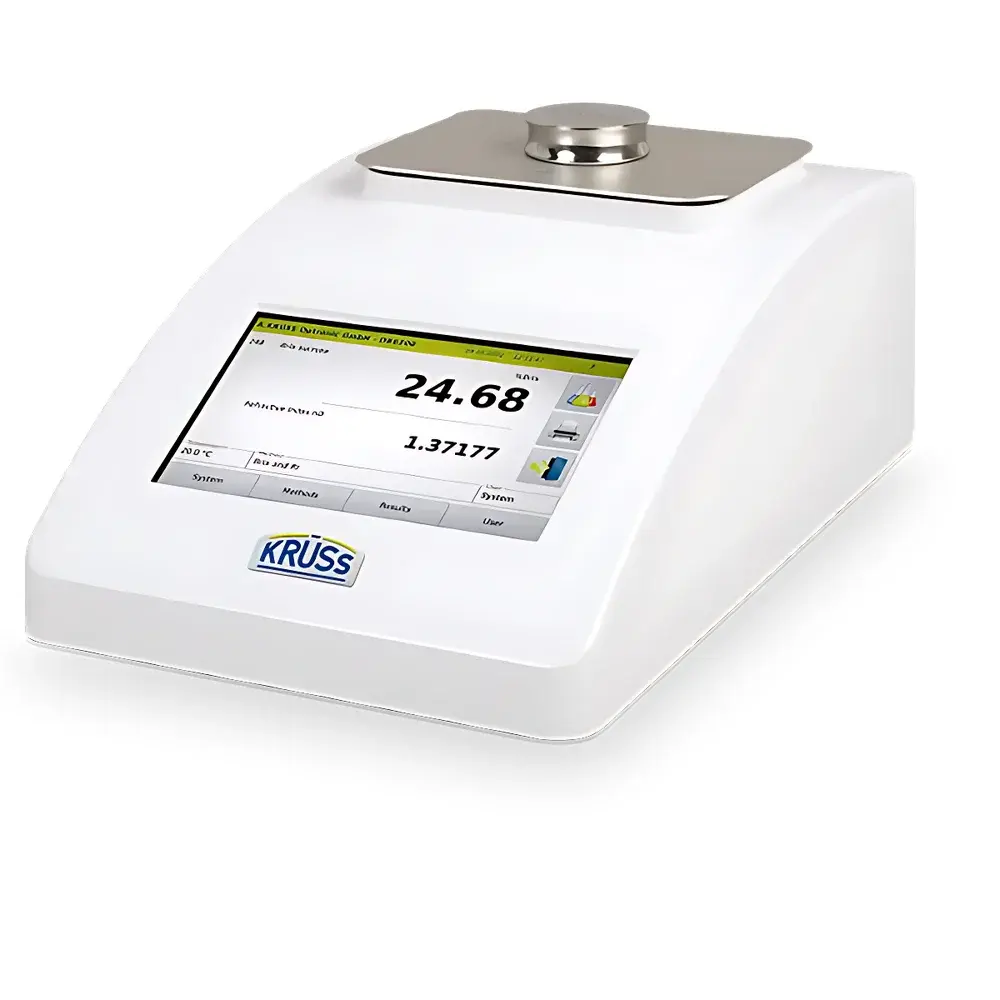
KRUSS DR6000 Series Digital Refractometer
| Brand | KRUSS |
|---|---|
| Origin | Germany |
| Model | DR6000 Series Digital Refractometer |
| Instrument Type | Benchtop Refractometer |
| Temperature Control | Peltier-based, integrated |
| Display | 5.7″ TFT touchscreen (320 × 240 px) |
| Measurement Range | 1.3200–1.7000 nD |
| Brix Range | 0–95 % |
| Refractive Index Accuracy | ±0.0001 nD |
| Brix Accuracy | ±0.1 % |
| Refractive Index Resolution | 0.0001 nD |
| Brix Resolution | 0.1 % |
| Temperature Measurement Range | 5–90 °C |
| Temperature Accuracy | ±0.05 °C |
| Temperature Resolution | 0.1 °C |
| Temperature Control Range (T-models) | 10–80 °C |
| Temperature Stability | ±0.05 °C |
| Prism Material | Sapphire |
| Light Source | 590 nm LED (Lifespan > 100,000 h) |
| Sample Contact Surface | Stainless steel |
| Enclosure | Powder-coated cast aluminum |
| IP Rating | IP65 (measurement cell) |
| Power Supply | 90–260 V AC, 50/60 Hz, 60 W |
| Interfaces | RS-232, USB, Ethernet |
| Data Storage | Embedded SQL database (99 user-defined methods, 999 measurement records) |
| Compliance | GLP-compliant, FDA 21 CFR Part 11 ready (with optional user management module) |
| Optional Accessories | Flow cell unit, external Peltier thermostat PT31, RS-232 thermal printer |
Overview
The KRUSS DR6000 Series Digital Refractometer is a high-precision benchtop instrument engineered for accurate, repeatable determination of refractive index (nD) and related concentration units—including %Brix, %w/w, and user-defined scales—based on the principle of total internal reflection at the prism-sample interface. Utilizing a monochromatic 590 nm LED light source and a sapphire prism with exceptional optical homogeneity and chemical resistance, the DR6000 delivers measurement stability independent of sample turbidity, color, or particulate content—eliminating the need for filtration or centrifugation prior to analysis. Its core optical architecture complies with ISO 21147:2021 and ASTM D1218 standards for refractometric measurement. The integrated Peltier temperature control system enables rapid, precise thermal equilibration of both prism and sample (±0.05 °C accuracy), replacing conventional water-bath systems and ensuring strict adherence to temperature-dependent calibration protocols required in regulated environments.
Key Features
- Peltier-driven active temperature control (10–80 °C range in T- and FT-models) with ±0.05 °C stability and real-time PT100 monitoring
- High-resolution sapphire prism (Vickers hardness >2000 HV) resistant to abrasion, acids, alkalis, and organic solvents
- 5.7″ industrial-grade TFT touchscreen interface with intuitive icon-driven navigation and multilingual support
- Embedded relational SQL database supporting up to 99 customizable measurement methods and 999 traceable results
- Full GLP compliance: automatic timestamping, operator ID logging, audit trail (with optional user management module), and 21 CFR Part 11 readiness
- Multi-interface connectivity: RS-232 (for legacy printers), USB (for direct data export to FAT32-formatted USB drives), and Ethernet (for LAN integration and remote diagnostics)
- Automatic temperature compensation using ICUMSA 3-point user-defined algorithms or built-in standard tables (e.g., sucrose, glucose, fructose)
- Measurement cycle time ≤4 seconds per sample; no prism cleaning required between consecutive analyses
Sample Compatibility & Compliance
The DR6000 accommodates liquid, semi-liquid, and low-viscosity suspensions across diverse industrial matrices—including pulp slurries (papermaking), fruit juice concentrates, syrup formulations, polymer emulsions, metalworking coolants, and wastewater effluents. Its stainless-steel sample stage and sealed sapphire interface ensure compatibility with aggressive media (pH 0–14, halogenated solvents, oxidizers). All models meet IEC 61010-1 safety requirements for laboratory equipment and carry CE marking. For pharmaceutical and food-grade applications, the instrument supports validation documentation packages (IQ/OQ/PQ), conforms to USP and EP 2.2.24 refractometry guidelines, and enables full traceability under GMP/GLP frameworks when configured with role-based access control and electronic signature modules.
Software & Data Management
Data acquisition, processing, and archival are managed via the embedded SQL engine, which logs date/time stamps, operator IDs, method parameters, raw nD and Brix values, temperature readings, and instrument status flags for every measurement. Export options include CSV and XLS formats directly to USB storage—preserving column headers, metadata, and ISO 8601 timestamps. Ethernet connectivity permits integration into LIMS environments via TCP/IP protocols and enables secure remote firmware updates and diagnostic logging through KRUSS’s proprietary service portal. Optional software extensions support statistical process control (SPC) charting, trend analysis over time, and automated report generation compliant with ISO/IEC 17025 clause 7.8.
Applications
The DR6000 series serves as a primary quality control tool in regulated and high-throughput production environments. In beverage and sugar industries, it verifies extract concentration and blending consistency in real time. Within pulp and paper manufacturing, it monitors dissolved solids in black liquor and white water circuits. In chemical and petrochemical labs, it quantifies solvent composition, monomer conversion rates, and surfactant concentrations without interference from chromophores. Metalworking fluid analysis benefits from its immunity to oil mist contamination, while wastewater treatment plants rely on its robustness for rapid salinity and glycol antifreeze screening. The flow-cell variants (DR6000-F, DR6100-F, etc.) support inline process monitoring at sampling points with minimal dead volume.
FAQ
Does the DR6000 require daily recalibration?
No—factory-calibrated using NIST-traceable reference fluids; routine verification with distilled water (nD = 1.3330 @ 20 °C) or certified sucrose standards is recommended before critical batches.
Can the instrument measure non-aqueous samples like ethylene glycol or silicone oils?
Yes—provided the sample wets the sapphire prism and falls within the optical window (1.3200–1.7000 nD). Temperature-controlled models are strongly advised for volatile or thermally sensitive organics.
Is network authentication supported for multi-user laboratories?
Yes—optional user management software enforces password-protected roles (administrator, analyst, reviewer) with configurable permissions and electronic signature capture.
What is the expected lifetime of the LED light source?
Rated for >100,000 hours of continuous operation—equivalent to >11 years at 24/7 usage—with negligible intensity drift over time.
How does the DR6000 handle samples with air bubbles or surface foam?
The sapphire prism’s hydrophobic surface minimizes bubble adhesion; measurement algorithms automatically reject unstable signals during the 4-second acquisition window, ensuring only thermally and optically stabilized readings are recorded.



