
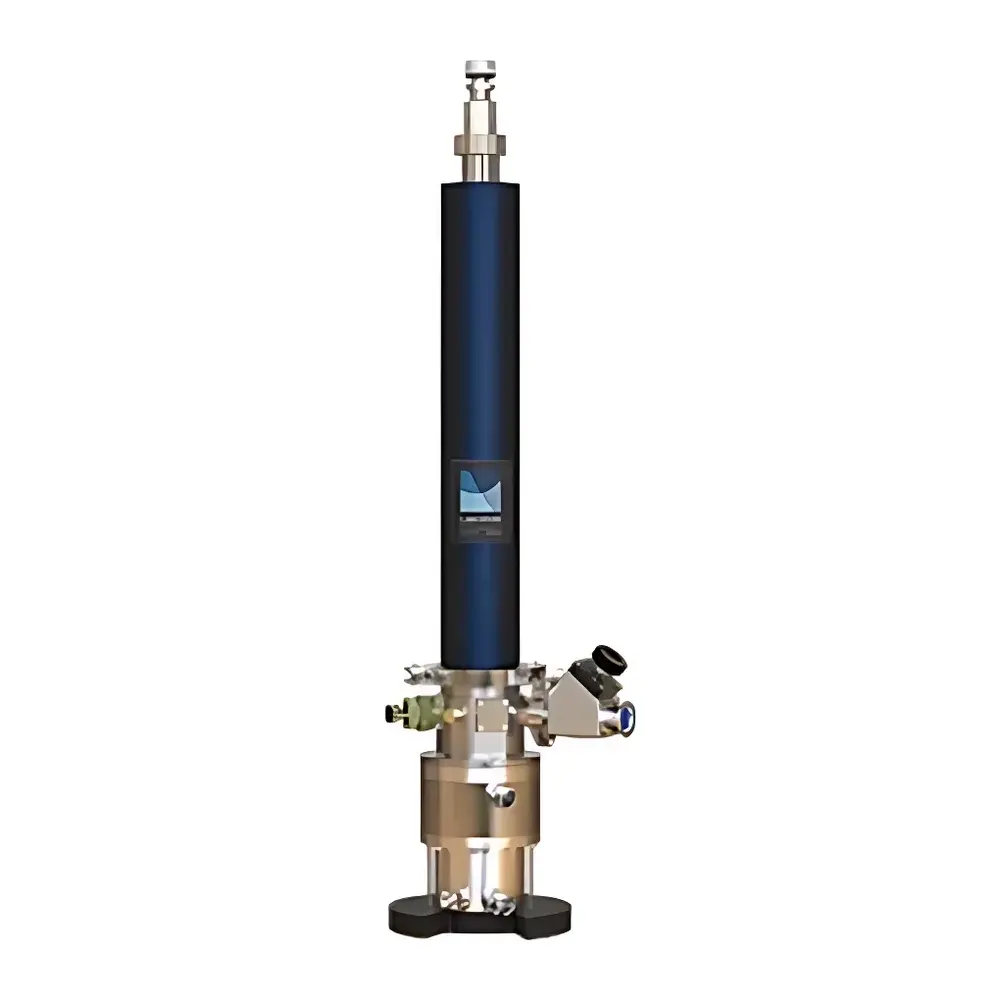
Lake Shore CCS-TRAP / CCS-TRAP-H Helium-Free Cryogenic Trap Thermostat
| Brand | Lake Shore |
|---|---|
| Origin | USA |
| Manufacturer Status | Authorized Distributor |
| Origin Category | Imported |
| Model | CCS-TRAP / CCS-TRAP-H |
| Pricing | Upon Request |
| Cooling Type | Closed-Cycle Refrigeration |
| Temperature Range | <8 K to 325 K / <9 K to 500 K |
| Typical Temperature Stability | ±50 mK |
| Sample Environment | High Vacuum |
| Cool-down Time | 1–1.5 h |
| Cold Head Position | Bottom-Mounted |
| Approx. Height | 91.4 cm / 96.5 cm |
| Approx. Weight | 19.1 kg |
| Recommended Refrigerator Maintenance Interval | 13,000 h |
Overview
The Lake Shore CCS-TRAP and CCS-TRAP-H are helium-free, closed-cycle cryogenic trap thermostats engineered for high-fidelity noble gas and stable isotope extraction in geochemical and cosmochemical laboratories. Unlike conventional liquid helium–cooled traps, these systems employ a two-stage pulse tube cryocooler to achieve base temperatures below 8 K (CCS-TRAP) or below 9 K (CCS-TRAP-H), with continuous, programmable operation across a broad thermal range—up to 325 K or 500 K, respectively. The fundamental operating principle relies on cryo-adsorption: at ultra-low temperatures and under high vacuum (<10⁻⁷ Torr typical), inert gases—including He, Ne, Ar, Kr, and Xe—and isotopically resolved oxygen species (¹⁶O, ¹⁷O, ¹⁸O) condense or adsorb onto cryogenically cooled metal surfaces (typically OFHC copper or gold-plated traps), enabling quantitative capture and subsequent stepwise thermal desorption for mass spectrometric analysis. Designed for integration into ultra-high-vacuum (UHV) noble gas extraction lines, the CCS-TRAP series eliminates logistical and operational constraints associated with liquid cryogens while maintaining the thermal stability (±50 mK) and vacuum compatibility required for sub-picoamp-level ion current measurements in multi-collector noble gas mass spectrometry (MC-NGMS).
Key Features
- Helium-free operation using a reliable, low-vibration two-stage pulse tube refrigerator—no liquid cryogen handling, refills, or boil-off losses
- Two standard configurations: CCS-TRAP (base T < 8 K, max 325 K) optimized for high-sensitivity noble gas trapping; CCS-TRAP-H (base T < 9 K, max 500 K) supporting broader thermal desorption protocols including oxygen isotope release from silicates and ice matrices
- Integrated high-vacuum compatible design: all internal surfaces are UHV-bakeable (to 150 °C), with all-metal seals and zero-outgassing polymers
- Bottom-mounted cold head architecture ensures mechanical stability and minimizes thermal gradients along the trap axis—critical for uniform adsorption kinetics and reproducible release profiles
- Real-time temperature monitoring via calibrated Cernox® or RuO₂ sensors, traceable to NIST standards, with PID-controlled thermal regulation
- Modular flange interface (CF-63 or CF-100 standard) enables direct integration with gas purification manifolds, laser extraction chambers, and quadrupole or magnetic sector mass spectrometer inlets
Sample Compatibility & Compliance
The CCS-TRAP series accommodates diverse sample geometries and matrices—including crushed volcanic glasses, meteoritic olivine separates, polar ice core sections (via optional custom ice-core cooling adapters), and synthetic mineral standards. All trap bodies are constructed from oxygen-free high-conductivity (OFHC) copper with electropolished interior surfaces to minimize surface reactivity and maximize adsorption efficiency for low-concentration noble gas species. The system complies with ASTM E2912–22 (Standard Practice for Noble Gas Extraction from Geomaterials) and supports GLP-compliant workflows when paired with Lake Shore’s Traceable Calibration Services. Vacuum integrity meets ISO 10110-7 requirements for optical-grade cryogenic systems, and the refrigeration unit conforms to IEC 61000-6-2/6-4 electromagnetic compatibility standards.
Software & Data Management
Operation is managed through Lake Shore’s proprietary CryoCon 34i controller firmware, supporting both local front-panel control and remote Ethernet-based communication (TCP/IP, Modbus TCP). Temperature ramping, hold times, and thermal cycling profiles are programmable via ASCII command sets or integrated Python/LabVIEW drivers. All thermal data—including sensor readings, compressor status, and cooldown history—are timestamped and logged with microsecond resolution. Audit trails comply with FDA 21 CFR Part 11 requirements when used with validated electronic record systems, and raw logs export natively to CSV or HDF5 formats for downstream processing in IsoplotR, Squid2, or custom MATLAB pipelines.
Applications
- Extraction and purification of mantle-derived noble gases from basaltic glass and olivine for planetary degassing studies
- Step-heating release of radiogenic ⁴⁰Ar/³⁹Ar and nucleogenic ¹²⁹Xe from meteorites and lunar samples
- Cryo-trapping of atmospheric O₂ isotopologues (e.g., ¹⁶O¹⁸O) from polar ice cores for paleoclimate reconstruction
- In situ noble gas separation during laser-ablation noble gas mass spectrometry (LA-NGMS)
- Calibration of noble gas reference materials (e.g., Hb3gr, GA-1550) under reproducible cryo-adsorption conditions
- Adsorption-based gas purification in ultra-trace analytical chemistry, including removal of H₂O, CO₂, and hydrocarbons from carrier gas streams
FAQ
Can the CCS-TRAP be integrated into an existing noble gas extraction line?
Yes—the system features standard ConFlat (CF) vacuum flanges and is designed for drop-in replacement of liquid-helium cold traps. Custom adapter plates and differential pumping interfaces are available upon request.
What vacuum level is required for optimal noble gas adsorption?
A base pressure ≤5 × 10⁻⁸ Torr is recommended prior to cooldown; the trap itself contributes negligible outgassing after a 12-h bakeout at 120 °C.
Is remote monitoring and control supported?
Yes—Ethernet connectivity, SCPI-compatible command sets, and third-party API support (LabVIEW, Python, MATLAB) enable full automation within larger analytical workflows.
How often does the pulse tube refrigerator require maintenance?
Lake Shore specifies a mean time between maintenance (MTBM) of 13,000 hours under continuous operation; preventive service includes compressor oil inspection and cold head alignment verification.
Can the trap be configured for dual-zone temperature control?
Yes—custom variants with independently controlled dual cold heads (e.g., for simultaneous trapping and pre-desorption zones) are offered as OEM solutions.



