
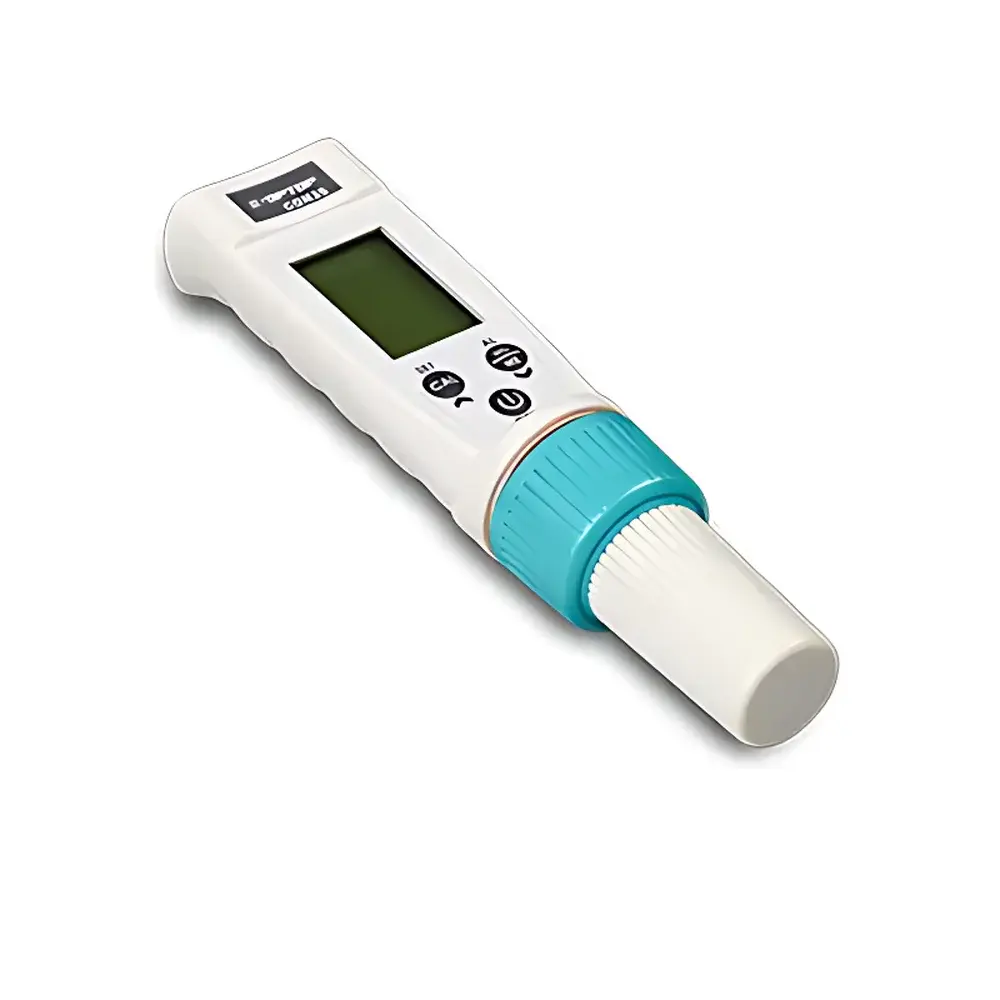
SOPTOP CON35 Handheld Conductivity Meter
| Brand | SOPTOP |
|---|---|
| Origin | Shanghai, China |
| Model | CON35 |
| Measurement Range | 0–200.0 µS/cm (ppm), 0–50.0 mS/cm (ppt) |
| Temperature Range | 0–60.0 °C / 32–140.0 °F |
| Temperature Compensation | Automatic or Manual |
| Resolution | 0.1 / 1 µS/cm (ppm), 0.1 / 1 mS/cm (ppt), 0.1 °C, 1 °F |
| Accuracy | ±1% F.S. |
| Temperature Coefficient Adjustment | 0.00–10.00% |
| TDS Conversion Factor | 0.40–1.00 |
| Salinity Factor | 0.65 |
| Electrode Material | PPS-encapsulated graphite conductivity sensor |
| Calibration | Single-point auto-ranging calibration |
| Data Storage | 10 measurement records |
| Ingress Protection | IP67 |
| Display | Multi-line LED, 22 × 32 mm active area with energy-efficient backlight |
| Power Supply | 1 × AA alkaline battery (1.5 V) |
Overview
The SOPTOP CON35 Handheld Conductivity Meter is a rugged, field-deployable electrochemical instrument engineered for reliable, real-time measurement of electrical conductivity, total dissolved solids (TDS), and salinity in aqueous solutions. Based on the fundamental principle of two-electrode AC conductometric measurement—where an alternating current is applied across a graphite sensing element to minimize polarization and electrode fouling—the CON35 delivers stable readings across a wide dynamic range (0–200.0 µS/cm and 0–50.0 mS/cm). Its temperature-compensated output adheres to standard linear compensation models (adjustable α coefficient 0.00–10.00%/°C), enabling traceable conversion to reference temperatures (typically 25 °C), consistent with ASTM D1125 and ISO 7888 guidelines for conductivity reporting. Designed for operational simplicity without compromising metrological integrity, the CON35 serves as a primary verification tool in water quality screening, environmental monitoring, aquaculture management, and routine process checks where portability, durability, and rapid response are critical.
Key Features
- Rugged IP67-rated housing ensures full dust ingress protection and temporary submersion resistance (up to 1 m for 30 min), making it suitable for outdoor, industrial, and wastewater field use.
- PPS-encapsulated graphite conductivity cell offers chemical resistance to common ions (Cl⁻, SO₄²⁻, NO₃⁻), low polarization drift, and minimal maintenance requirements compared to platinum or stainless-steel electrodes.
- Multi-parameter display shows simultaneous conductivity/TDS/salinity values alongside real-time temperature, with user-selectable units (µS/cm, mS/cm, ppm, ppt) and dual-scale temperature readout (°C/°F).
- Energy-optimized LED display (22 × 32 mm active area) features adjustable backlighting for legibility under low-light conditions—critical during nighttime sampling or in shaded infrastructure environments.
- Single-point auto-ranging calibration simplifies setup using standard KCl solutions (e.g., 1413 µS/cm or 12.88 mS/cm); no manual range selection required.
- Auto-hold function freezes stable readings for documentation; auto-power-off (6-minute timeout) preserves battery life while retaining last-measured data in non-volatile memory.
Sample Compatibility & Compliance
The CON35 is validated for use with low-to-moderate ionic strength aqueous samples, including freshwater, surface runoff, cooling tower water, hydroponic nutrient solutions, and brackish estuarine samples. It is not intended for highly viscous, suspended-solids-laden, or strongly oxidizing media (e.g., >10% HNO₃ or ClO₄⁻-rich solutions) that may degrade the PPS housing or alter electrode surface kinetics. While not certified to GLP or GMP standards out-of-the-box, its documented accuracy (±1% F.S.), traceable calibration protocol, and data retention capability support compliance with ISO/IEC 17025 internal QA procedures when used within defined scope and documented uncertainty budgets. The adjustable TDS factor (0.40–1.00) allows alignment with site-specific ion composition per USP recommendations for purified water testing.
Software & Data Management
The CON35 operates as a standalone instrument with embedded firmware—no PC connectivity or proprietary software required. All configuration (temperature coefficient, TDS factor, salinity factor, unit preferences) is managed via intuitive button navigation. Ten measurement records—including conductivity value, temperature, date/time stamp (if enabled via optional firmware update), and measurement mode—are stored in non-volatile memory and recalled sequentially. Data export requires manual transcription; for laboratories requiring electronic audit trails or integration into LIMS, SOPTOP recommends pairing the CON35 with external logging devices compliant with FDA 21 CFR Part 11 (e.g., Bluetooth-enabled data loggers with digital signature support).
Applications
- Environmental field surveys: rapid assessment of stream conductivity as a surrogate for ionic load and anthropogenic contamination.
- Aquaculture and hydroponics: daily monitoring of nutrient solution EC to maintain optimal osmotic potential for plant or aquatic species.
- Facility maintenance: verification of deionized water loop resistivity, boiler feedwater purity, and cooling system concentration ratios.
- Educational labs: hands-on instruction in solution chemistry fundamentals, including Kohlrausch’s law, ion mobility, and temperature dependence of electrolytic conduction.
- Regulatory pre-screening: preliminary checks prior to submission of samples for certified lab analysis per EPA Method 120.1 or APHA Standard Methods 2510B.
FAQ
What calibration standards are recommended for the CON35?
Standard KCl solutions are recommended: 1413 µS/cm (at 25 °C) for low-range verification and 12.88 mS/cm for high-range validation. Always rinse the electrode with deionized water between calibrations.
Can the CON35 measure seawater salinity accurately?
It provides a salinity estimate using a fixed 0.65 conversion factor, suitable for comparative or trend analysis—but not for oceanographic-grade reporting, which requires multi-frequency induction or CTD-based measurements per UNESCO Practical Salinity Scale (PSS-78).
Is the graphite electrode replaceable?
Yes—the PPS-encapsulated graphite sensor is a field-replaceable module (SOPTOP part number CON-EL-GR-01); replacement preserves instrument calibration coefficients if re-zeroed post-installation.
Does the device meet any international EMC or safety standards?
The CON35 complies with IEC 61326-1 (industrial electromagnetic compatibility) and IEC 61010-1 (electrical safety for measurement equipment), with CE marking for the European Economic Area.
How often should the electrode be cleaned?
Clean with mild detergent and soft brush after each use in turbid or organic-rich samples; soak in 0.1 M HNO₃ for 5 minutes if mineral scaling is observed—rinse thoroughly before reuse.






