
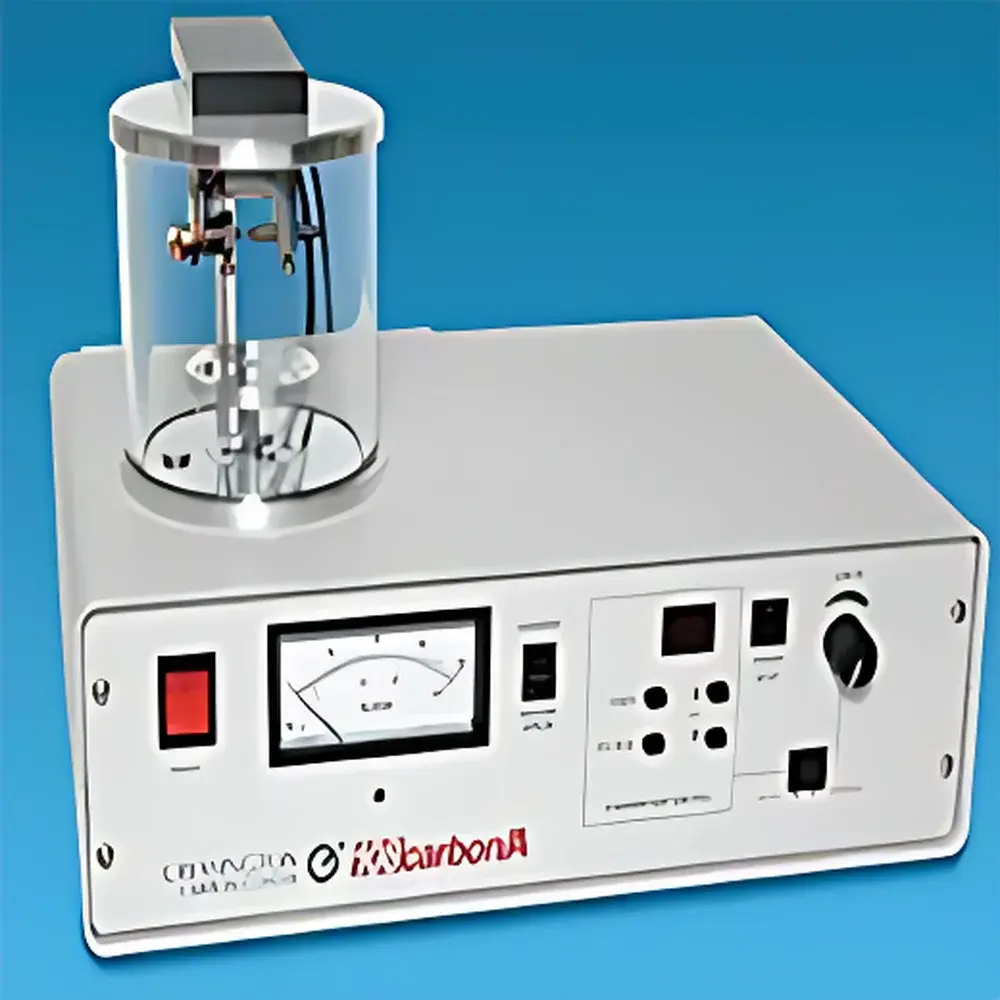
Ted Pella M108C Compact Ion Sputter Coater
| Brand | Ted Pella |
|---|---|
| Origin | Imported |
| Manufacturer Type | Authorized Distributor |
| Model | M108C |
| Target Material | Carbon Rod |
| Target Dimensions | Ø5 mm × 100 mm |
| Control Mode | Fully Automatic with Manual Override |
| Chamber Dimensions | Ø120 mm × H120 mm |
| Sample Stage | 12-position holder with 50 mm vertical adjustability |
| Sputtering Gas | Air or Argon |
| Operating Voltage Range | Adjustable (Manual Mode) |
| Current Range | 0–200 mA |
| Ultimate Vacuum | ≤0.01 mbar |
Overview
The Ted Pella M108C Compact Ion Sputter Coater is a benchtop-scale, high-stability DC magnetron sputtering system engineered for reproducible, ultra-thin conductive coating of non-conductive specimens prior to scanning electron microscopy (SEM), energy-dispersive X-ray spectroscopy (EDS), and focused ion beam (FIB) analysis. It operates on the principle of cold cathode glow discharge sputtering, where energetic ions—generated from air or argon plasma—bombard a carbon rod target, ejecting atomic carbon species that condense as a uniform, amorphous conductive film on sample surfaces. Unlike thermal evaporation, this low-energy, room-temperature process minimizes specimen heating, beam damage, and topographic artifacts—critical for delicate biological tissues, polymers, ceramics, and nanomaterials. The M108C integrates real-time current and voltage monitoring with closed-loop feedback control to maintain consistent sputter rate and film thickness across variable chamber conditions, ensuring metrological traceability in routine lab environments.
Key Features
- Compact footprint (W × D × H ≈ 300 × 350 × 400 mm) optimized for space-constrained laboratories and shared imaging facilities.
- Dual-mode operation: fully programmable automatic mode with stored protocols, plus analog manual mode enabling real-time adjustment of voltage and deposition time via calibrated front-panel controls.
- Pulse and continuous DC sputtering modes—selectable to balance film uniformity, grain size control, and heat load management for sensitive samples.
- Integrated vacuum monitoring with digital readout; achieves base pressure ≤0.01 mbar using built-in two-stage rotary vane pump (no external roughing pump required).
- Carbon-specific design: precision-machined Ø5 mm × 100 mm graphite rod target with standardized electrical contact geometry for stable arc-free operation and extended target life.
- 12-position rotating sample stage with 50 mm vertical travel and independent height locking—enabling simultaneous coating of multiple specimens at identical working distance and angle.
- Robust stainless-steel chamber (Ø120 mm × H120 mm) with quartz viewport and O-ring sealed lid for rapid loading, visual process monitoring, and long-term vacuum integrity.
Sample Compatibility & Compliance
The M108C accommodates standard SEM stubs (up to 25 mm diameter), TEM grids (3.05 mm), multi-well sample holders, and custom substrates mounted on its adjustable stage. Its low-energy sputtering profile preserves fine surface morphology and avoids charging artifacts in insulating materials including silica aerogels, freeze-fractured lipid bilayers, electrospun nanofibers, and geological thin sections. The system complies with IEC 61000-6-3 (EMC emissions) and IEC 61010-1 (electrical safety for laboratory equipment). While not certified for GMP production use, its repeatable process parameters, operator-accessible calibration logs, and manual protocol documentation support GLP-aligned workflows in academic, industrial R&D, and quality control labs. Vacuum and current data are recorded manually per run—consistent with ISO/IEC 17025 documentation practices for method validation.
Software & Data Management
The M108C operates without proprietary software or PC interface; all functions are managed locally via tactile rotary dials, LED indicators, and analog meters—ensuring operational reliability, minimal maintenance, and immunity to driver conflicts or OS obsolescence. Process parameters (voltage setpoint, current draw, duration, gas type) are logged manually in lab notebooks or LIMS-compatible spreadsheets. For labs requiring electronic audit trails, optional USB-datalogging modules (e.g., National Instruments USB-9215A with custom LabVIEW VI) may be integrated externally to record time-synchronized voltage/current/vacuum traces—meeting FDA 21 CFR Part 11 requirements when paired with appropriate electronic signature and access control policies.
Applications
- Routine SEM sample preparation for biological specimens (e.g., plant epidermis, insect cuticle, bacterial biofilms) requiring sub-5 nm carbon films to prevent charging without masking ultrastructure.
- Coating of TEM support films (Formvar, carbon lace) to enhance mechanical stability during high-resolution imaging and electron tomography.
- Preparation of cross-sectioned polymer composites and battery electrode cross-sections for artifact-free EDS mapping.
- Deposition of conductive underlayers for XPS and AES analysis of oxide surfaces, where carbon’s low Z and chemical inertness minimize spectral interference.
- Teaching laboratories: ideal for introducing sputtering physics, vacuum fundamentals, and surface characterization workflow integration due to intuitive controls and transparent chamber design.
FAQ
Can the M108C be used with gold or platinum targets?
No—the M108C is mechanically and electrically optimized for carbon rod targets only. Its anode geometry, cooling path, and current regulation range are calibrated specifically for graphite’s resistivity and sputter yield. Use of metallic targets may cause arcing, unstable plasma, or premature chamber contamination.
Is argon gas mandatory for high-quality coatings?
Argon is strongly recommended over air for improved film density, reduced oxidation, and higher reproducibility—especially for quantitative EDS or high-magnification SEM. Air may be used for rapid screening or educational demonstrations where ultimate resolution is not required.
What maintenance is required for long-term vacuum integrity?
Routine maintenance includes monthly O-ring inspection and silicone grease reapplication, quarterly pump oil replacement, and annual verification of vacuum gauge calibration using a reference Pirani sensor.
Does the system support timed endpoint control based on film thickness?
No—film thickness estimation relies on empirical correlation between current, time, and working distance. For thickness-critical applications, users should validate deposition rates using quartz crystal microbalance (QCM) calibration or TEM cross-section measurement.



