
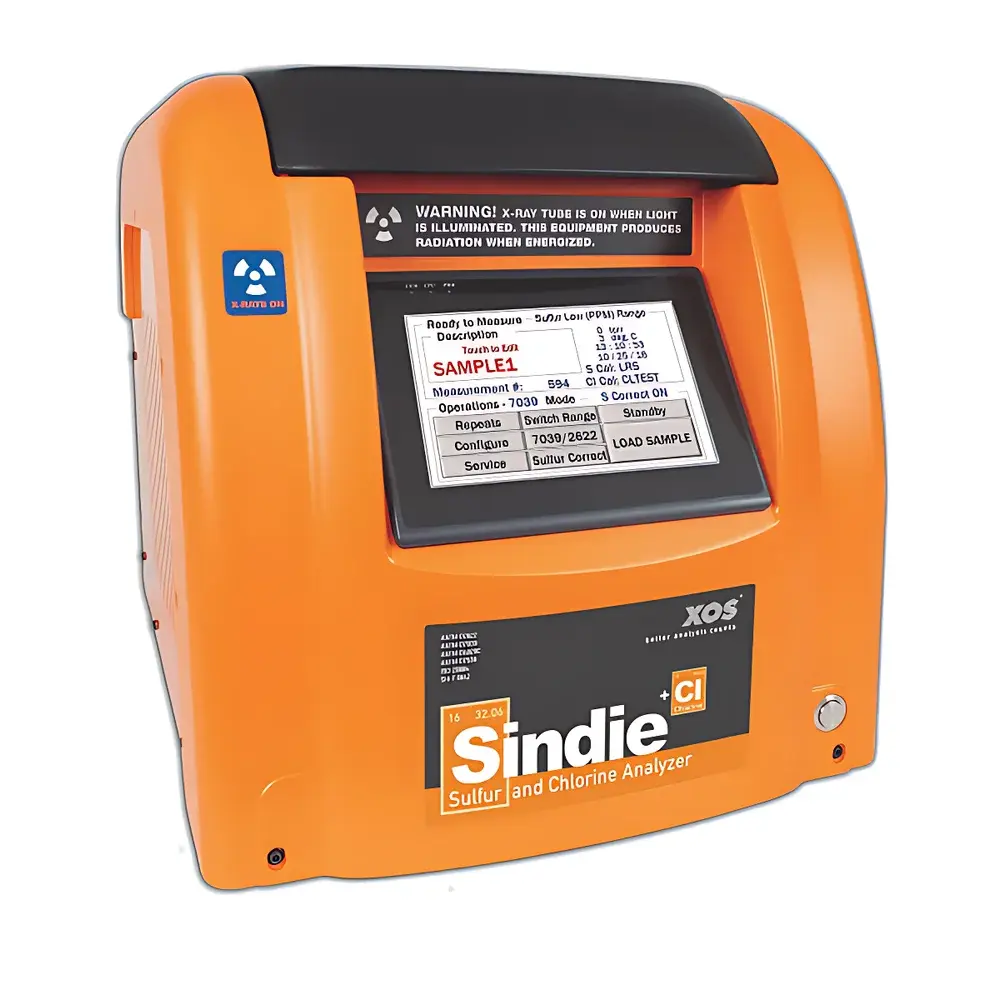
XOS Sindie +Cl Wavelength-Dispersive X-Ray Fluorescence Analyzer for Simultaneous Sulfur and Chlorine Determination
| Brand | XOS |
|---|---|
| Model | Sindie +Cl |
| Instrument Type | Benchtop WDXRF Spectrometer |
| Excitation | Monochromatic Wavelength-Dispersive XRF (MWDXRF) |
| X-ray Tube Power | 75 W |
| Elements Analyzed | Sulfur (S), Chlorine (Cl) |
| LOD | 0.4 ppm (S), 0.3 ppm (Cl) |
| Quantification Range | 0.4 ppm – 5 wt% (S), 0.3 ppm – 3000 ppm (Cl) |
| Sample Volume | ≤10 mL |
| Sample Membrane | Mylar film |
| Measurement Time | 30–900 s (user-configurable) |
| Detector Configuration | Dual independent solid-state detectors |
| Compliance | ASTM D7039-15, ASTM D2622, ASTM D7536-16, ASTM D4929-19, ISO 20884:2019, NB/SH/T 0842-2017, SH/T 0977-2019, GB 11140-2008 |
Overview
The XOS Sindie +Cl is a benchtop monochromatic wavelength-dispersive X-ray fluorescence (MWDXRF) spectrometer engineered for the simultaneous, non-destructive quantification of sulfur (S) and chlorine (Cl) in liquid hydrocarbon fuels and related petroleum products. Unlike energy-dispersive (EDXRF) or combustion-based techniques, MWDXRF employs a highly collimated, monochromatic primary beam—generated via crystal diffraction—to selectively excite target elements while minimizing spectral background and matrix interference. This physical principle delivers exceptional signal-to-noise ratios, enabling sub-part-per-trillion-level detection sensitivity and high reproducibility across diverse fuel matrices. The instrument operates without combustion, carrier gases, high-temperature ovens, or chemical reagents, making it intrinsically safe, environmentally compliant, and operationally robust for routine QC/QA environments in refineries, third-party testing laboratories, and regulatory compliance facilities.
Key Features
- Dual-channel MWDXRF architecture with two independently optimized solid-state detectors—one dedicated to sulfur Kα line (2.308 keV) and one to chlorine Kα line (2.622 keV)—ensuring concurrent, interference-free measurement without sequential scanning.
- Ultra-low background design achieved through monochromatic excitation, eliminating Bremsstrahlung continuum and reducing scatter-induced noise; contributes directly to the stated LODs of 0.4 ppm for S and 0.3 ppm for Cl.
- No sample digestion, oxidation, or derivatization required: liquids are sealed under inert Mylar film (≥3.5 µm thickness) and analyzed as-received, preserving sample integrity and eliminating consumables such as oxygen, argon, or catalysts.
- Fixed-optics optical path with zero moving parts in the analyzer head—no goniometer, no rotating crystals, no motorized filters—resulting in long-term mechanical stability and minimal preventive maintenance intervals.
- Benchtop footprint (W × D × H ≈ 45 × 50 × 35 cm) compatible with standard laboratory workbenches; powered solely by 100–240 V AC, 50/60 Hz; no external cooling water or compressed air required.
- User-configurable analysis time (30–900 s per measurement) enables optimization between throughput and precision—ideal for both rapid screening (<60 s) and high-accuracy certification-grade reporting (≥300 s).
Sample Compatibility & Compliance
The Sindie +Cl is validated for direct analysis of low-viscosity liquid hydrocarbons including gasoline, diesel, jet fuel (Jet A/A-1), kerosene, naphtha, biodiesel (B100), biodiesel blends (B5–B20), ethanol-gasoline blends (E10, E15), crude oil, vacuum gas oil, and lubricant base stocks. It accommodates samples with varying volatility, aromaticity, and heteroatom content without dilution or pre-treatment. All method performance claims—including precision (RSD 0.9999 over full dynamic range)—are traceable to NIST-traceable CRM oils and verified per ASTM D7039-15 and ISO 20884:2019 protocols. The system supports GLP-compliant audit trails, user access control, electronic signatures, and 21 CFR Part 11–ready data archiving when integrated with XOS’s optional LIMS-ready software suite.
Software & Data Management
Instrument control, calibration management, and report generation are handled via XOS’s proprietary SpectraSuite™ software, a Windows-based application compliant with IEC 62443-3-3 industrial cybersecurity standards. The interface supports up to 20 independent calibration curves—each configurable with polynomial or linear regression, internal standard correction, and matrix-matched CRM validation points. All raw spectra, peak deconvolution parameters, and measurement metadata (operator ID, timestamp, environmental temperature/humidity logs) are stored in encrypted SQLite databases with immutable audit logs. Export formats include CSV, PDF, XML (ASTM E1382-compliant), and direct OPC UA connectivity for integration into enterprise MES or LIMS platforms.
Applications
The Sindie +Cl serves as a primary or confirmatory method for sulfur and chlorine monitoring across the petroleum value chain: feedstock qualification (e.g., crude assay), process stream control (hydrotreater inlet/outlet), finished product release (ULSD, Euro 5/6, Tier 3 gasoline), and regulatory enforcement (EPA 40 CFR Part 1090, China VI, EN 590). Its ability to quantify Cl in aromatic solvents and naphthas addresses critical corrosion risk assessment—particularly for organic chloride species that evade GC-based methods due to thermal lability. In R&D settings, it supports catalyst poisoning studies, additive interaction analysis, and biofuel compatibility testing where elemental co-quantification reduces analytical cycle time by >60% versus sequential EDXRF or combustion IC.
FAQ
Does the Sindie +Cl require daily recalibration?
No. Due to its fixed-monochromator optics and drift-compensated detector electronics, recalibration is typically required only after major maintenance, relocation, or quarterly verification using certified reference materials per ASTM D7039 Annex A3.
Can it analyze viscous or waxy samples like heavy fuel oil or bitumen?
Not directly. The instrument is designed for low-to-medium viscosity liquids (≤50 cSt at 40 °C). High-viscosity samples must be diluted with xylene or toluene to ensure uniform film formation and avoid membrane sagging; validation per ASTM D7536 Annex B is recommended.
Is spectral interference between sulfur and chlorine lines possible?
No. The monochromatic excitation isolates each element’s characteristic Kα emission, and the dual-detector geometry ensures physically separated detection pathways—eliminating peak overlap even at extreme Cl:S concentration ratios (>1000:1).
What sample containment options are available beyond Mylar film?
Standard configuration uses 4-mil (100 µm) Mylar; optional 6-mil (150 µm) films are available for higher-volatility samples. Quartz cuvettes are not supported—only sealed, flat-film geometries maintain optical alignment and vacuum integrity.
How is data integrity ensured during multi-shift operations?
SpectraSuite™ enforces role-based permissions, session locking, electronic signature capture for result approval, and tamper-evident database logging—all aligned with FDA 21 CFR Part 11 Subpart B requirements for closed systems.
Related Products






