
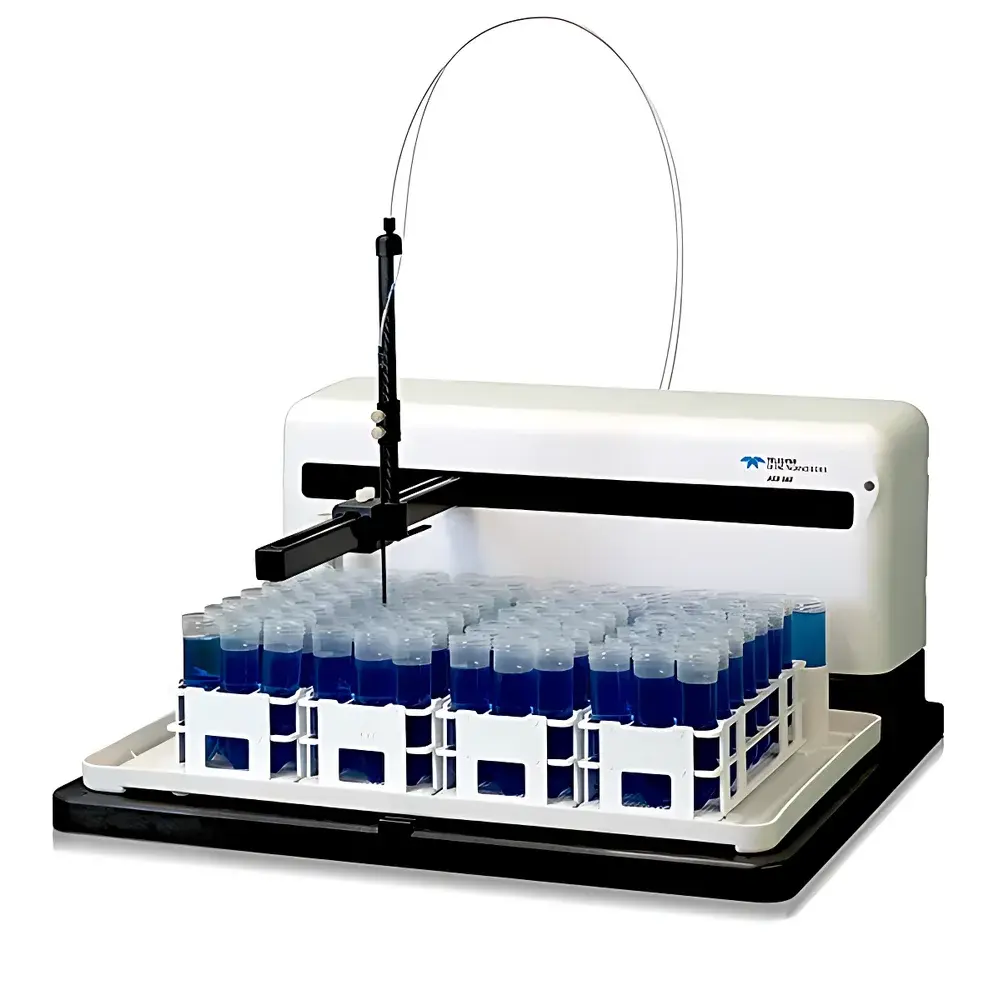
CETAC ASX-560 Automated Sample Introduction System
| Brand | CETAC |
|---|---|
| Origin | Imported |
| Manufacturer Type | Authorized Distributor |
| Model | ASX-560 |
| Pricing | Available Upon Request |
Overview
The CETAC ASX-560 Automated Sample Introduction System is a high-precision, modular autosampler engineered for seamless integration with a broad spectrum of elemental analysis platforms—including graphite furnace atomic absorption spectrometry (GFAAS), inductively coupled plasma optical emission spectrometry (ICP-OES), and inductively coupled plasma mass spectrometry (ICP-MS). Designed using proven fluidic architecture and precision motion control principles, the ASX-560 operates on a syringe-pump-driven aspiration and dispensing mechanism, ensuring volumetric accuracy and minimal carryover across diverse matrix types. Its core function is to replace manual sample handling in routine, high-throughput laboratory environments—enabling unattended operation for extended periods while maintaining trace-level reproducibility required for regulatory-compliant analyses.
Key Features
- Modular rack configuration supporting 1–4 independently configurable sample trays, accommodating up to 360 positions using standardized vial formats (e.g., 12 × 75 mm, 16 × 100 mm, 18 × 150 mm, 20 × 150 mm, and 25 × 150 mm)
- Z-axis compliant drive system that decouples vertical motion from mechanical shock, protecting delicate sampling probes during insertion into narrow-necked or pressurized vessels
- Dual-channel rinse station with programmable flow rates (0.1–80 mL/min) and customizable rinse sequence logic to minimize cross-contamination between samples
- Programmable aspiration/dispense volume control with sub-microliter resolution, compatible with both low-volume microsampling and macro-volume dilution workflows
- Integrated communication interface utilizing CETAC’s proprietary serial protocol (RS-232/RS-485), enabling bidirectional handshake with host instrument software for synchronized method execution and status reporting
- Expandable I/O architecture allowing coordinated operation with auxiliary modules such as CETAC’s AutoDilute™ dilution system, FastFlow™ rapid introduction kit, or external peristaltic pumps for online preconcentration
Sample Compatibility & Compliance
The ASX-560 accommodates aqueous, acidic (up to 6 M HNO₃ or 2 M HCl), organic (e.g., methanol, acetonitrile), and mixed-phase solutions without degradation of fluoropolymer wetted components (e.g., PTFE, FEP, and ETFE tubing and seals). All fluid path materials comply with USP Class VI biocompatibility standards and are resistant to leaching under prolonged exposure. The system supports GLP- and GMP-aligned workflows through audit-trail-capable method logging (when operated via compatible host software), and its operational parameters align with key ASTM standards including ASTM D1976 (ICP analysis of water), ASTM E1447 (ICP-MS multi-element determination), and ISO 17294-2 (water quality – ICP-MS methods).
Software & Data Management
Control is executed via host instrument software (e.g., Thermo Fisher iCAP Series, Agilent ICP-MS MassHunter, PerkinElmer Syngistix), eliminating the need for standalone operator interfaces. Method files define not only sequence order (sequential or random-access sampling) but also per-sample rinse duration, aspiration speed, wash cycles, and conditional branching logic (e.g., “if signal intensity exceeds threshold, trigger dilution”). Raw event logs—including timestamped actuator commands, sensor feedback, and error codes—are embedded within instrument data files, facilitating full traceability during FDA 21 CFR Part 11–compliant audits when paired with validated electronic signature workflows.
Applications
- Routine environmental monitoring: automated batch analysis of soil digests, wastewater effluents, and drinking water per EPA Methods 200.8 and 6020B
- Clinical and biological matrices: high-throughput quantification of essential/toxic elements (e.g., Pb, Cd, As, Se) in serum, urine, and tissue homogenates
- Geochemical and metallurgical QA/QC: repetitive analysis of ore leachates and alloy dissolution samples under ISO/IEC 17025-accredited conditions
- Pharmaceutical raw material testing: compliance-driven screening of catalyst residues (e.g., Pd, Pt, Rh) in active pharmaceutical ingredients (APIs) per ICH Q2(R2) guidelines
- Research laboratories requiring method flexibility: support for non-standard protocols including internal standard spiking mid-sequence, dynamic dilution series, and multi-point calibration bracketing
FAQ
Is the ASX-560 compatible with my existing ICP-MS system?
Yes—the ASX-560 has been validated for direct integration with major vendor platforms including Thermo Fisher Scientific, Agilent Technologies, PerkinElmer, and Shimadzu via native driver support or OEM-licensed communication libraries.
Can it handle viscous or particulate-laden samples?
It supports samples with viscosities up to 10 cP and suspended solids <5 µm; for higher particulate loads, optional inline filtration (0.45 µm PTFE) and ultrasonic probe-assisted homogenization modules are available.
Does it meet regulatory requirements for data integrity?
When operated within a validated software environment (e.g., MassHunter or Syngistix with audit trail enabled), the ASX-560 contributes to ALCOA+ data governance frameworks by preserving immutable acquisition metadata, user action logs, and system state snapshots.
What maintenance intervals are recommended?
Syringe pump calibration and fluid path inspection are recommended every 6 months or after 5,000 sample injections; consumables (e.g., syringe barrels, septa, tubing) are field-replaceable with documented SOPs provided in the technical manual.
Related Products



