
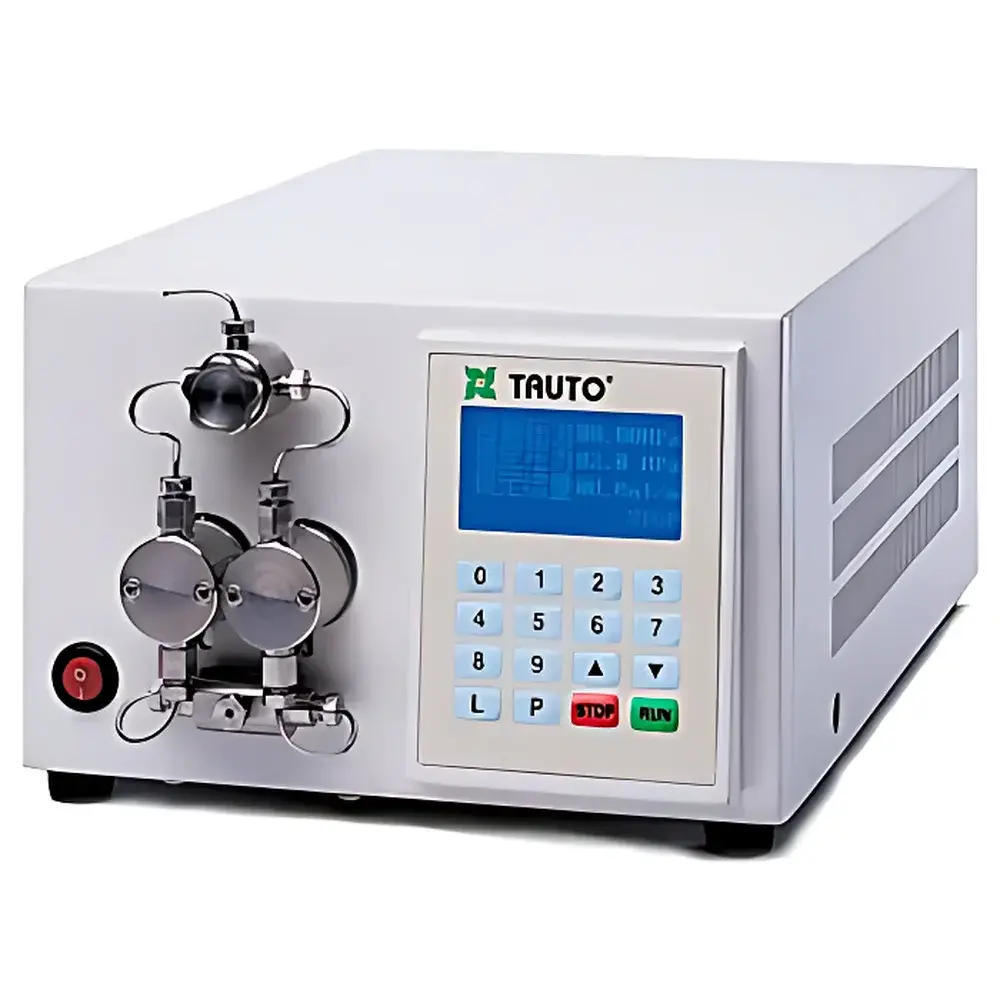
Tongtian Flash 300 Dual-Piston Medium-Pressure Constant Flow Pump
| Brand | Tongtian |
|---|---|
| Model | Flash 300 |
| Origin | Shanghai, China |
| Construction | Dual-piston positive displacement |
| Flow Range | 0.1–300.0 mL/min |
| Pressure Range | 0–2.0 MPa |
| Pressure Pulsation | ≤ 0.08 MPa |
| Flow Accuracy | ≤ ±1% |
| Flow Precision (RSD) | ≤ 1% |
| Pressure Accuracy | ≤ ±0.05 MPa |
| Wetted Materials | Sapphire, 316L stainless steel, zirconia ceramic |
| Communication Interface | RS232 |
| Power Supply | 220 V ±10%, 50/60 Hz |
| Power Consumption | 75 W |
| Dimensions | 360 × 255 × 160 mm |
| Weight | 12 kg |
Overview
The Tongtian Flash 300 is a dual-piston, medium-pressure constant flow pump engineered for high-reliability liquid delivery in preparative and analytical chromatographic applications—particularly flash chromatography, process-scale purification, and method development workflows. It operates on the principle of positive displacement via synchronized dual reciprocating pistons, which significantly suppresses pressure pulsation while maintaining linear flow response across its full operational range (0.1–300.0 mL/min at up to 2.0 MPa). Unlike single-piston designs, the dual-piston architecture ensures continuous fluid displacement with overlapping stroke cycles, yielding stable hydraulic output and minimizing flow interruption during directional reversal. The pump’s wetted path is constructed from chemically inert, high-hardness materials—including sapphire check valves, 316L stainless steel manifolds, and zirconia ceramic piston seals—conferring exceptional resistance to organic solvents, strong acids, and alkaline media commonly used in reversed-phase, normal-phase, and ion-exchange chromatography. Its mechanical design complies with ISO 8573-1 for compressed air purity (where applicable in pneumatic auxiliary systems) and adheres to IEC 61000-6-2/6-4 electromagnetic compatibility standards.
Key Features
- Dual-piston architecture with phase-shifted actuation to reduce pressure pulsation to ≤ 0.08 MPa (peak-to-peak), ensuring baseline stability in UV detection and reproducible fraction collection.
- Chemically resistant fluid path: sapphire ball-and-seat check valves, 316L stainless steel pump heads and tubing, and zirconia ceramic piston seals—validated for compatibility with acetonitrile, methanol, THF, DCM, chloroform, concentrated HCl (up to 6 M), and NaOH (up to 2 M).
- Integrated overpressure protection circuitry with automatic shutdown at user-defined thresholds (adjustable from 0.5–2.0 MPa), safeguarding columns and downstream detectors.
- Real-time digital monitoring via backlit LCD interface: simultaneous display of setpoint and actual pressure (MPa), setpoint and actual flow rate (mL/min), elapsed runtime, and system status flags.
- RS232 serial interface compliant with EIA/TIA-232-F specifications, enabling bidirectional communication with host PCs or PLCs for remote parameter setting, data logging, and synchronization with fraction collectors or UV monitors.
- Onboard timer function supporting programmable start/stop sequences (up to 99 h 59 min), ideal for unattended overnight purification runs.
- Manual and automated priming modes with integrated bubble purge valve—designed to evacuate entrained gas from solvent lines prior to column equilibration, preventing void formation and flow instability.
Sample Compatibility & Compliance
The Flash 300 is suitable for continuous delivery of low- to medium-viscosity liquids (≤ 20 cP) across diverse sample matrices, including crude natural product extracts, synthetic reaction mixtures, protein-containing buffers (pH 3–11), and aqueous-organic gradients. Its material construction meets USP Class VI biocompatibility requirements for sapphire and zirconia components, and 316L stainless steel conforms to ASTM A276/A479 specifications. The pump supports GLP/GMP-aligned operation through optional audit-trail-enabled software (via RS232), allowing timestamped recording of all parameter changes, error events, and operational logs—fully traceable for FDA 21 CFR Part 11 compliance when deployed with validated electronic signature modules. It is routinely employed in laboratories accredited to ISO/IEC 17025 for method validation and QC release testing in pharmaceutical and agrochemical manufacturing.
Software & Data Management
While the Flash 300 operates autonomously via front-panel controls, its RS232 port enables integration into custom LabVIEW, Python (pySerial), or MATLAB environments for script-driven method execution. A Windows-based configuration utility (supplied on USB drive) permits saving/restoring up to 10 user-defined pump profiles—including flow/pressure setpoints, ramp rates, hold times, and safety limits—with checksum-verified integrity. All real-time pressure and flow data can be streamed at 10 Hz resolution for post-run analysis in CSV format. The system does not require proprietary drivers; standard Windows COM port enumeration suffices. For industrial automation, optional Modbus RTU firmware (custom order) allows seamless integration with Siemens S7, Allen-Bradley ControlLogix, or Mitsubishi Q-series PLCs.
Applications
- Flash chromatography purification of organic intermediates, APIs, and natural products (e.g., isolation of flavonoids, alkaloids, or terpenoids at 10–100 mg scale).
- Method scouting and gradient optimization in preparative HPLC, where precise flow control directly impacts resolution and loading capacity.
- Continuous solvent delivery in membrane filtration systems and electrochemical flow cells requiring pulse-free laminar flow.
- Calibration of flow meters and pressure transducers in metrology labs, leveraging its certified flow accuracy (≤ ±1%) and repeatability (RSD ≤ 1%).
- Mobile phase delivery in field-deployable GC-MS or LC-MS systems where robustness against vibration and solvent polarity shifts is critical.
FAQ
What is the maximum solvent compatibility temperature for the Flash 300?
The pump is rated for continuous operation at ambient temperatures between 5 °C and 40 °C. Solvent inlet temperature must remain below 40 °C to prevent thermal degradation of sapphire seals and zirconia components.
Can the Flash 300 be used with viscous solvents like DMSO or glycerol/water mixtures?
It is optimized for solvents with viscosity ≤ 20 cP at operating temperature. For DMSO (1.98 cP at 25 °C) or ≤ 20% glycerol/water (< 3 cP), performance remains within specification. Above 20 cP, flow accuracy degrades due to increased volumetric slip across piston seals.
Is the RS232 interface optically isolated?
Yes—the interface incorporates galvanic isolation rated to 1500 VRMS, protecting connected PCs from ground-loop interference in electrically noisy lab environments.
Does the pump support gradient programming natively?
No. Gradient formation requires external mixing (e.g., two Flash 300 units in parallel with synchronized RS232 control or integration with a dedicated gradient mixer). The Grad series is recommended for native binary gradient capability.
How often should the sapphire check valves be inspected or replaced?
Under typical use with filtered, particle-free solvents, sapphire valves exhibit service life exceeding 10,000 hours. Visual inspection every 6 months is advised; replacement is required only if flow deviation exceeds ±2% after calibration or if audible clicking increases markedly during operation.



