
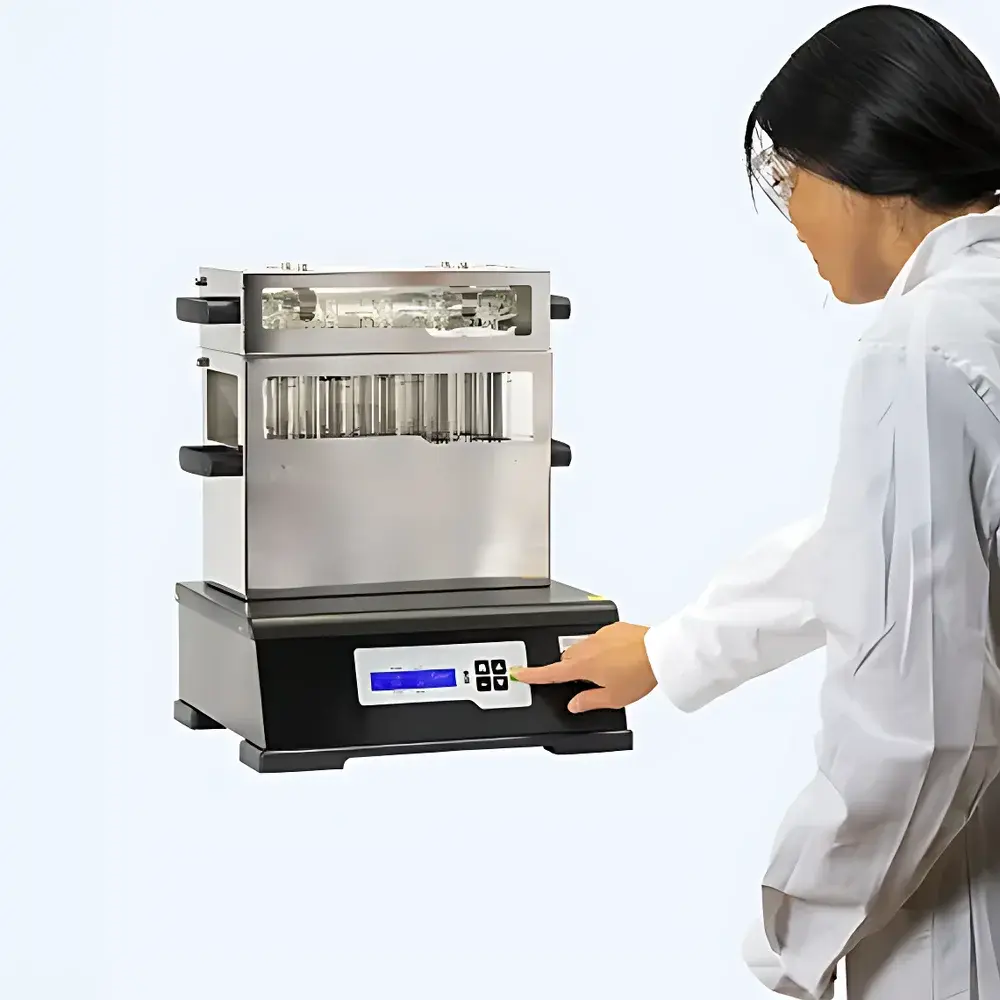
OPSIS DI-210 10-Position Electric Digestion Block for Kjeldahl Sample Preparation
| Brand | OPSS/OPSIS |
|---|---|
| Origin | Sweden |
| Manufacturer Status | Authorized Distributor |
| Origin Category | Imported |
| Model | DI-210 |
| Instrument Type | Electric Heating Digestion System |
| Automation Level | Semi-Automatic |
| Digestion Positions | 10 |
| Max Heating Temperature | 450 °C |
| Temperature Control Accuracy | ±0.5 °C |
| Heating Principle | Resistive Electric Heating |
| Reagent Channels | 10 |
| Sample Capacity | Up to 15 mL liquid or 5 g solid per tube |
| Programmable Step Duration | 0–999 min per stage |
| Continuous Operation | 24 h |
| Interface | RS232 and USB |
| Display | LCD with real-time temperature & timer |
| Safety Features | Over-Temperature Protection with Audible Alarm |
| Cooling Mode | Auto-cooling post-digestion |
| Temperature Sensor | Self-Calibrating Electronic Sensor |
| Language Options | Multi-Language UI (English, German, French, Spanish, Chinese) |
| Upgradeability | Hardware and firmware upgradable |
Overview
The OPSS DI-210 is a precision-engineered 10-position electric digestion block designed specifically for Kjeldahl sample preparation in compliance with ISO 5983, AOAC 984.13, and ASTM D5142 standards. It operates on resistive electric heating principles to deliver uniform thermal energy across all digestion tubes, enabling complete mineralization of organic matrices—such as cereals, feedstuffs, dairy products, environmental sediments, and chemical intermediates—under controlled sulfuric acid reflux conditions. Unlike open-flame or oil-bath systems, the DI-210 eliminates combustion hazards and thermal gradient inconsistencies. Its microprocessor-controlled architecture ensures reproducible digestion kinetics, critical for downstream nitrogen quantification via steam distillation. The system supports both classical Kjeldahl nitrogen (total N, protein-N) and non-Kjeldahl applications including volatile basic nitrogen (VBN), total sulfite, formaldehyde, ethanol, volatile acidity, ammonia, nitrate/nitrite, cyanide, phenol, and urea—making it a foundational unit in food safety, agricultural QA/QC, environmental monitoring, and pharmaceutical raw material testing laboratories.
Key Features
- 10 independent digestion positions with individual thermal isolation to prevent cross-contamination and ensure inter-sample reproducibility
- Precise temperature control (±0.5 °C) up to 450 °C, validated by self-calibrating platinum RTD sensors with no manual calibration required
- Multi-stage programmable ramping: users define up to 5 temperature/time segments per run to suppress foam formation and avoid violent boiling or wall splashing
- Dedicated reagent channel per position (10 channels total), enabling parallel addition of catalysts (e.g., CuSO₄/K₂SO₄) or oxidizing agents (e.g., H₂O₂)
- Integrated over-temperature cut-off with audible alarm and automatic power disengagement to protect samples and operator safety
- Full-separation architecture: electrical control circuitry is physically isolated from the heating zone to minimize electromagnetic interference and extend service life
- LCD interface displaying real-time temperature, elapsed time, remaining time, and active program ID; supports English, German, French, Spanish, and Chinese
- RS232 and USB ports for direct connection to LIMS, lab PCs, or thermal printers—enabling traceable data export and remote monitoring
- Compatible with standard 16 mm and 20 mm diameter Kjeldahl digestion tubes (e.g., borosilicate glass, quartz); optional fume hood adapter kit available for acid gas capture
Sample Compatibility & Compliance
The DI-210 accommodates heterogeneous sample types—including viscous liquids (milk, juice), particulate solids (grains, soil), and semi-solids (sludge, compost)—within its 5 g solid / 15 mL liquid per tube capacity. Digestion protocols are fully compliant with GLP and GMP documentation requirements: all user inputs (temperature setpoints, dwell times, sample IDs) are logged internally with timestamps. Optional software integration supports 21 CFR Part 11-compliant electronic signatures and audit trails when paired with certified laboratory informatics platforms. Exhaust gases (SO₂, NOₓ, NH₃) can be directed through an external alkaline scrubber (e.g., NaOH trap) via the integrated fume port, meeting OSHA PEL and EU Directive 2004/108/EC emission guidelines.
Software & Data Management
While the DI-210 operates autonomously via front-panel programming, its RS232/USB interface enables bidirectional communication with third-party software such as OPSS LabControl Suite or generic SCADA-compatible tools. Users may download complete run logs—including start/end timestamps, actual vs. setpoint temperature profiles, and error codes—for inclusion in analytical reports. Firmware updates are delivered via USB stick and verified using SHA-256 checksums to ensure integrity. All configuration changes are stored in non-volatile memory and persist after power cycling. No proprietary drivers are required: USB CDC class support ensures plug-and-play compatibility with Windows, macOS, and Linux hosts.
Applications
- Food & Feed: Protein determination in flour, soybean meal, pet food, and infant formula per AOAC Official Methods 981.10 and 992.15
- Environmental: Total Kjeldahl nitrogen (TKN) analysis in wastewater, sludge, and sediment per EPA Method 351.2 and ISO 11905-1
- Pharmaceutical: Nitrogen content verification in excipients and APIs under ICH Q5C stability protocols
- Chemical Industry: Sulfur and halogen recovery assessment in organic synthesis residues
- Research Labs: Method development for novel digestion matrices requiring precise thermal ramping and extended hold times
FAQ
What sample tube sizes are compatible with the DI-210?
Standard 16 mm and 20 mm outer-diameter Kjeldahl digestion tubes made of borosilicate glass or quartz are supported. Tube height must not exceed 300 mm.
Can the DI-210 be integrated into an automated Kjeldahl workflow with a distillation unit?
Yes—its digital interface allows synchronization with OPSS DK-210 or third-party distillers via TTL-level trigger signals or time-based sequencing.
Is validation documentation (IQ/OQ/PQ) available?
Factory-issued IQ/OQ protocols are provided upon request; PQ templates aligned with ISO/IEC 17025 are included in the user manual.
Does the system require annual recalibration?
No—the embedded temperature sensor performs automatic electronic self-calibration at power-on; periodic verification against a NIST-traceable reference thermometer is recommended annually.
What maintenance is required for long-term reliability?
Routine cleaning of the heating block surface and ventilation grilles every 200 runs; no lubrication or consumable parts are required in the heating module.



