
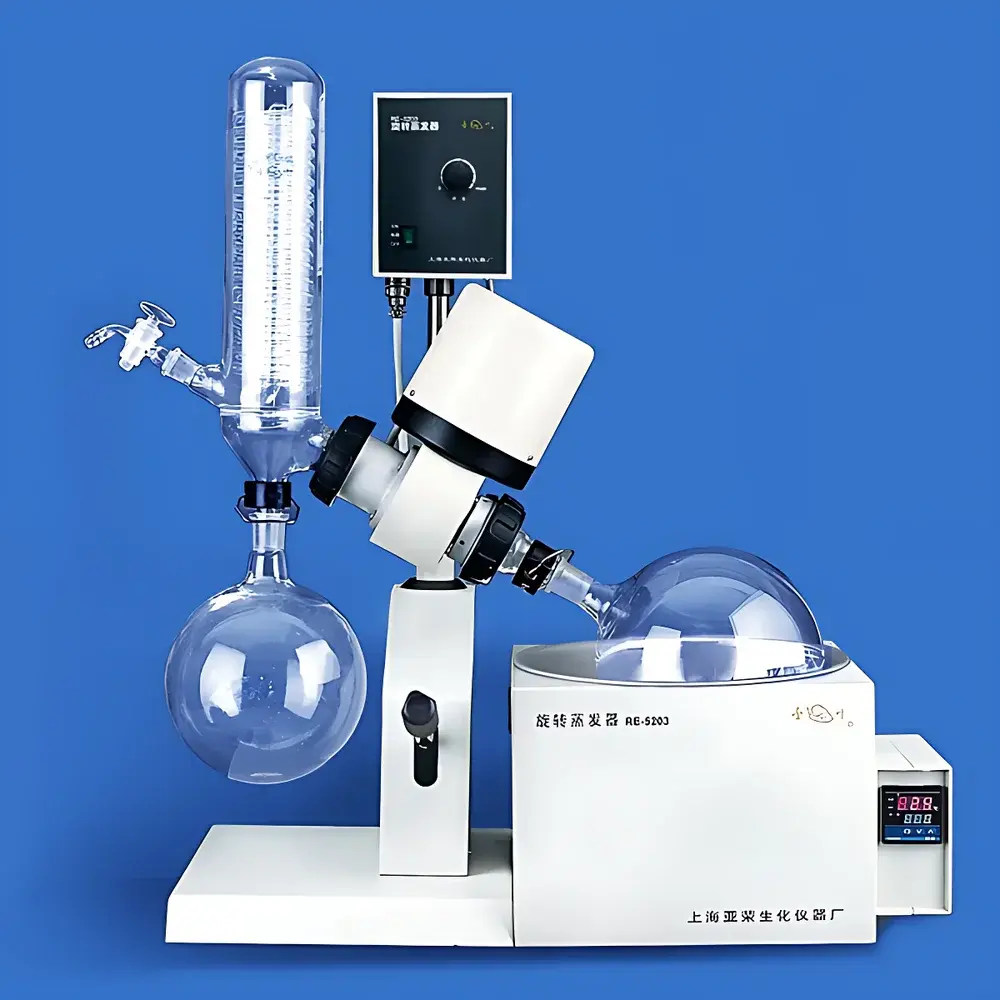
Jinye RE-5203 Rotary Evaporator
| Brand | Jinye |
|---|---|
| Origin | Shanghai, China |
| Manufacturer Type | Direct Manufacturer |
| Origin Category | Domestic (China) |
| Model | RE-5203 |
| Capacity | 3 L |
| Rotational Speed | Electronically Controlled, 0–120 rpm with Digital Controller |
| Temperature Control Range | Digital Display, Automatic Control from Ambient to 99 °C |
| Temperature Accuracy | ±1 °C |
| Condenser Cooling Surface Area | 0.15 m² |
Overview
The Jinye RE-5203 Rotary Evaporator is an engineered solution for efficient solvent removal, concentration, and purification under reduced pressure in research laboratories and pilot-scale production environments. Based on the principle of vacuum-assisted rotary distillation—where sample rotation increases surface area while controlled heating and condensation facilitate selective phase separation—the RE-5203 delivers reproducible performance for thermally sensitive compounds. Its robust glassware assembly features standardized ground-glass joints (ISO 29/32 or equivalent), ensuring leak-tight vacuum integrity and compatibility with auxiliary systems such as vacuum pumps, chiller units, and cold traps. Designed for continuous operation in academic, pharmaceutical, and fine chemical settings, the unit supports GMP-aligned workflows when integrated with documented procedures and calibration records.
Key Features
- 3-liter evaporation flask capacity—optimized for batch processing of moderate-volume samples without compromising rotational stability or film uniformity.
- Electronically regulated motor drive with digital speed control (0–120 rpm), enabling precise adjustment to match solvent volatility and viscosity profiles.
- Digital temperature controller with real-time display and automatic feedback loop, maintaining bath setpoints within ±1 °C across the full ambient-to-99 °C range.
- High-efficiency vertical condenser with 0.15 m² effective cooling surface area, facilitating rapid vapor condensation using standard circulating chillers (e.g., −10 °C to 10 °C coolant).
- All-glass main assembly constructed from borosilicate 3.3 (e.g., Pyrex®-grade), resistant to thermal shock and common organic solvents including acetone, ethanol, ethyl acetate, and dichloromethane.
- Integrated vacuum seal design with PTFE-coated stopcocks and silicone gaskets, supporting stable operation at pressures down to 10 mbar (7.5 Torr) when paired with a suitable vacuum source.
Sample Compatibility & Compliance
The RE-5203 accommodates a broad spectrum of sample matrices—including aqueous extracts, organic reaction mixtures, polymer solutions, and botanical concentrates—provided they exhibit sufficient thermal stability below 99 °C and do not react with borosilicate glass or PTFE components. While the instrument itself does not carry CE, UL, or FDA device certification, its mechanical and thermal specifications align with general laboratory safety standards (e.g., IEC 61010-1). Users performing regulated work (e.g., USP , ISO 17025, or GLP-compliant extraction protocols) are advised to implement routine verification of rotational speed accuracy (via tachometer), temperature uniformity (using calibrated probe), and vacuum integrity (leak rate testing per ASTM E493). Documentation of maintenance, calibration, and operational parameters supports audit readiness.
Software & Data Management
The RE-5203 operates as a standalone analog-digital hybrid system with no embedded firmware or network interface. All controls—including rotation speed and bath temperature—are managed via front-panel push-button interface with LED indicators. For traceable process recording, external data loggers may be connected to analog outputs (if equipped) or used with independent temperature and vacuum sensors. Laboratories requiring 21 CFR Part 11 compliance must integrate the evaporator into a validated environmental monitoring system, employing electronic lab notebooks (ELNs) or LIMS platforms to capture time-stamped operational metadata (e.g., start/stop times, setpoints, observed vacuum levels). No proprietary software is supplied; configuration remains fully manual and user-defined.
Applications
- Solvent recovery and concentration of natural product extracts in phytochemistry and nutraceutical R&D.
- Removal of low-boiling solvents (e.g., hexane, diethyl ether) following Grignard or Suzuki coupling reactions in synthetic organic chemistry labs.
- Preparative-scale dehydration of heat-labile biomolecules—including peptides and enzyme fractions—under mild vacuum and controlled thermal input.
- Crystallization initiation by gradual solvent reduction in API intermediate purification workflows.
- Standardized evaporation steps in AOAC 985.24 (fat extraction) and EPA Method 3510C (liquid-liquid extraction) sample preparation protocols.
FAQ
What vacuum level is recommended for optimal operation of the RE-5203?
A stable vacuum between 10–50 mbar is typically appropriate for most low-to-medium boiling point solvents; final selection depends on solvent vapor pressure curves and desired evaporation rate.
Can the RE-5203 be used with corrosive solvents such as concentrated HCl or HF?
No—borosilicate glass and PTFE components are incompatible with hydrofluoric acid and fuming sulfuric or nitric acids; use only with solvents listed in Corning or Schott chemical resistance charts.
Is the water bath temperature sensor calibrated at the factory?
The unit ships with factory-set calibration; however, users must perform periodic verification using a NIST-traceable thermometer immersed at the same depth as the sensor tip.
Does the RE-5203 support automated distillate collection switching?
No—fraction collection requires manual flask exchange or integration with third-party fraction collectors equipped with vacuum-compatible valves.
What is the maximum allowable load on the rotary joint?
The motor and bearing assembly is rated for continuous operation with a 3 L flask containing up to 2.5 L of liquid; overfilling may cause imbalance, vibration, or seal failure.



