
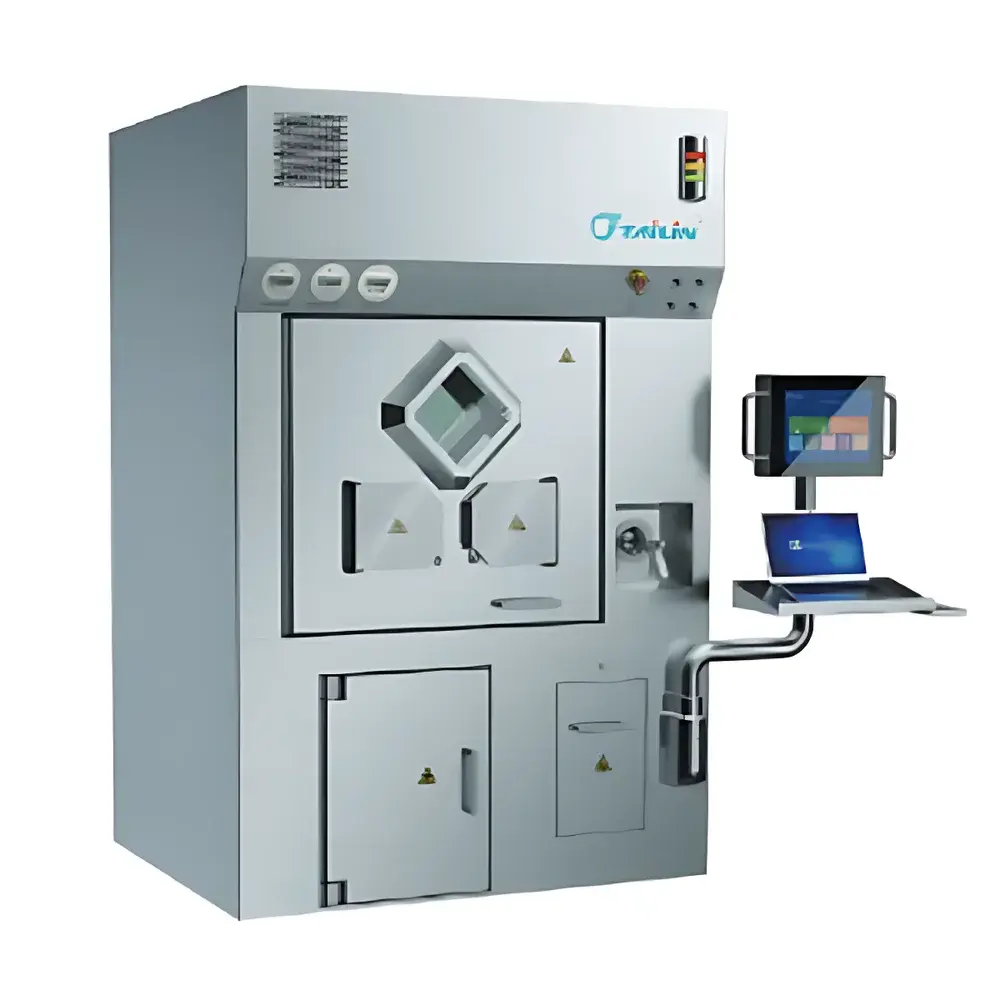
Tailin Bioengineering High-Integrity, Radiation-Shielded Hot Cell for GMP Radiopharmaceutical Manufacturing
| Brand | Tailin Biotechnology |
|---|---|
| Origin | Zhejiang, China |
| Manufacturer Type | OEM Manufacturer |
| Product Category | Domestic |
| Model | Radiopharmaceutical Production Solution |
| Pricing | Available Upon Request |
Overview
The Tailin Bioengineering High-Integrity, Radiation-Shielded Hot Cell is a purpose-engineered containment system designed specifically for the aseptic synthesis, formulation, and dispensing of radiopharmaceuticals under current Good Manufacturing Practice (cGMP) conditions. Built upon Couette-flow–compatible shielding architecture and ISO 14644-1 Class A–C cleanroom-compliant environmental control, this hot cell integrates nuclear safety engineering with sterile process isolation. It operates on the principle of negative-pressure differential containment, utilizing dual-stage HEPA filtration (inlet) and BIBO-configured HEPA plus activated carbon exhaust filtration to prevent radionuclide release. Real-time internal radiation monitoring—via embedded Geiger-Müller or scintillation detectors—enforces interlocked door access: the front shielded viewport door remains mechanically locked until ambient dose rate falls below pre-set thresholds (e.g., <0.5 µSv/h at surface), ensuring ALARA (As Low As Reasonably Achievable) compliance during operator intervention.
Key Features
- Radiation shielding configurable from 10 mm to 120 mm lead-equivalent thickness, calibrated per radionuclide emission profile (e.g., 18F, 68Ga, 99mTc, 177Lu)
- Work chamber constructed from electropolished AISI 316L stainless steel with fully radiused internal corners (R ≥ 15 mm) to eliminate shadow zones and support validated VHP (vaporized hydrogen peroxide) or autoclave-compatible sterilization cycles
- Front viewport and external cladding fabricated from AISI 304 stainless steel with Ra ≤ 0.4 µm surface finish for non-porous, low-adhesion decontamination
- Inlet air supply conditioned through H14-class HEPA filters (≥99.995% @ 0.3 µm), certified per EN 1822-1
- Exhaust train incorporating BIBO (Bag-In/Bag-Out) H14 HEPA filters plus replaceable granular activated carbon cartridges for iodine and volatile organic radionuclide adsorption
- Integrated real-time radiation dosimetry with data-logged output traceable to national standards (e.g., NIM China calibration certificates)
- Sealed fluid transfer interfaces compliant with ISO 8536-4 for sterile, leak-tight connection of syringes, vials, and tubing manifolds
Sample Compatibility & Compliance
This hot cell supports handling of both short-lived positron emitters and therapeutic beta/gamma emitters across liquid, gaseous, and solid precursor forms. Its structural integrity and material compatibility are validated for exposure to common radiolabeling reagents—including acetonitrile, dimethyl sulfoxide (DMSO), hydrochloric acid (HCl), and sodium hydroxide (NaOH) solutions—without corrosion or outgassing. Regulatory alignment includes adherence to EU Annex 1 (2022), USP , ASTM D6377-20 (for vapor pressure–based containment verification), and IAEA Safety Standards Series No. SSG-46. All critical components undergo FAT/SAT protocols per ISO 13485:2016 and meet design qualification requirements for FDA 21 CFR Part 11 electronic record integrity and audit trail generation.
Software & Data Management
The integrated control system runs on a deterministic real-time OS with redundant PLC architecture (Siemens S7-1500 series). It provides continuous logging of environmental parameters (differential pressure, temperature, humidity, airflow velocity, radiation dose rate) with timestamped, encrypted storage compliant with ALCOA+ principles. The HMI interface supports multi-level user authentication, role-based access control, and automated report generation in PDF/A-1b format—fully traceable to batch records and suitable for regulatory inspection. Audit trails are immutable, time-stamped, and include operator ID, action type, parameter value before/after change, and reason-for-change annotation fields.
Applications
- Automated radiosynthesis of 18F-FDG, 68Ga-DOTATATE, and 99mTc-MDP using modular cassette-based synthesizers
- Aseptic dispensing of unit doses into evacuated glass vials or polymer syringes under ISO 5 conditions
- Shielded transfer of radioactive intermediates between hot cells, QC labs, and PET cyclotron vaults via pass-through chambers with dual-door interlock
- On-site decay storage and solid waste conditioning using shielded, ventilated waste bins with gamma spectroscopy verification
- Process validation studies supporting regulatory submissions (e.g., EMA CHMP assessment, FDA IND/NDAs)
FAQ
What radiation shielding thickness options are available, and how are they selected?
Shielding thickness (10–120 mm Pb eq.) is determined by nuclide-specific gamma energy spectrum, maximum anticipated activity, and required dose rate reduction factor—calculated using Monte Carlo simulation (MCNPX) and verified via thermoluminescent dosimeter (TLD) mapping during commissioning.
Is the hot cell compatible with robotic integration?
Yes—standardized mounting flanges and Ethernet/IP communication ports enable seamless integration with industrial robots (e.g., Stäubli TX2-90) or master-slave manipulators (e.g., Schilling Ultra), including force feedback and collision detection protocols.
How is sterility assurance validated for the work chamber?
Sterility is confirmed via media fill studies per PDA Technical Report No. 26 and microbial challenge testing using Bacillus atrophaeus spores, with recovery rates ≥95% following VHP cycles (60% RH, 750 ppm, 90 min exposure).
Does the system support 21 CFR Part 11 compliance?
Yes—the software architecture includes electronic signatures, audit trail review tools, and data integrity safeguards aligned with FDA guidance on data reliability for regulated manufacturing environments.




