
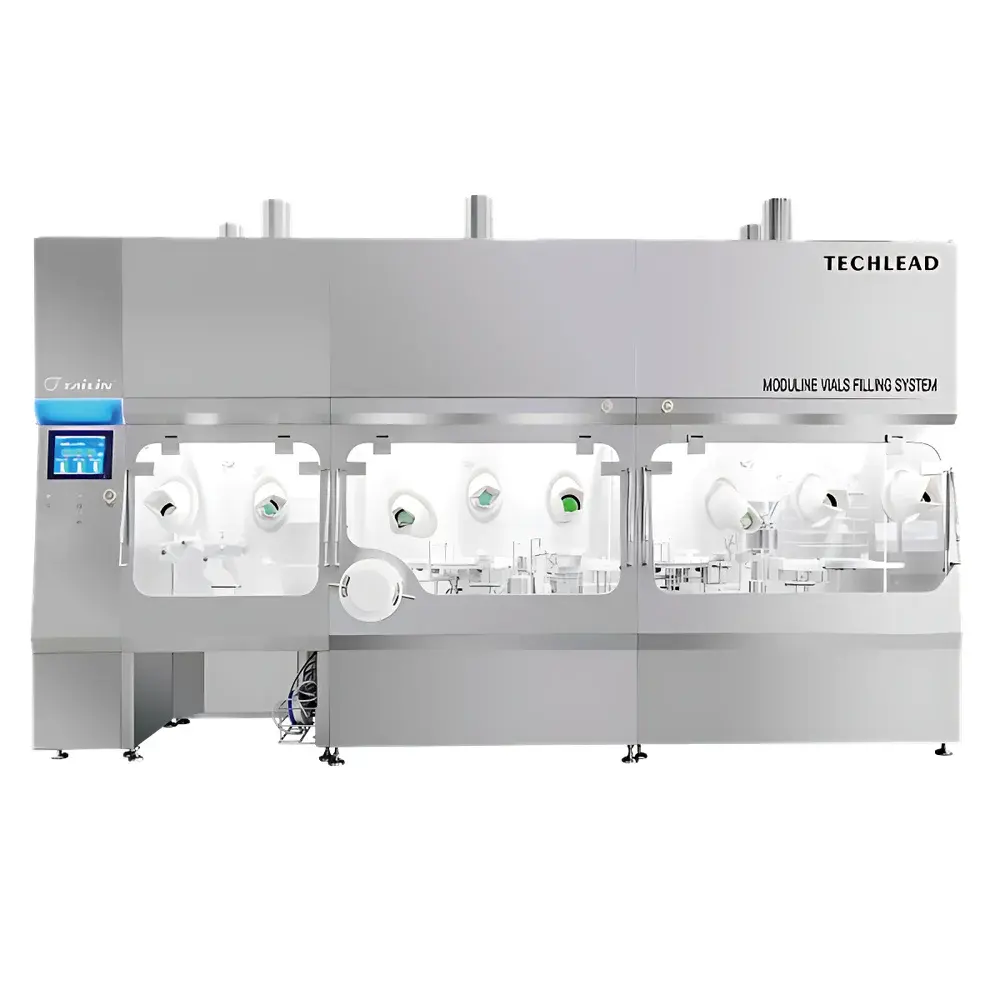
Tailin AFL Series Sterile Filling Isolator
| Brand | Tailin |
|---|---|
| Origin | Zhejiang, China |
| Manufacturer Type | Manufacturer |
| Regional Category | Domestic |
| Model | AFL |
| Pricing | Upon Request |
Overview
The Tailin AFL Series Sterile Filling Isolator is an engineered aseptic processing solution designed for high-integrity containment and sterility assurance in the manufacture of parenteral drugs, advanced therapy medicinal products (ATMPs), and other sensitive biopharmaceutical formulations. Built upon a triple-chamber architecture—comprising a pass-through chamber, filling chamber, and crimping chamber—the system implements physical barrier isolation to eliminate operator-to-product contact and mitigate microbiological contamination risks inherent in open cleanroom operations. Its core operational principle relies on dynamic air management via unidirectional laminar airflow (ULPA/HEPA-filtered), coupled with validated vaporized hydrogen peroxide (VHPS®) decontamination cycles applied either simultaneously across all chambers or independently per chamber. This dual-mode sterilization strategy ensures rapid biological indicator (BI) log6 reduction while maintaining process flexibility and minimizing downtime between batches. The isolator operates as a Class A (ISO 5) environment within a background Grade D (ISO 8) cleanroom, significantly reducing facility infrastructure requirements and lifecycle energy consumption.
Key Features
- Triple-chamber modular configuration (pass-through, filling, crimping) enabling end-to-end aseptic processing under continuous isolation.
- H14 HEPA filtration (≥99.995% @ 0.1 µm) integrated into supply and recirculation air paths, delivering ISO Class 5 air quality in all operational zones.
- Tailin-developed VHPS® generator with real-time H2O2 vapor concentration and saturation control—validated for ≤15-minute cycle times achieving ≥6-log microbial reduction per ISO 14644-3 Annex B.
- GMP-compliant inflatable silicone gaskets ensuring leak-tight physical sealing between chamber interfaces and glove ports.
- Automated integrity testing per ISO 10648-2 (pressure decay method): volumetric leakage rate <0.5% per hour at 2× test pressure.
- Glove integrity testing per ISO 14644-7 (positive-pressure decay): detection sensitivity down to 300 µm pinhole defects across all installed gloves.
- Sustainable low-pressure variable-frequency drive (VFD) ventilation system reducing average power draw by up to 40% compared to conventional isolators.
Sample Compatibility & Compliance
The AFL isolator accommodates standard pharmaceutical primary packaging formats—including glass vials (2–50 mL), syringes, and cartridges—as well as custom containers used in ATMP manufacturing. All internal surfaces are constructed from electropolished AISI 304 stainless steel (Ra ≤ 0.8 µm), compliant with ASME BPE-2022 surface finish standards. The system meets EU GMP Annex 1 (2022) requirements for isolator-based aseptic processing, including mandatory environmental monitoring (EM) integration for viable/non-viable particle counts, temperature, relative humidity, differential pressure, and air velocity. It supports full validation documentation packages aligned with ICH Q5A, Q5B, and ISO 13408-1. Optional configurations include DPTE (Double-Peak Transfer Enclosure) interfaces, bag-in/bag-out (BIBO) filter housings for hazardous agents, sterile liquid wall penetrations, and catalytic VHP decomposition units (internal and external) meeting OSHA PEL and EU Directive 2004/37/EC occupational exposure limits.
Software & Data Management
The AFL Series employs a Windows-based industrial PC control platform with embedded SCADA architecture. It provides role-based user access control (RBAC) with three-tier permission levels (Operator, Supervisor, Administrator), full electronic audit trail per FDA 21 CFR Part 11 and EU Annex 11, and digitally signed electronic records for all critical events—including sterilization cycles, environmental alarms, glove tests, and maintenance logs. Data export is supported via secure SFTP or encrypted USB; raw historical datasets are retained for ≥30 years in compressed binary format with SHA-256 checksum verification. The system supports optional integration with MES/SCADA platforms via OPC UA 1.04, enabling real-time batch status synchronization and automated deviation reporting.
Applications
- Aseptic filling of monoclonal antibodies, viral vectors, and cell therapies under GMP-compliant conditions.
- Final container closure operations (rubber stoppering, aluminum crimping) without compromising sterility assurance.
- Handling of potent compounds requiring containment (OEB 3–5) when configured with BIBO filters and negative-pressure gloveboxes.
- Process development and clinical-scale manufacturing where regulatory traceability and reproducibility are mandated.
- Stability testing sample preparation in controlled environments with minimized human intervention.
FAQ
What validation support is provided with the AFL isolator?
Tailin supplies IQ/OQ protocols compliant with ASTM E2500-13 and ISPE Baseline Guide Vol. 5, along with completed reports, risk assessments (FMEA), and BI challenge data for VHPS® cycles.
Can the AFL system be integrated into existing cleanroom HVAC infrastructure?
Yes—the isolator operates with independent air handling and requires only standard utility connections (compressed air, electrical, drain); it does not rely on room-level HVAC for air supply or exhaust.
Is remote diagnostics and firmware updates supported?
All AFL units include TLS 1.2-secured remote access capability via authenticated VPN or zero-trust network architecture, enabling Tier-2 technical support and over-the-air software patches without on-site visits.
What glove materials are compatible with the integrated GIT system?
The automatic glove tester supports standard nitrile, butyl, and chloroprene gloves rated for VHPS® exposure per ISO 14644-7 Annex C; compatibility testing reports are available upon request.
How is residual H2O2 monitored post-decontamination?
Integrated electrochemical sensors provide real-time ppm-level measurement inside each chamber, with automatic cycle termination if residual concentration exceeds 1 ppm—verified by independent第三方 HPLC analysis per USP .




