
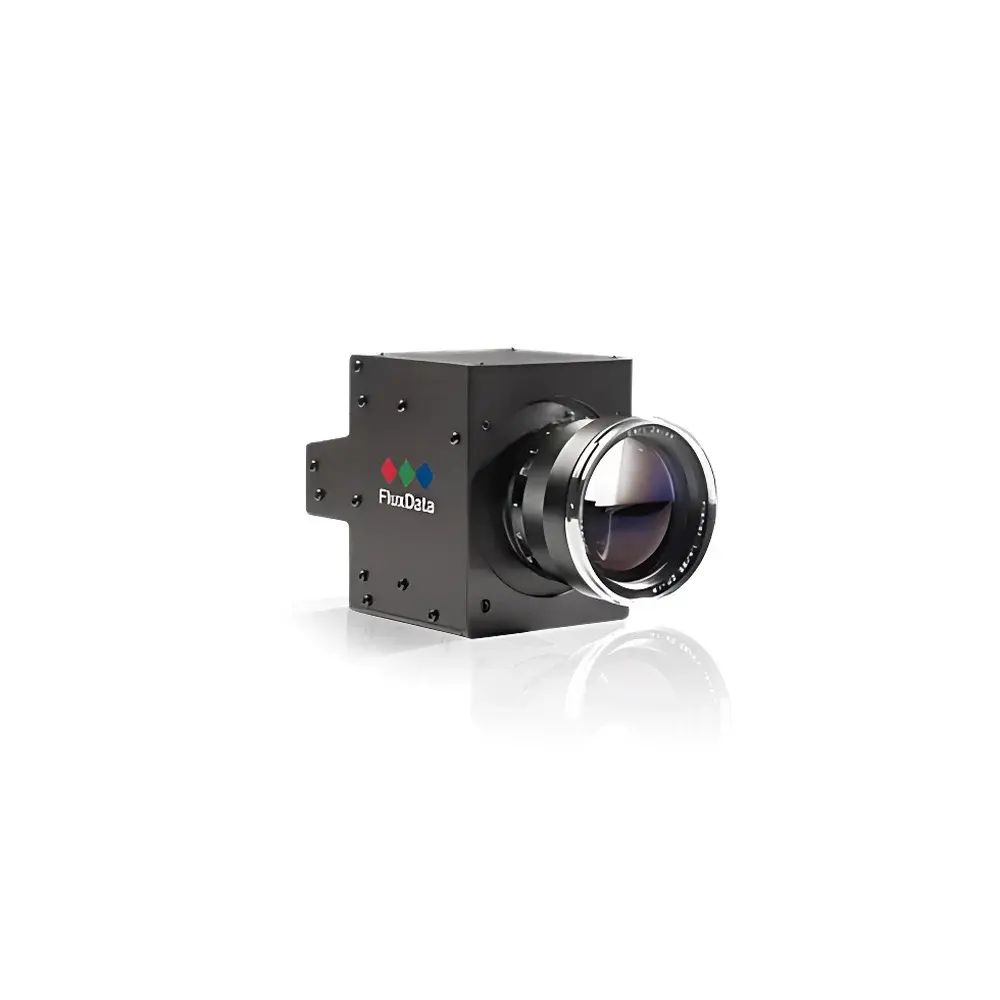
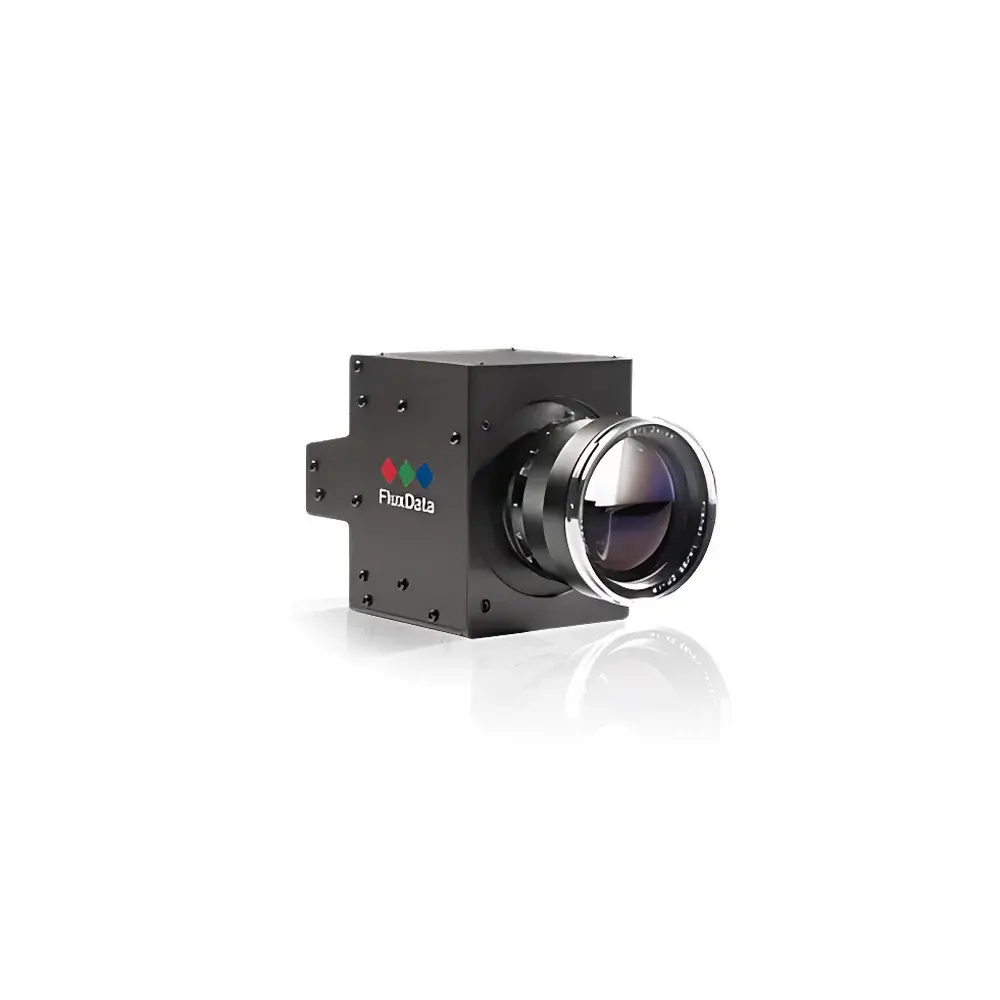
Ocean Optics FD-1665 Multispectral Imaging System
| Brand | Ocean Optics |
|---|---|
| Origin | USA |
| Manufacturer Type | Original Equipment Manufacturer (OEM) |
| Import Status | Imported |
| Model | FD-1665 |
| Effective Pixels | 1628 × 1236 |
| Pixel Size | 4.4 µm (standard CCD) |
| Spectral Range | 400–1100 nm |
| Frame Rate | up to 71 fps |
| Bit Depth | 12-bit ADC |
| Interface | Triple Gigabit Ethernet (CAT 5e/6) |
| Lens Mount | Nikon F-mount |
| Operating Temperature | 0–40 °C |
| Power Consumption | 10 W |
| Sensor Configuration | Trichroic beam-splitting architecture with three parallel CCD planes |
| Output Formats | Y8, Y16, RGB, YUV411/422/444, raw 8-/16-bit Bayer |
| Shutter Modes | Auto, manual, one-shot programmable |
| GPIO | 12-pin Hirose connector |
Overview
The Ocean Optics FD-1665 Multispectral Imaging System is a precision-engineered, tri-sensor imaging platform designed for high-fidelity spectral data acquisition across the visible and near-infrared (VNIR) spectrum (400–1100 nm). Unlike conventional monochrome or RGB cameras, the FD-1665 employs a fixed trichroic prism-based optical architecture—eliminating moving parts, mechanical filter wheels, or time-multiplexed acquisition. Three synchronized CCD sensors are optically aligned on a common focal plane, ensuring intrinsic sub-pixel registration, zero parallax, and identical magnification across all spectral bands. This architecture enables true simultaneous capture of 3–9 spectrally distinct channels—whether configured as factory-tuned 3-, 5-, or 7-band RGB-NIR systems, or fully customizable 3CCD setups with user-selected interference filters. The system’s rigid mechanical design, combined with GigE Vision-compliant triple Ethernet output, supports deterministic latency, precise hardware-triggered synchronization, and robust operation in industrial and clinical environments.
Key Features
- Simultaneous multispectral acquisition via three physically co-registered CCD sensors using a solid-state trichroic beam-splitting optic
- Native spatial resolution of 1628 × 1236 pixels per channel, with 4.4 µm pixel pitch and 12-bit analog-to-digital conversion
- Configurable spectral band selection: pre-calibrated RGB-NIR variants (3/5/7 bands) or custom 3CCD configurations with discrete bandpass filters (400–1100 nm)
- Independent per-sensor control of exposure time, gain, and readout timing—enabling dynamic range optimization per spectral band
- Hardware- and software-synchronized triggering (TTL, LVDS, or Ethernet-based), supporting external event-driven acquisition and multi-camera coordination
- GigE Vision 2.0 compliant interface with three independent Gigabit Ethernet ports (CAT 5e/6), enabling high-throughput streaming of 8-/16-/24-bit image data
- Nikon F-mount compatibility with support for fixed focal length lenses (14 mm to 1500 mm), including telecentric and macro optics for metrology-grade applications
- Onboard GPIO (12-pin Hirose connector) for TTL-level I/O, strobe control, encoder synchronization, and external device interfacing
- Thermally stable housing rated for continuous operation at 0–40 °C; power consumption limited to 10 W under full sensor readout
Sample Compatibility & Compliance
The FD-1665 is optimized for non-contact, label-free analysis of heterogeneous biological, industrial, and geophysical samples where spectral signature discrimination is critical. Its broad 400–1100 nm sensitivity supports chlorophyll absorption, hemoglobin oxygenation mapping, melanin quantification, and silicon-based semiconductor inspection. The system meets key regulatory expectations for research-grade instrumentation: it supports audit-trail-capable metadata logging (timestamp, exposure, gain, temperature), adheres to GigE Vision standard packet structure for traceable data provenance, and operates within ISO 13406-2 ergonomic display guidelines when used with calibrated monitor workflows. While not FDA-cleared as a medical device, its architecture aligns with design controls referenced in IEC 62304 and data integrity principles outlined in FDA 21 CFR Part 11 for electronic records—particularly when integrated into validated laboratory information management systems (LIMS) or GLP-compliant imaging pipelines.
Software & Data Management
The FD-1665 integrates natively with third-party machine vision SDKs (e.g., Common Vision Blox, HALCON, Matrox Imaging Library) and scientific computing environments (Python via GenICam-compliant drivers, MATLAB Image Acquisition Toolbox). Ocean Optics provides the Overture Software Suite—a modular application framework supporting real-time preview, batch acquisition scripting, spectral cube generation (BIL/BIP/BSQ), and radiometric calibration import. All image streams retain embedded metadata (exposure, gain, sensor ID, timestamp, lens FOV) in standard TIFF or HDF5 containers. Raw Bayer data (8-/16-bit) and planar YUV/Y8/Y16 formats are preserved without compression, ensuring fidelity for downstream spectral unmixing, PCA, or deep learning model training. Firmware updates are delivered via signed .bin packages with SHA-256 verification, maintaining chain-of-custody integrity for regulated deployments.
Applications
- Biomedical Imaging: Simultaneous acquisition of oxy/deoxy-hemoglobin, melanin, and water absorption bands for intraoperative tissue perfusion mapping and pre-cancerous lesion characterization (e.g., cervical dysplasia, oral mucosa screening)
- Industrial Process Monitoring: Real-time spectral classification of pharmaceutical tablet coatings, polymer blend homogeneity, or food product moisture content during high-speed conveyance
- Vulkanology & Environmental Remote Sensing: Co-registered thermal-reflective imaging of lava flow surfaces using calibrated NIR-SWIR band ratios for emissivity-corrected temperature estimation
- Ophthalmic Research: Pupil-constrained, motion-compensated retinal imaging across multiple vascular contrast bands to quantify microcirculatory response during surgical interventions
- Security & Surveillance: Polarization-enhanced multispectral detection of concealed materials (e.g., explosives residues, synthetic fabrics) under variable ambient illumination
FAQ
Does the FD-1665 require external cooling or active thermal management?
No—the system operates passively within 0–40 °C ambient conditions and maintains sensor dark current stability without thermoelectric coolers.
Can the FD-1665 be synchronized with external laser sources or strobes?
Yes—via the Hirose GPIO port, users can configure input trigger signals (TTL/LVDS) or output strobe pulses with programmable delay and width, enabling gated acquisition for fluorescence lifetime or time-resolved reflectance studies.
Is radiometric calibration included or supported?
Radiometric calibration is optional and performed using NIST-traceable integrating sphere sources; calibration files (per-sensor, per-wavelength) are loaded directly into Overture or exported for custom processing pipelines.
What is the maximum sustained data throughput per GigE port?
Each port delivers up to 115 MB/s sustained bandwidth—sufficient for full-frame 16-bit streaming at >45 fps per sensor when using jumbo frames and optimized network stack configuration.
Are lens distortion and chromatic aberration corrected in firmware?
Geometric distortion correction is applied per-sensor using factory-measured polynomial models; chromatic registration errors are minimized optically by the trichroic prism and do not require post-processing alignment.




