
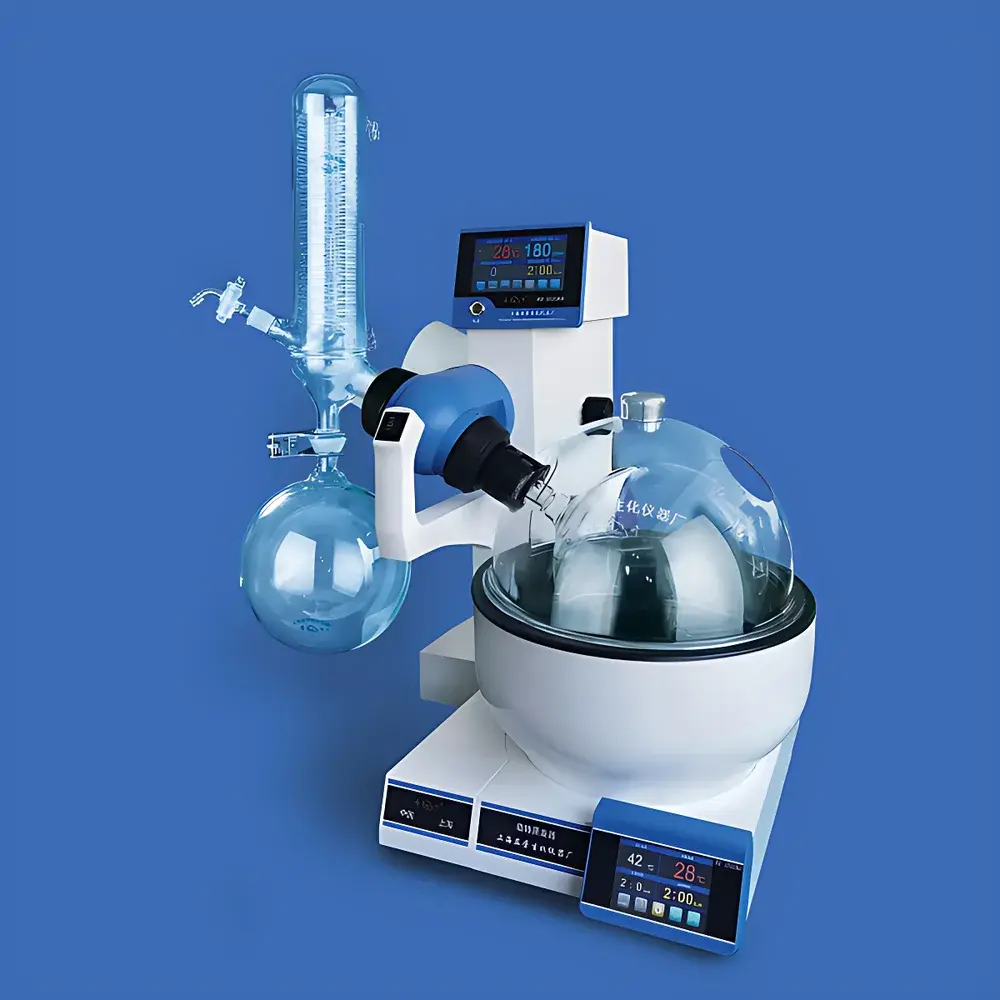
Jinye RE-3000AA Rotary Evaporator
| Brand | Jinye |
|---|---|
| Origin | Shanghai, China |
| Manufacturer Type | Direct Manufacturer |
| Model | RE-3000AA |
| Evaporation Flask Capacity | 50–3000 mL |
| Ultimate Vacuum Range | –0.01 to –0.095 MPa (built-in vacuum controller, accuracy ±0.2–0.5%) |
| Rotation Speed | 0–200 rpm (bidirectional rotation) |
| Temperature Control Range | Room temperature to 99 °C (PID-controlled water bath, color touchscreen display) |
| Temperature Accuracy | ±1 °C |
| Condenser Surface Area | 0.15 m² (dual-flow vertical condenser with standardized 24/40 ground-glass joints and extended glass shaft tube) |
| Connection Interface | M42 bayonet-type locking nut |
Overview
The Jinye RE-3000AA Rotary Evaporator is a precision-engineered benchtop purification system designed for efficient solvent removal, concentration, and recovery under reduced pressure. It operates on the fundamental principle of rotary evaporation: simultaneous application of heat (via thermostatically controlled water bath), mechanical rotation (to increase surface area and promote uniform thin-film formation), and vacuum (to lower boiling points and accelerate volatilization). This tri-variable control architecture enables reproducible, scalable, and gentle processing of thermally sensitive compounds—critical in pharmaceutical R&D, natural product isolation, and synthetic chemistry workflows. The unit integrates a dual-flow vertical condenser with a total cooling surface area of 0.15 m², optimized for high-efficiency vapor capture across a broad range of solvent polarities and boiling points—from low-boiling diethyl ether (34.6 °C) to higher-boiling dimethylformamide (153 °C).
Key Features
- Bidirectional rotation motor (0–200 rpm) with programmable direction switching, enabling enhanced film stability for viscous or foaming samples.
- Integrated vacuum control module with digital setpoint adjustment (–0.01 to –0.095 MPa) and real-time feedback; vacuum accuracy maintained within ±0.2–0.5% of set value over extended operation.
- PID-regulated water bath with ±1 °C temperature stability across the full 20–99 °C operating range; independent bath operation allows use as a standalone heating platform.
- Full-color capacitive touchscreen interface supporting simultaneous display of bath temperature, rotation speed, vacuum level, and timer status—enabling intuitive multi-parameter monitoring and logging.
- Standardized 24/40 ground-glass joint system with extended-length glass shaft and M42 bayonet locking mechanism ensures leak-tight, rapid assembly and secure flask retention during high-speed rotation.
- Modular dual-flow condenser design maximizes thermal exchange efficiency while minimizing backstreaming risk; compatible with standard laboratory chillers (e.g., 5–15 °C glycol/water supply).
Sample Compatibility & Compliance
The RE-3000AA accommodates evaporation flasks from 50 mL to 3000 mL, supporting both small-scale screening (e.g., 100 mg API purification) and preparative-scale work (e.g., 500 mL crude extract concentration). Its inert borosilicate glass construction (including 24/40 joints and condenser tubing) ensures chemical compatibility with common organic solvents (acetone, ethyl acetate, methanol, dichloromethane), aqueous buffers, and mildly acidic/basic media. The system meets general laboratory safety requirements per IEC 61010-1 and conforms to CE marking directives for electrical equipment. While not pre-certified for GMP environments, its digital PID control, stable thermal performance, and repeatable vacuum regulation support GLP-compliant documentation when paired with external audit-trail-capable data loggers.
Software & Data Management
The RE-3000AA features embedded firmware with non-volatile parameter memory—retaining user-defined setpoints (temperature, speed, vacuum, timer) after power cycling. All operational parameters are displayed in real time on the touchscreen, with timestamped manual recording capability. Though no proprietary PC software is bundled, the device supports analog output signals (0–10 V or 4–20 mA) for integration into centralized lab automation systems (e.g., LabArchives, DeltaV, or custom SCADA platforms) via optional I/O modules. For regulated environments requiring electronic records, users may employ third-party validated data acquisition tools compliant with FDA 21 CFR Part 11—particularly when linking vacuum and temperature logs to batch records in pharmaceutical manufacturing.
Applications
- Solvent removal from reaction mixtures post-synthesis (e.g., elimination of THF after Grignard coupling).
- Concentration of heat-labile biomolecules—including peptides, oligonucleotides, and enzyme fractions—without denaturation.
- Recovery and recycling of high-purity solvents in fine chemical production, reducing waste disposal costs and environmental impact.
- Preparative isolation of natural products (e.g., alkaloids, flavonoids) from plant extracts using sequential fractional evaporation.
- Drying of hygroscopic intermediates prior to crystallization or lyophilization steps.
FAQ
What is the maximum recommended flask size for stable operation at 200 rpm?
For optimal mechanical balance and film uniformity, use flasks ≤2000 mL at speeds above 150 rpm; 3000 mL flasks are rated for continuous operation up to 120 rpm.
Can the water bath be used independently of the rotation and vacuum functions?
Yes—the bath operates as a standalone thermostatic heater with independent PID control, suitable for dissolution studies or sample warming protocols.
Is the condenser compatible with dry ice/acetone cooling for low-boiling solvents?
The dual-flow design supports cryogenic coolant circulation; however, sub-0 °C operation requires external chiller compatibility verification and condenser jacket insulation to prevent frosting-induced flow restriction.
Does the vacuum controller support external pressure transducer input for closed-loop feedback?
No—the built-in sensor provides direct readout and proportional control; external transducer integration requires aftermarket PLC-level interfacing.
What maintenance intervals are recommended for long-term vacuum system reliability?
Inspect and replace the vacuum pump oil every 200 operating hours; clean the condenser interior quarterly with ethanol and lint-free wipes to maintain thermal transfer efficiency.



