
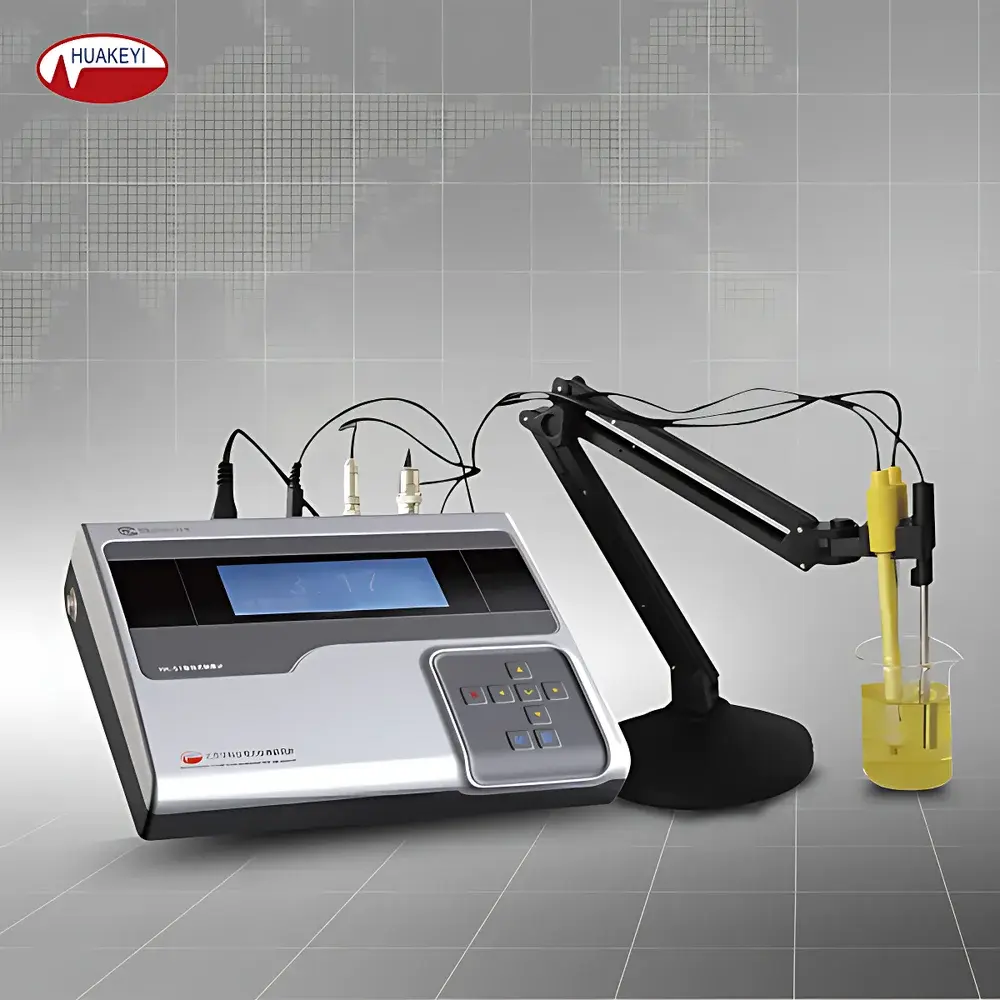
Huake Instrument HK-51 Benchtop Sodium Ion Analyzer
| Brand | Huake Instrument |
|---|---|
| Origin | Beijing, China |
| Manufacturer Type | Authorized Distributor |
| Country of Origin | China |
| Model | HK-51 |
| Instrument Category | Sodium Ion Analyzer |
| Form Factor | Benchtop |
| Measurement Range | (1.00–8.00) pNa, 0.23 μg/L – 2.30 g/L |
| Detection Limit | 0.01 pNa, 0.01 μg/L |
| Response Time (T90) | 2 min at 25 °C |
| Accuracy | ±0.03 pNa or ±5 μg/L (whichever is greater) |
| Temperature Range | (0.00–99.9) °C |
| Display | 192 × 64 dot-matrix LCD (English/Chinese selectable) |
| Resolution | 0.01 pNa, 0.01 μg/L |
| Input Impedance | ≥1 × 10¹² Ω |
| Temperature Sensor | Pt1000 |
| Temp. Compensation | Automatic or Manual (0.1–60.0 °C) |
| Power Supply | AC 100–240 V, 50–60 Hz |
| Power Consumption | 3 W |
| Dimensions | 270 × 200 × 65 mm (L × W × H) |
| Weight | 2 kg |
Overview
The Huake Instrument HK-51 Benchtop Sodium Ion Analyzer is a precision potentiometric instrument engineered for trace-level sodium ion quantification in ultra-pure and process water systems. It operates on the principle of ion-selective electrode (ISE) potentiometry, utilizing a solid-state sodium-selective membrane electrode paired with a high-impedance reference electrode to generate a Nernstian potential response proportional to the logarithmic activity of Na⁺ ions in solution. Designed specifically for applications demanding sub-ppb sensitivity—such as steam cycle chemistry monitoring in thermal power plants—the HK-51 delivers reliable pNa measurements across a calibrated range of 1.00–8.00 pNa (equivalent to 0.23 μg/L–2.30 g/L). Its architecture integrates a 32-bit embedded microcontroller, low-noise analog front-end circuitry, and active shielding to minimize drift and electromagnetic interference—critical for stable readings in electrically noisy plant environments. The system supports both manual and automatic temperature compensation via an integrated Pt1000 sensor, ensuring thermodynamic accuracy across operational temperatures from 5 °C to 60 °C.
Key Features
- High-stability 32-bit embedded microcontroller with surface-mount technology (SMT) PCB assembly for long-term repeatability and reduced thermal drift
- IP65-rated enhanced plastic housing with full silicone membrane keypad—resistant to moisture, dust, and chemical splashes common in lab and field settings
- Dual-parameter display (pNa and equivalent concentration in μg/L or g/L) with real-time temperature overlay; user-selectable English/Chinese UI
- Intelligent auto-stabilization algorithm that dynamically evaluates electrode potential convergence before finalizing measurement—eliminating subjective endpoint judgment
- Configurable calibration protocols: single-point, two-point, or multi-point calibration using certified pNa standards (e.g., pNa2 solution)
- Automatic temperature compensation (ATC) with Pt1000 sensor (±0.5 °C accuracy, 0.1 °C resolution) and optional manual offset adjustment within 0.1–60.0 °C range
- Input impedance ≥1 × 10¹² Ω ensures minimal loading error when interfacing with high-resistance sodium ISEs
Sample Compatibility & Compliance
The HK-51 is validated for aqueous matrices including ultrapure steam condensate, boiler feedwater, turbine drain water, deionized water, and low-conductivity industrial process streams. It is not intended for use in high-ionic-strength media (>100 mS/cm), viscous solutions, or samples containing fluoride, heavy metals, or surfactants above manufacturer-specified thresholds—substances known to interfere with sodium-selective membrane performance. While the instrument itself does not carry CE or UKCA certification, its electrical design complies with IEC 61010-1:2010 safety requirements for laboratory equipment. When operated under documented SOPs—including daily calibration verification, electrode conditioning per manufacturer guidelines, and use of traceable NIST-traceable pNa standards—the HK-51 supports data integrity frameworks aligned with GLP and internal QA/QC protocols. Full audit trails are maintained manually via printed or exported logs; electronic record retention meets basic FDA 21 CFR Part 11 readiness when integrated into validated LIMS environments.
Software & Data Management
The HK-51 operates as a standalone analytical platform without proprietary PC software. All configuration, calibration, and measurement functions are executed via the front-panel interface. Measurement results—including date/time stamp, temperature, pNa value, concentration, and electrode mV reading—are displayed in real time and may be recorded manually or transferred externally via RS-232 serial output (optional adapter required). The device stores no historical data internally but supports immediate hard-copy documentation through optional thermal printer integration. For laboratories requiring electronic data capture, third-party SCADA or LabVIEW-compatible DAQ systems can acquire serial output in ASCII format (e.g., “2024-06-15 14:22:07, 25.3°C, 6.42 pNa, -189.7 mV”). Calibration records, electrode maintenance logs, and environmental conditions must be retained separately per ISO/IEC 17025 Clause 7.7 requirements.
Applications
- Power generation: Continuous monitoring of sodium breakthrough in condensate polishing units and feedwater trains to detect early-stage cation resin exhaustion or condenser tube leakage
- Pharmaceutical manufacturing: Verification of sodium residuals in purified water (PW) and water for injection (WFI) distribution loops per USP guidance
- Semiconductor fabrication: Final rinse water quality assurance where Na⁺ contamination >0.1 ppb risks gate oxide defects
- Research laboratories: Kinetic studies of sodium transport across synthetic membranes or ion-exchange resins
- Environmental testing: Baseline sodium profiling in low-TDS natural waters (e.g., alpine springs, rainwater) where conventional conductivity methods lack specificity
FAQ
What is the minimum detectable sodium concentration the HK-51 can reliably quantify?
The instrument specifies a detection limit of 0.01 pNa, equivalent to 0.01 μg/L under ideal conditions—achievable only with properly conditioned electrodes, rigorous blank control, and electrochemical shielding from ambient static and stray fields.
Does the HK-51 support ASTM D4582 or ISO 10523-compliant measurement procedures?
While the HK-51 implements core principles referenced in ASTM D4582 (Standard Practice for Measuring Sodium Ion Activity in Water), it does not include built-in method templates or automated compliance reporting; users must implement sample pretreatment, calibration frequency, and uncertainty evaluation per those standards manually.
Can the sodium electrode be used in hot water samples above 60 °C?
No. The recommended sample temperature range is 5–60 °C. Exposure to temperatures >60 °C accelerates membrane leaching and shortens electrode service life; measurements outside this range require external cooling and are not covered by warranty or accuracy specifications.
Is the HK-51 suitable for seawater or brine analysis?
No. High ionic strength causes significant activity coefficient deviation and junction potential errors. The HK-51 is optimized for low-conductivity matrices (<10 μS/cm); seawater (≈50 mS/cm) exceeds its operational design envelope and will yield non-Nernstian responses.
How often should the sodium ISE be recalibrated during routine operation?
For critical applications (e.g., power plant chemistry control), calibration verification is recommended before each analytical batch and after every 8 hours of continuous use; full two-point calibration is advised at least once per shift when measuring below 10 μg/L.
Related Products







