
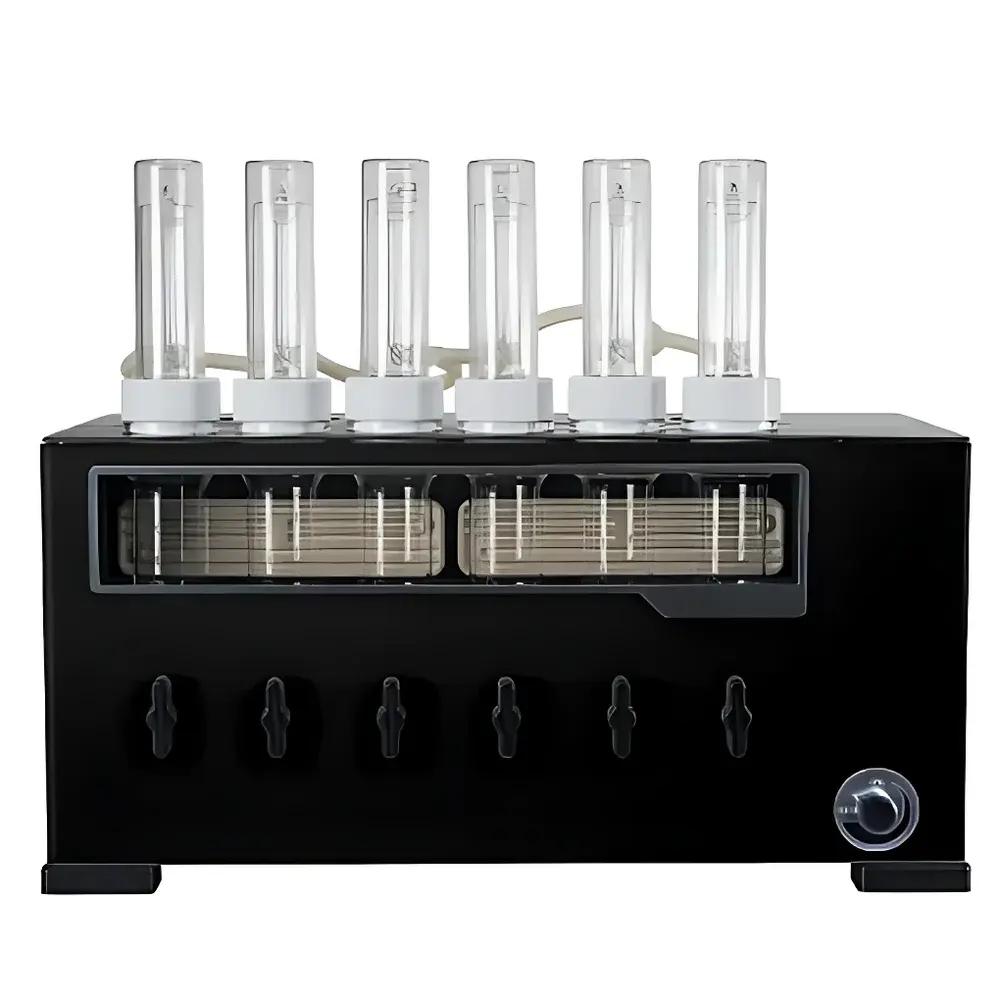
OPSIS FB-120 Manual Fiber Analyzer
| Brand | OPISIS |
|---|---|
| Origin | Sweden |
| Manufacturer Status | Authorized Distributor |
| Origin Category | Imported |
| Model | FB-120 |
| Price | Upon Request |
| Capacity | 6 samples per batch |
| Dimensions (W×H×D) | 655 × 325 × 475 mm |
| Weight | 25 kg |
| Operating Temperature | 5–40 °C |
| Relative Humidity | ≤80 % RH |
| Voltage | 190–240 VAC, 50–60 Hz |
| Max. Power Consumption | 2000 W |
| Fiber Method | Crude Fiber (CF) per Weende and AOAC/ISO-compliant protocols |
| Hydrolysis Compatibility | Samples with fat content 0.1–100 %, sample mass 0.5–3 g |
Overview
The OPISIS FB-120 Manual Fiber Analyzer is a benchtop, gravimetric fiber analysis system engineered for precision, repeatability, and regulatory compliance in feed, food, and agricultural laboratories. It implements the classical Weende method for crude fiber (CF) determination—based on sequential acid and alkali hydrolysis followed by filtration, drying, and ashing—to quantify the lignin, cellulose, and hemicellulose residues resistant to digestion. Unlike automated systems requiring complex fluidics or robotics, the FB-120 maintains full manual control over each analytical step—acid hydrolysis, base hydrolysis, rinsing, drying, and incineration—enabling rigorous method validation, troubleshooting, and alignment with ISO 5986, AOAC 962.09, and USDA Feed Composition Database protocols. Its robust stainless-steel construction, independent sample positioning, and thermal-stable heating elements ensure consistent temperature profiles across all six reaction vessels, minimizing inter-sample variability and supporting GLP-aligned documentation workflows.
Key Features
- Six-position parallel processing with physically isolated digestion vessels—no cross-contamination between samples during acid/base hydrolysis or rinsing steps.
- Integrated heating module with precise temperature control (±2 °C) across the full operating range (5–40 °C ambient), optimized for reproducible hydrolysis kinetics per AOAC and ISO time–temperature matrices.
- Dedicated support for standardized consumables: FB-010-A coarse fiber bags (glass microfiber, PTFE-lidded) and SX-043-A hydrolysis filters compatible with OPISIS Soxhlet extractors for concurrent total fat analysis.
- Modular accessory ecosystem—including FB-104-A acetone-resistant black marker for sample bag labeling and FB-110-A heat sealer—ensures traceability and integrity of fiber bags prior to and after hydrolysis.
- Compliance-ready design: All operational parameters (time, temperature, reagent volumes) are manually logged per batch, facilitating audit trails required under ISO/IEC 17025 and FDA 21 CFR Part 11–aligned quality systems when paired with laboratory notebooks or LIMS integration.
Sample Compatibility & Compliance
The FB-120 accommodates solid, semi-solid, and homogenized matrices including compound feeds, forage silages, cereal grains, pet food formulations, and botanical extracts. Sample masses range from 0.5 g to 3.0 g—optimized for accurate CF recovery across low-fiber (e.g., dairy concentrates) and high-fiber (e.g., straw, hulls) materials. The instrument supports both cold and hot filtration protocols and integrates seamlessly with standard laboratory ovens (105 °C drying) and muffle furnaces (550 °C ashing). Method validation data confirm linearity (R² > 0.999), repeatability (RSD < 2.5 % for duplicate CF determinations), and recovery rates within ±3 % of certified reference materials (e.g., NIST SRM 1846, AOCS 932.06). Regulatory alignment includes AOAC Official Method 962.09, ISO 5986:2014, and EU Regulation (EC) No 152/2009 Annex IV for feedstuff fiber testing.
Software & Data Management
As a manual platform, the FB-120 does not incorporate embedded firmware or proprietary software. Instead, it is designed for integration into established laboratory quality frameworks: raw weight measurements, hydrolysis durations, drying/ashing times, and final ash-corrected CF values are recorded directly into paper-based lab notebooks or electronic systems (e.g., LabWare LIMS, Agilent OpenLab ECM) using standardized templates. Each FB-120 unit ships with a comprehensive user guide (LP1021), method-specific SOP appendices, and calibration verification procedures—enabling full traceability, internal audit readiness, and seamless transition to ISO/IEC 17025 accreditation. Optional digital logbook templates (Excel/CSV) are available upon request for structured data capture and statistical process control.
Applications
- Feed formulation labs quantifying crude fiber for ration balancing and nutritional labeling per AAFCO and EU Feed Hygiene Regulations.
- Contract testing laboratories performing third-party CF analysis for ISO/IEC 17025-accredited reports.
- Research institutions studying fiber digestibility in ruminant nutrition models, where method transparency and operator control are essential.
- Quality assurance units validating incoming raw materials (e.g., alfalfa meal, soy hulls) against supplier specifications and internal release criteria.
- Academic teaching labs demonstrating classical proximate analysis principles with hands-on, stepwise methodology.
FAQ
Is the FB-120 compliant with AOAC and ISO fiber testing standards?
Yes—the instrument is validated for use with AOAC 962.09 and ISO 5986:2014 methods, and its physical configuration supports all critical procedural requirements including controlled hydrolysis timing, filtration geometry, and thermal stability.
Can the FB-120 be used for detergent fiber analysis (NDF, ADF)?
No—it is specifically configured for Weende-type crude fiber; NDF/ADF require neutral/detergent solutions, reflux condensation, and specialized filter crucibles not supported by this platform.
What consumables are mandatory for routine operation?
FB-010-A coarse fiber bags (50/pack) and appropriate reagents (H₂SO₄, NaOH, acetone) are required; SX-043-A hydrolysis filters are optional but recommended for concurrent fat extraction workflows.
Does the FB-120 include temperature logging capability?
No—temperature monitoring must be performed externally using calibrated thermometers or data loggers per GLP requirements; the unit provides stable, uniform heating but no built-in datalogging.
Is service and technical support available outside Sweden?
Yes—authorized distributors provide installation verification, operator training, preventive maintenance, and spare parts logistics under global warranty terms aligned with ISO 9001-certified service networks.





