
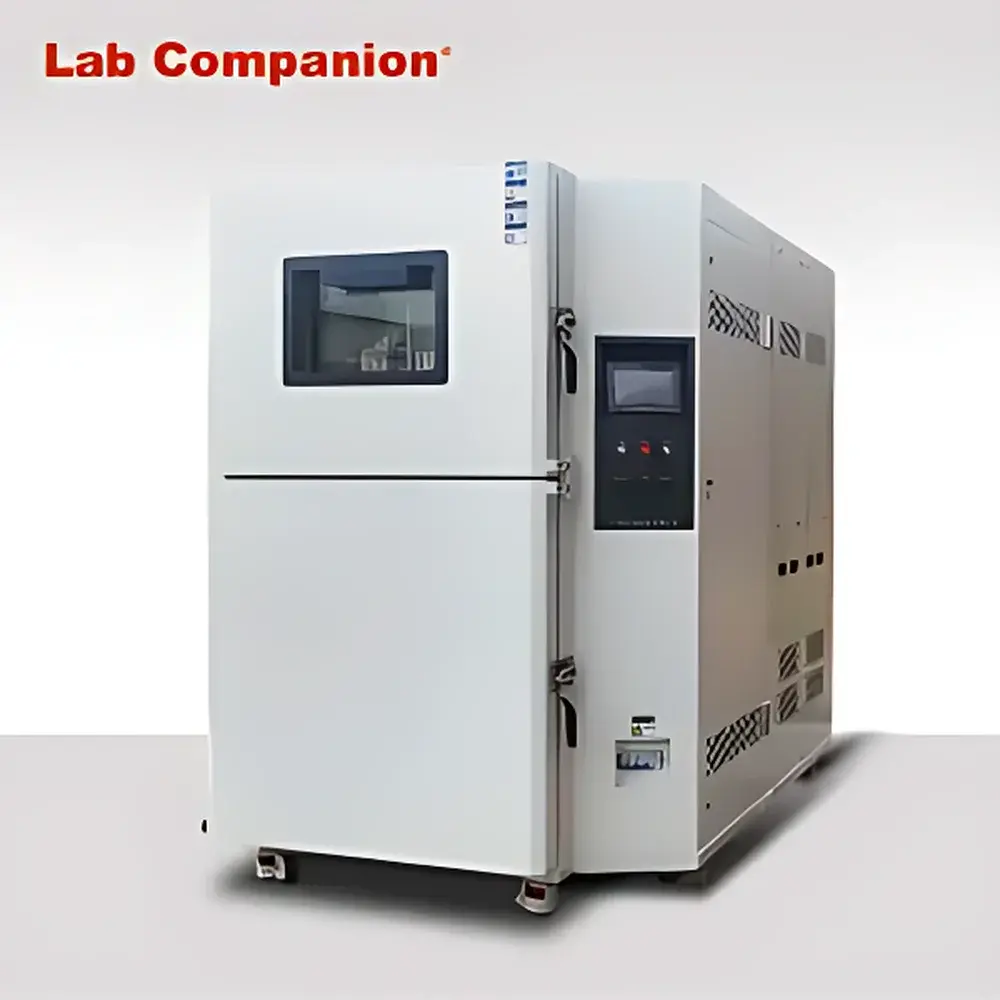
LabCompanion TS2 Mobile Three-Zone Thermal Shock Test Chamber
| Brand | LabCompanion |
|---|---|
| Origin | Guangdong, China |
| Manufacturer Type | Direct Manufacturer |
| Product Category | Domestic |
| Model | TS2 |
| High-Temperature Range | +150 °C |
| Low-Temperature Range | −65 °C |
| Thermal Shock Range | −65 °C to +150 °C |
| Temperature Transition Time (RT to −80 °C) | ≤90 min |
| Temperature Transition Time (RT to +200 °C) | ≤40 min |
| Standard Chamber Volumes | 36 L, 80 L, 150 L, 225 L |
| Custom Volume Range | 36 L to 8000 L |
| Exposure Temperature Range | −65 °C to +150 °C |
| Test Chamber Temperature Uniformity | ≤±2 °C |
| Temperature Recovery Time | ≤5 min |
| Load Capacity per Shelf | 30 kg |
| Max. Sample Weight | 7.5–10 kg |
| Actuation Method | Pneumatic Air-Damper Switching Between Three Zones |
Overview
The LabCompanion TS2 Mobile Three-Zone Thermal Shock Test Chamber is an engineered environmental stress screening system designed for rapid, repeatable, and high-fidelity thermal cycling of electronic components, aerospace assemblies, automotive modules, and advanced packaging materials. Unlike single- or dual-zone systems, the TS2 implements a true three-chamber architecture—comprising independent high-temperature (HT), low-temperature (LT), and test (T) zones—enabling uninterrupted thermal shock testing via pneumatic damper switching. This configuration eliminates thermal mass interference between zones and ensures precise control over exposure dwell times, transition rates, and recovery stability. The chamber operates on the principle of accelerated thermal fatigue induction, subjecting specimens to abrupt temperature transitions that simulate field-relevant thermal stresses such as those encountered during aircraft ascent/descent, automotive under-hood thermal cycling, or reflow soldering mismatches in PCB assemblies. Its mobile base with locking casters supports flexible lab-floor deployment and integration into automated reliability test lines.
Key Features
- Three-zone independent thermal reservoirs: HT zone (up to +200 °C), LT zone (down to −80 °C), and insulated test chamber—each with dedicated heating/cooling circuits and PID-controlled air circulation;
- Pneumatically actuated high-speed air dampers enabling zone switching in <3 seconds, minimizing transition lag and ensuring compliance with MIL-STD-810H Method 503.5 and IEC 60068-2-14 requirements;
- Mobile chassis with industrial-grade locking casters (load-rated to 500 kg), facilitating relocation between qualification labs, production floors, and cross-functional validation bays;
- Configurable internal volume range from 36 L to 8000 L; standard models (80 L, 150 L, 225 L, 408 L) ship within 6 weeks; non-standard dimensions supported via OEM engineering collaboration;
- Temperature uniformity maintained at ≤±2 °C across full working volume per ISO 16750-4 Annex A and ASTM E145 Class B specifications;
- Integrated safety interlocks including over-temperature cut-off, refrigerant pressure monitoring, door-open alarm, and emergency stop circuit compliant with EN 61000-6-2/6-4 EMC directives.
Sample Compatibility & Compliance
The TS2 accommodates a broad spectrum of physically heterogeneous samples—from miniature surface-mount devices (SMDs) and QFN packages to large-format battery modules and avionics enclosures. Standard shelf loading capacity is 30 kg per level, with maximum sample weights ranging from 7.5 kg (for 36–80 L chambers) to 10 kg (150–408 L). All chamber interiors feature stainless-steel 304 construction with electropolished welds, meeting cleanroom-compatible surface roughness (Ra ≤ 0.8 µm) per ISO 14644-1 Class 8 requirements. The system supports full traceability for regulated environments: integrated data logging meets FDA 21 CFR Part 11 audit trail requirements when paired with optional LabCompanion TraceManager software; calibration certificates are NIST-traceable and include uncertainty budgets per ISO/IEC 17025.
Software & Data Management
Control and monitoring are executed via the LabCompanion TSCore v4.2 embedded HMI—a 10.1″ capacitive touchscreen running a real-time Linux kernel with deterministic loop timing ( ±1.5 °C, pause and alert”). Raw sensor data (PT100 class A, ±0.1 °C accuracy) is logged at 1 Hz resolution and exportable in CSV, XML, or PDF formats. Optional Ethernet/IP and Modbus TCP gateways enable integration into MES platforms (e.g., Siemens Opcenter, Rockwell FactoryTalk) and centralized test data lakes. All firmware updates are digitally signed and validated prior to installation to ensure integrity and regulatory compliance.
Applications
- Qualification testing of semiconductor packages per JEDEC JESD22-A104 (Temperature Cycling) and JESD22-A106 (Thermal Shock);
- Reliability validation of EV battery cells and module housings under extreme ambient gradients (−40 °C to +85 °C cycling);
- Aerospace component screening per DO-160 Section 4 (Operating Temperature) and SAE ARP4754A thermal stress analysis;
- Medical device sterilization compatibility assessment (e.g., repeated autoclave-to-freeze cycles on polymer housings);
- Material coefficient-of-thermal-expansion (CTE) mismatch evaluation in multi-layer ceramic capacitors (MLCCs) and SiP assemblies.
FAQ
What distinguishes the TS2’s three-zone architecture from conventional two-zone thermal shock chambers?
The TS2 isolates heating, cooling, and test functions into physically separate chambers—eliminating thermal crosstalk and enabling simultaneous conditioning of multiple specimens at different setpoints. This architecture achieves faster recovery times (<5 min), tighter uniformity (±2 °C), and higher repeatability (CV <1.2%) than lift-type or basket-transfer systems.
Can the TS2 be validated for GLP/GMP environments?
Yes. With optional IQ/OQ documentation packages, 21 CFR Part 11-compliant electronic signatures, and full audit trail logging, the TS2 satisfies instrument qualification requirements for pharmaceutical packaging validation and medical device design verification per ISO 13485.
Is remote monitoring and control supported?
Standard Ethernet connectivity enables secure web-based access via TLS 1.2-encrypted HTTP(S). Optional VPN tunneling and role-based user permissions (admin/operator/viewer) are configurable through the TSCore gateway.
What maintenance intervals are recommended for long-term operational stability?
Compressor oil and refrigerant filter replacement every 24 months; annual calibration of all PT100 sensors and verification of damper actuation timing; biannual inspection of gasket integrity and airflow balance per ISO 16750-4 Clause 6.3.3.



