
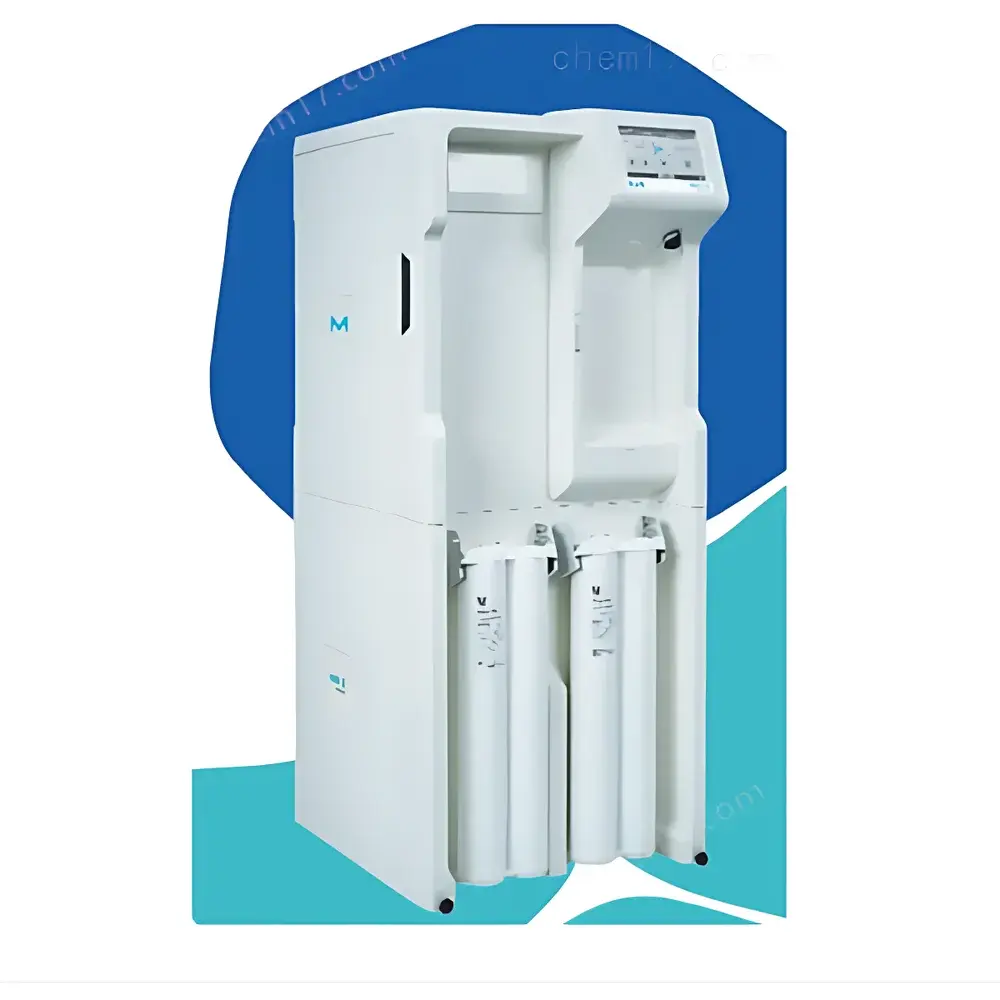
Milli-Q® HR7000 Intelligent High-Flow Pure Water System
| Brand | Milli-Q |
|---|---|
| Origin | France |
| Manufacturer | Merck KGaA |
| Product Type | Imported Ultra-Pure Water Generation System |
| Model | Milli-Q® HR7000 |
| Pure Water Grade | ASTM Type III / ISO 3696 Grade 3 |
| Resistivity | ≥18.2 MΩ·cm (at 25°C, post-polishing) |
| Ionic Rejection Rate | ≥95% (RO stage) |
| Heavy Metals & Soluble Silica | <1 ppb |
| Total Organic Carbon (TOC) | <5 ppb (typical, post-polishing) |
| Microbial Count | <0.001 CFU/mL |
| Endotoxin Level | <0.001 EU/mL |
| Particles (>0.1 µm) | <1 particle/mL |
| Flow Rate | Up to 220 L/h (7–30°C ambient), scalable to 13,000 L/day with multi-unit configuration |
Overview
The Milli-Q® HR7000 Intelligent High-Flow Pure Water System is a modular, networked Type III pure water generation platform engineered for centralized laboratory infrastructure. It employs a multi-stage purification architecture integrating pre-treatment (Progard® dual-stage filtration), high-rejection reverse osmosis (RO), and optional post-RO polishing modules to consistently deliver ASTM Type III / ISO 3696 Grade 3 water. Unlike point-of-use units, the HR7000 is designed for facility-scale deployment—serving benchtop dispensing points, automated instrumentation (e.g., clinical analyzers, autoclaves, washer-disinfectors), environmental chambers, and as feedwater for downstream ultra-pure water systems (e.g., Milli-Q® IQ7000). Its core innovation lies in E.R.A.™ (Efficient Recovery Adjustment) technology: an adaptive RO control algorithm that dynamically modulates recovery rate (45–75%) based on real-time feedwater parameters—including conductivity, temperature, hardness, alkalinity, and CO₂ content—ensuring stable permeate flow and minimized waste across seasonal or geographic variations in municipal supply.
Key Features
- High-capacity output: 220 L/h continuous flow at 7–30°C ambient; scalable via daisy-chained configurations (up to 3 units) for total capacity of 13,000 L/day
- E.R.A.™ technology: Fully automated RO optimization eliminating manual valve adjustments, reducing water consumption by ≥50% versus conventional RO systems while extending membrane service life
- Integrated human-machine interface (HMI): 7-inch capacitive touchscreen with guided maintenance workflows, intuitive navigation, and context-sensitive help—no manual lookup required for consumable replacement or calibration
- Comprehensive connectivity: Embedded TCP/IP web server supporting secure remote monitoring/control via browser, LIMS integration (via HTTP/HTTPS API), BMS interfacing (2 × 4–20 mA analog outputs), and SNMP-based network alerts
- Smart consumables management: Real-time tracking of Progard® cartridges, RO membranes, UV lamps, and terminal filters with predictive end-of-life warnings and usage logging
- Optional inline monitoring: Configurable resistivity and TOC sensors on distribution loops for continuous quality verification per ISO 15189 and CLSI EP23-A requirements
Sample Compatibility & Compliance
The Milli-Q® HR7000 meets or exceeds international standards for laboratory-grade pure water production, including ASTM D1193 Type III, ISO 3696 Grade 3, and CLSI EP23-A Annex A specifications for feedwater to analytical instruments and cleaning processes. All wetted materials comply with USP Class VI biocompatibility and FDA 21 CFR 177.2600 for food-contact polymers. The system supports full GxP compliance through audit-ready electronic records: timestamped event logs (alarms, maintenance, parameter deviations), 2-year onboard data retention, USB export capability, and optional 21 CFR Part 11–compliant user authentication and electronic signature modules. Installation Qualification (IQ), Operational Qualification (OQ), and Preventive Maintenance protocols are available per ISO/IEC 17025 and ISO 15189 validation frameworks.
Software & Data Management
Data integrity is ensured via an embedded Linux-based controller with encrypted local storage and role-based access control (RBAC). All operational parameters—including feed/resistivity/TOC values, pump cycles, UV intensity, tank level, alarm history, and consumable usage—are logged with millisecond timestamps. Reports are auto-generated in PDF or CSV format and can be scheduled for email delivery or pushed to LIMS via RESTful API. The system supports GLP/GMP audit trails with immutable records of user actions, configuration changes, and calibration events. Remote diagnostics are enabled through Merck’s certified service portal, allowing authorized engineers to perform firmware updates, trend analysis, and root-cause assessment without physical site visits.
Applications
The HR7000 serves as primary pure water infrastructure for academic research cores, pharmaceutical QC labs, clinical diagnostics facilities, and industrial R&D centers. Typical use cases include feedwater for HPLC mobile phase preparation, buffer formulation for cell culture, rinsing in semiconductor wafer cleaning, reagent dilution in ELISA and PCR workflows, and supply to high-throughput washers and sterilizers. Its scalability makes it suitable for both single-floor laboratories and multi-story science buildings requiring centralized, load-balanced distribution. When paired with the SDS 500 Smart Storage & Distribution System, it forms a validated closed-loop architecture compliant with ISO 20361 for stored water quality preservation.
FAQ
What is the minimum feedwater quality required for optimal HR7000 performance?
The system is designed for standard municipal tap water meeting EPA or WHO drinking water guidelines. For high-hardness (>150 ppm CaCO₃) or high-chlorine (>0.5 ppm) sources, Progard® pre-treatment with anti-scalant dosing or external ultrafiltration is recommended.
Can the HR7000 integrate with existing building automation systems?
Yes—via two configurable 4–20 mA analog outputs and Modbus TCP support, enabling seamless integration into BMS platforms such as Siemens Desigo, Honeywell Enterprise Buildings Integrator, or Schneider EcoStruxure.
Is validation documentation included with the system?
Merck provides IQ/OQ protocol templates, traceable calibration certificates for all sensors, material compliance declarations (RoHS, REACH, USP VI), and FAT/SAT checklists. Full qualification support is available through Merck’s Certified Validation Services.
How does E.R.A.™ affect RO membrane lifetime?
By maintaining optimal cross-flow velocity and minimizing fouling-induced pressure spikes, E.R.A.™ extends typical RO membrane service intervals from 18 to ≥36 months under routine operation.
What cybersecurity measures protect remote access functionality?
All remote connections require TLS 1.2+ encryption, multi-factor authentication (MFA), session timeout enforcement, and IP whitelisting. Firmware updates are cryptographically signed and verified prior to installation.



