
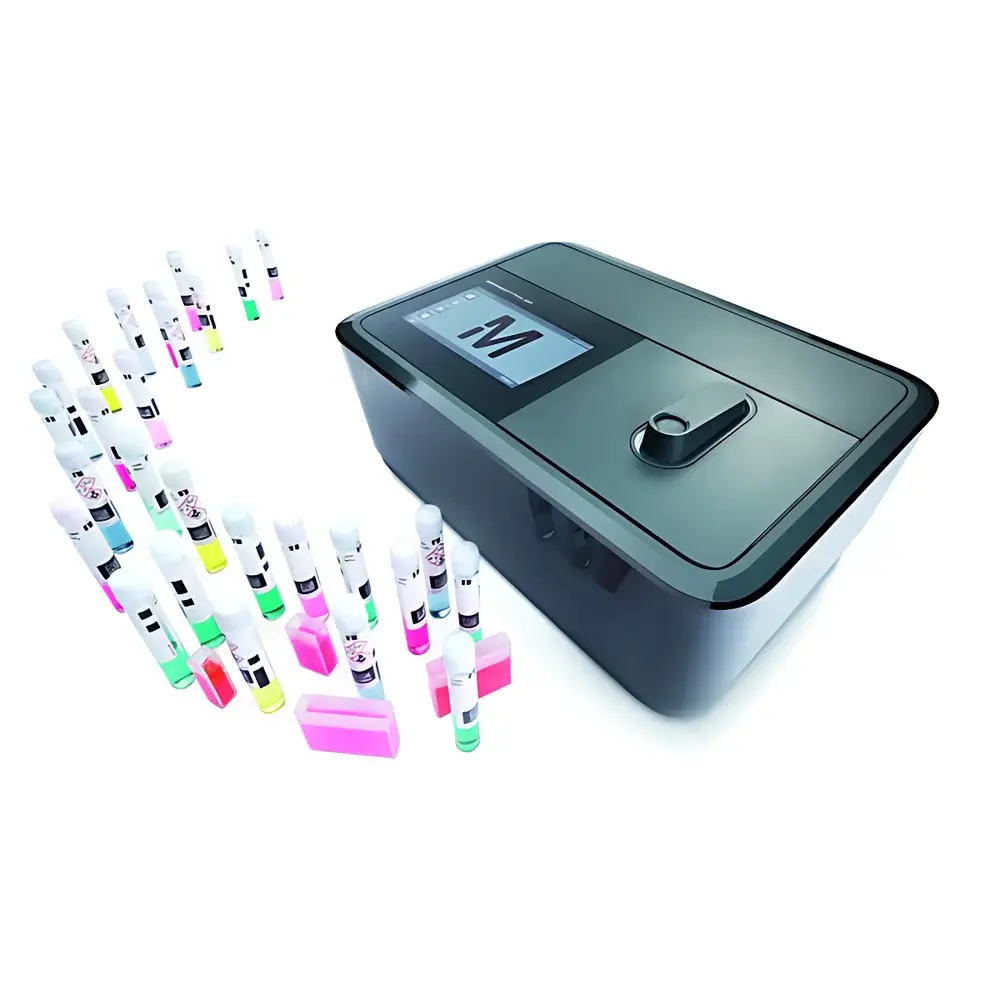
Merck Millipore Spectroquant® Prove Multi-Parameter Water Quality Analyzer
| Brand | Merck Millipore |
|---|---|
| Origin | Germany |
| Model | Prove |
| Instrument Type | Laboratory Water Quality Analyzer |
| Detection Capacity | 180 water quality parameters |
| Wavelength Range | 190–1,100 nm (UV-Vis) |
| Light Sources | Tungsten-halogen lamp (Prove100), Pulsed xenon lamp (Prove300/Prove600) |
| Spectral Bandwidth | 4 nm (Prove100), 1.8 nm (Prove300/Prove600) |
| Cuvette Compatibility | 16 mm round tubes |
| Display | Resistive touchscreen (Prove100/300), P-cap glass capacitive touchscreen (Prove600) |
| Language Support | 28 built-in languages |
| AQA Levels | AQA 1, AQA 2, pipette accuracy verification |
| Barcode Integration | Full QR-code support for reagent lot, expiry, calibration data, and method traceability |
| Compliance | Designed for GLP/GMP-aligned workflows |
Overview
The Merck Millipore Spectroquant® Prove Multi-Parameter Water Quality Analyzer is a laboratory-grade UV-Vis spectrophotometer engineered for high-reproducibility quantitative analysis of water samples across environmental, municipal, industrial, and regulatory compliance laboratories. Built upon dual-beam reference optics architecture, the Prove series eliminates drift-induced measurement error by continuously monitoring source intensity via an integrated reference photodetector—enabling stable photometric performance without routine lamp recalibration. Its extended spectral coverage (190–1,100 nm) supports both ultraviolet absorbance (e.g., nitrate, TOC estimation, bromate) and visible-range colorimetric assays (e.g., phosphate, ammonia, heavy metals), making it compatible with the full portfolio of Spectroquant® certified test kits. The system’s optical design incorporates patented ambient-light compensation: the cuvette compartment lid may be opened during measurement without signal degradation, ensuring robustness in variable lighting conditions typical of shared lab environments.
Key Features
- Dual-beam reference optics with real-time source monitoring—reduces photometric drift and extends lamp service life (tungsten-halogen lamp rated >2,000 h in Prove100; pulsed xenon lamp rated >10⁹ flashes, equivalent to multi-year operation in Prove300/Prove600)
- Automated cuvette recognition across five formats: 16 mm round vials and 10/20/50/100 mm square cuvettes—eliminates manual configuration errors and accelerates method switching
- QR-code–enabled reagent management: scans preloaded Spectroquant® test kit barcodes to auto-load validated methods, calibration curves, lot-specific expiry dates, and QC limits
- Three-tier hardware platform: Prove100 (resistive touchscreen, 4 nm bandwidth), Prove300 (capacitive touchscreen, 1.8 nm bandwidth, kinetic & wavelength scan modes), Prove600 (chemically resistant P-cap glass touchscreen, enhanced thermal stability, full AQA 2 validation suite)
- Embedded Analytical Quality Assurance (AQA): configurable AQA 1 (system suitability), AQA 2 (full operational qualification), and pipette accuracy verification protocols aligned with ISO 8655 and CLSI EP15-A3
Sample Compatibility & Compliance
The Prove analyzer accommodates aqueous matrices ranging from raw surface water and wastewater effluents to ultrapure process water and beverage formulations. It complies with method requirements specified in ISO 7027 (turbidity), ISO 6060 (COD), ASTM D1253 (residual chlorine), EPA Method 365.3 (phosphate), and USP (TOC surrogate quantification). All factory-loaded methods undergo independent verification per ISO/IEC 17025:2017 clause 7.2.2, with documented uncertainty budgets traceable to NIST SRMs. The instrument firmware supports 21 CFR Part 11-compliant user authentication, electronic signatures, and immutable audit trails when connected to Merck’s optional LabX® software—facilitating FDA- and EMA-inspection readiness.
Software & Data Management
Prove instruments operate natively with embedded firmware supporting method storage (up to 99 user-defined methods), kinetic time-series acquisition (0.1–300 s intervals), and full-spectrum scanning (1 nm resolution). Data export is available via USB or Ethernet in CSV, PDF, or XML formats compliant with LIMS integration standards (ASTM E1467, HL7). Optional LabX® connectivity enables centralized method deployment, remote instrument monitoring, automated report generation with digital signatures, and long-term trend analysis across multiple Prove units. All measurement metadata—including operator ID, environmental temperature/humidity logs, reagent batch history, and instrument self-diagnostics—are embedded within each result file to satisfy GLP documentation requirements.
Applications
The Prove platform serves as a primary analytical tool in drinking water treatment plants (monitoring disinfection by-products, alkalinity, hardness), wastewater laboratories (BOD/COD surrogates, nutrient load assessment), pharmaceutical manufacturing (PW/DI water testing per EU GMP Annex 1), food & beverage QA (sugar color index per ICUMSA, beer turbidity, free chlorine in rinse water), and academic research (nutrient cycling studies, microplastic leachate screening via UV absorbance fingerprinting). Its method flexibility supports rapid adaptation to emerging contaminants—such as PFAS precursors (via indirect UV220/254 ratio analysis) or cyanotoxins (using proprietary enzymatic coupling assays)—without hardware modification.
FAQ
Does the Prove analyzer require annual lamp replacement?
No—its reference-beam architecture significantly reduces photometric drift; tungsten-halogen lamps in Prove100 typically exceed 2,000 operating hours, while xenon lamps in Prove300/Prove600 are rated for >10⁹ flashes and do not require scheduled replacement under normal use.
Can I import custom calibration curves from external sources?
Yes—user-defined methods support manual entry or CSV upload of multi-point calibrations, including polynomial or logarithmic fit models, with full traceability to reference standards.
Is the instrument suitable for field-deployable use?
The Prove series is designed exclusively for laboratory environments; it is not IP-rated for dust/moisture ingress and requires stable AC power and ambient temperatures between 10–30 °C.
How does barcode scanning enhance data integrity?
Each QR code encodes reagent lot number, expiration date, calibration coefficients, and method version—ensuring automatic application of correct analytical parameters and preventing outdated or mismatched reagent usage.
What validation documentation is provided with the system?
Factory-issued IQ/OQ documentation, wavelength accuracy verification (NIST-traceable holmium oxide filter), photometric linearity report (neutral density filters), and electronic logbook templates compliant with ISO/IEC 17025 are included.
Related Products







