Shimadzu STABLO-AP Electrostatic Discharger for Analytical Balances
| Brand | Shimadzu |
|---|---|
| Origin | Japan |
| Model | STABLO-AP |
| Application | Static Elimination for Analytical Balances (100–200 g Capacity) |
| Max. Weighing Range | 100 g |
| Readability | 0.01 mg |
| Repeatability | ±0.01 mg |
| Calibration | Automatic |
| Ion Output | Wide-Aperture, Fanless Discharge |
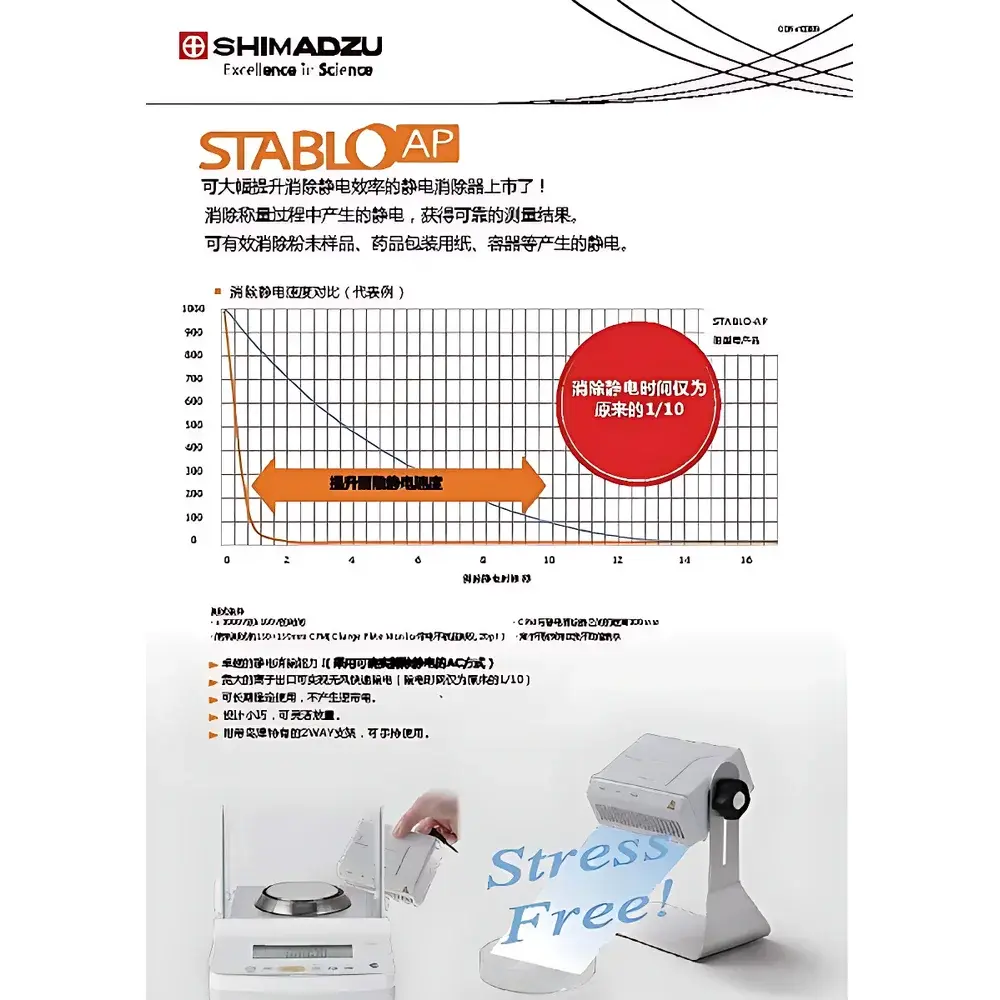
| Discharge Time | ≤10% of Conventional Units |
| Compliance | Designed for ISO/IEC 17025 and GLP Environments |
Overview
The Shimadzu STABLO-AP Electrostatic Discharger is an engineered solution designed specifically to mitigate electrostatic interference during high-precision mass measurement on analytical balances. Operating on the principle of balanced bipolar ion generation—emitting controlled streams of positive and negative ions—the STABLO-AP neutralizes surface charges on samples, containers, and weighing pans without airflow-induced disturbance. This is critical in environments where static-induced drift, unstable readings, or erroneous tare values compromise data integrity—particularly when handling low-mass, high-resistivity materials such as pharmaceutical powders, lyophilized APIs, filter papers, plastic vials, and desiccated biological samples. Unlike fan-assisted ionizers that introduce convective turbulence and thermal noise, the STABLO-AP employs a fanless, wide-aperture ion outlet architecture, enabling rapid, laminar charge neutralization directly at the weighing chamber interface. Its integration is fully compatible with Shimadzu’s AUW/AUX-series and other ISO-compliant analytical balances operating within the 100–200 g range and 0.01 mg readability class.
Key Features
- Fanless ion discharge design eliminates air currents, preventing balance pan vibration and thermal perturbation during measurement
- Wide-aperture ion nozzle ensures uniform coverage across standard balance weighing pans (up to Ø120 mm), reducing average discharge time to ≤1 second—approximately one-tenth that of conventional corona-based units
- Automatic polarity balancing and real-time ion current monitoring maintain stable neutralization performance over extended operation cycles
- Compact, modular housing (120 × 80 × 160 mm) enables benchtop mounting adjacent to or above the balance without obstructing access or calibration ports
- Integrated safety interlock prevents ion emission unless the device is correctly positioned and grounded—compliant with IEC 61340-5-1 ESD control requirements
- Low-maintenance construction with platinum-coated emitter pins and self-cleaning ionization surfaces extends service intervals beyond 12 months under typical lab use
Sample Compatibility & Compliance
The STABLO-AP is validated for use with non-conductive and semi-conductive sample matrices commonly encountered in regulated laboratories: micronized drug substances, cellulose-based packaging media, glass and polypropylene weighing boats, silica gel desiccants, and polymer-coated tablets. It supports adherence to pharmacopeial guidelines requiring static mitigation during USP <41> weight variation testing and EP 2.1.6 weighing procedures. The unit meets electromagnetic compatibility (EMC) Class B limits per EN 61326-1 and is constructed to satisfy mechanical safety requirements under EN 61010-1. When deployed within a documented balance qualification protocol—including Installation Qualification (IQ), Operational Qualification (OQ), and Performance Qualification (PQ)—the STABLO-AP contributes to full audit readiness under FDA 21 CFR Part 11 and EU Annex 11 frameworks, particularly where static-induced measurement uncertainty must be quantified and controlled.
Software & Data Management
While the STABLO-AP operates as a standalone hardware module, its performance parameters—including ion output stability, grounding verification status, and operational uptime—are accessible via optional RS-232 or USB-C interface for integration into laboratory information management systems (LIMS) or electronic lab notebooks (ELN). Shimadzu’s BalanceLink™ software suite (v4.2+) supports time-stamped logging of discharger activation events synchronized with balance weight records, enabling traceable correlation between static mitigation activity and measurement reproducibility. All logs include digital signatures and immutable timestamps compliant with ALCOA+ principles, supporting GLP/GMP data integrity requirements.
Applications
- Pharmaceutical QC labs performing assay, content uniformity, and dissolution sample preparation where static adhesion causes material loss or uneven distribution
- Reference material certification workflows requiring sub-0.02 mg repeatability across multiple weighings of certified reference standards
- Academic and contract research organizations conducting gravimetric analysis of nanomaterials, catalysts, and porous metal–organic frameworks (MOFs)
- Environmental testing labs analyzing airborne particulate matter collected on quartz fiber filters, where electrostatic retention impedes accurate mass determination
- ISO/IEC 17025-accredited calibration laboratories incorporating static control into uncertainty budgets for analytical balance accreditation
FAQ
Is the STABLO-AP compatible with non-Shimadzu analytical balances?
Yes—it is mechanically and electrically interoperable with any analytical balance featuring standard benchtop footprint and grounding provisions, including models from Mettler Toledo, Sartorius, and Ohaus.
Does it require periodic recalibration or certification?
No—ion output performance is factory-validated and drift-compensated; however, annual verification using a calibrated electrostatic field meter (e.g., Trek Model 520) is recommended per ISO/IEC 17025 Clause 6.4.6.
Can it be used inside a glovebox or inert atmosphere chamber?
Yes, provided the unit is installed externally with ion ducting routed through a sealed feedthrough port; nitrogen-purged operation is supported with optional inert-gas-compatible emitter modules.
What maintenance is required?
Emitter pin cleaning with isopropyl alcohol every 6 months; no consumables or replacement parts are needed within the first 36 months of continuous operation.
How is grounding verified during installation?
The unit includes a built-in ground continuity tester (LED indicator) that confirms <1 Ω resistance to facility earth prior to enabling ion emission—fully compliant with ANSI/ESD S20.20 Section 8.3.