
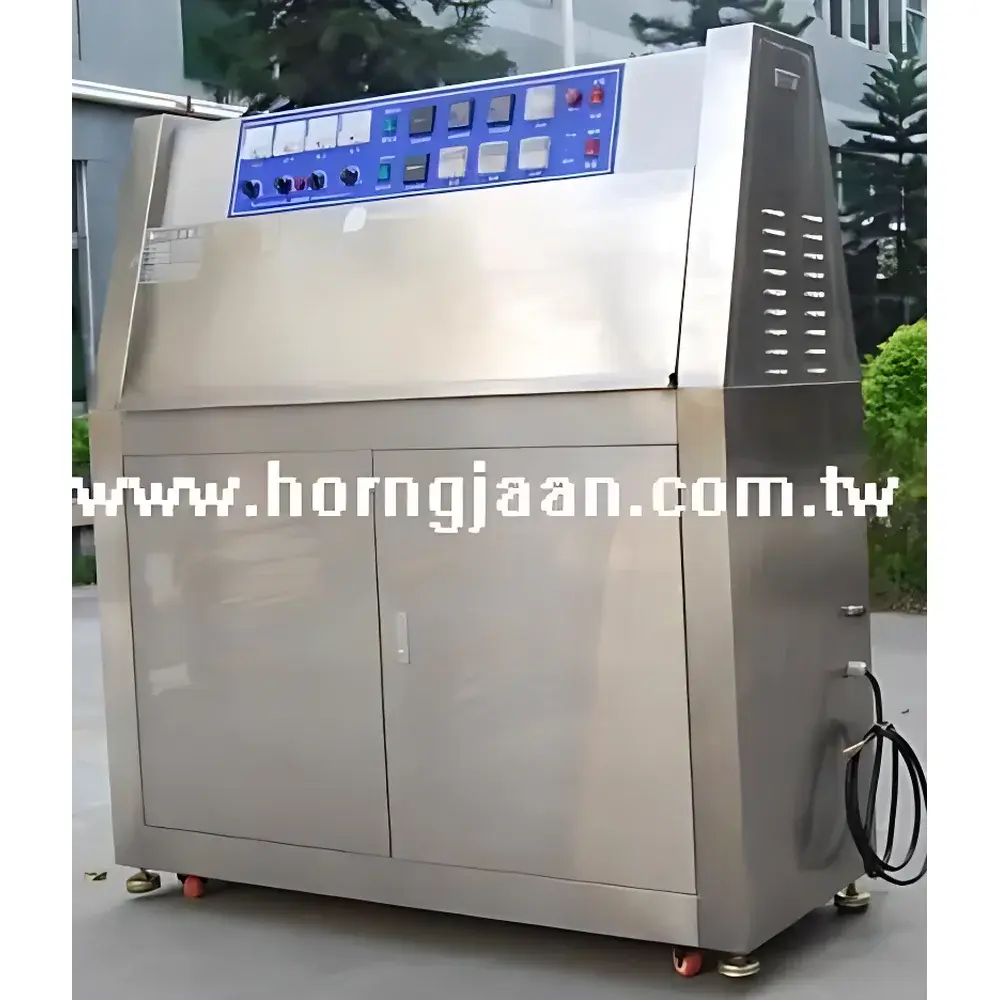
LabCompanion UV1 UV Aging Test Chamber
| Brand | LabCompanion |
|---|---|
| Origin | Guangdong, China |
| Manufacturer Type | Direct Manufacturer |
| Product Category | Domestic |
| Model | UV1 |
| Pricing | Upon Request |
| Temperature Range | RT+10 to 70 °C |
| Humidity Range | ≥90% RH |
| Sample-to-Lamp Distance | 50 ± 2 mm |
| Lamp Center-to-Center Spacing | 70 mm |
| Irradiance | UVA-340 @ 0.68 W/m², UVB-313 @ 0.60 W/m² |
| Interior Dimensions | 1170 × 450 × 500 mm (W×D×H) |
| Exterior Dimensions | 1300 × 550 × 1380 mm (W×D×H) |
Overview
The LabCompanion UV1 UV Aging Test Chamber is an engineered environmental test system designed for accelerated photochemical degradation assessment of polymeric and organic materials under controlled ultraviolet (UV) irradiation, condensation, and thermal cycling. It operates on the principle of fluorescent UV lamp exposure—specifically utilizing UVA-340 or UVB-313 spectral output—to replicate the most damaging short-wavelength components of terrestrial solar radiation (295–360 nm). Unlike full-spectrum xenon arc or metal halide systems, this chamber isolates UV-driven photodegradation mechanisms, enabling rapid, reproducible evaluation of surface-level deterioration including color fading, gloss loss, chalking, cracking, embrittlement, and oxidative crosslinking. The device complies with internationally recognized test protocols governing artificial weathering, including ASTM G53, ISO 4892-3, GB/T 16422.3, and GB/T 14522—making it suitable for R&D laboratories, quality control departments, and regulatory validation workflows in coatings, plastics, automotive trim, and elastomer manufacturing.
Key Features
- Stainless steel interior and exterior construction ensures long-term corrosion resistance and compliance with cleanroom-compatible maintenance standards.
- Intelligent digital controller with AI-based PID regulation supports precise temperature stability (±0.5 °C) and programmable irradiance compensation via real-time UV sensor feedback (optional).
- Dual-lamp configuration support: interchangeable UVA-340 (peak at 340 nm, optimal for realistic sunlight simulation) and UVB-313 (peak at 313 nm, for highly accelerated testing).
- Condensation cycle mechanism replicates nocturnal dew formation through saturated hot air contact on specimen surfaces while rear-side cooling maintains thermal gradient—mimicking natural moisture ingress without external water spray.
- Aluminum frame sample holder accommodates standard 150 mm × 75 mm specimens (up to 48 positions), with adjustable spacing to maintain consistent 50 ±2 mm lamp-to-sample distance per IEC 60068-2-5.
- Comprehensive safety architecture includes overtemperature cutoff, phase failure detection, ground fault interruption, low-water level lockout, and automatic power shutoff upon alarm activation.
Sample Compatibility & Compliance
The UV1 chamber accepts flat, rigid, or semi-flexible specimens up to 3 mm thickness—including thermoplastics (PP, ABS, PC), thermosets (epoxies, polyurethanes), solvent- and water-based coatings, rubber compounds (EPDM, SBR), and textile laminates. Specimen mounting does not require adhesive bonding or mechanical clamping, minimizing edge shielding artifacts. All operational parameters adhere to GLP-aligned documentation requirements: timestamped test logs, operator ID tagging, and configurable audit trails are supported when integrated with optional data acquisition modules. The system meets structural and electrical safety provisions of IEC 61000-6-2 (immunity) and IEC 61000-6-4 (emissions), and its thermal management design satisfies UL 61010-1 criteria for laboratory equipment.
Software & Data Management
While the base model features a standalone microprocessor controller with LED display and manual parameter entry, optional RS485/Modbus RTU interface enables integration into centralized LIMS or MES platforms. Firmware supports user-defined test profiles comprising multiple irradiance/temperature/humidity phases, each with independent duration and setpoint ramp rates. When equipped with the UV irradiance sensor option, the system performs closed-loop irradiance stabilization—automatically adjusting lamp voltage to compensate for spectral drift due to aging or ambient temperature fluctuations. Calibration certificates traceable to NIM (China National Institute of Metrology) are provided for all delivered sensors. Data export is available in CSV format for post-test statistical analysis using JMP, Minitab, or Python-based reliability modeling tools.
Applications
- Formulation screening of UV stabilizers (HALS, benzotriazoles) and pigment dispersion systems in automotive clearcoats.
- Comparative lifetime prediction of polymer roofing membranes per ASTM D4459.
- Validation of outdoor durability claims for consumer electronics housings under ISO 20340 marine environment guidelines.
- Accelerated qualification of medical device polymer packaging per ISO 11607-1 Annex C (aging equivalence modeling).
- Correlation studies between lab-scale UV exposure and field exposure data using Arrhenius-based kinetic models.
FAQ
What UV lamp types are supported, and how do they differ in application?
UVA-340 lamps replicate the solar cutoff at 295 nm and are recommended for realistic outdoor weathering simulation. UVB-313 lamps emit below 300 nm and are used for aggressive screening where time-to-failure must be minimized—though results require careful interpretation relative to real-world service life.
Is condensation cycle control automated?
Yes. The chamber autonomously initiates condensation by maintaining saturated humid air (≥90% RH) at elevated temperature (typically 50 °C) during dark cycles, inducing dew point-driven surface condensation without auxiliary water reservoirs or mist nozzles.
Can test parameters be validated for ISO/IEC 17025 accreditation?
Yes. With optional irradiance sensor, calibrated thermocouples, and documented calibration intervals, the UV1 supports uncertainty budgeting per ILAC-G8:2022 and satisfies clause 6.4.10 of ISO/IEC 17025:2017 regarding equipment suitability verification.
What maintenance is required for long-term irradiance stability?
Lamp replacement every 1600–2000 hours is recommended. Quartz sleeve cleaning every 500 hours prevents spectral attenuation from dust deposition. Full system recalibration is advised annually or after any major component replacement.



