
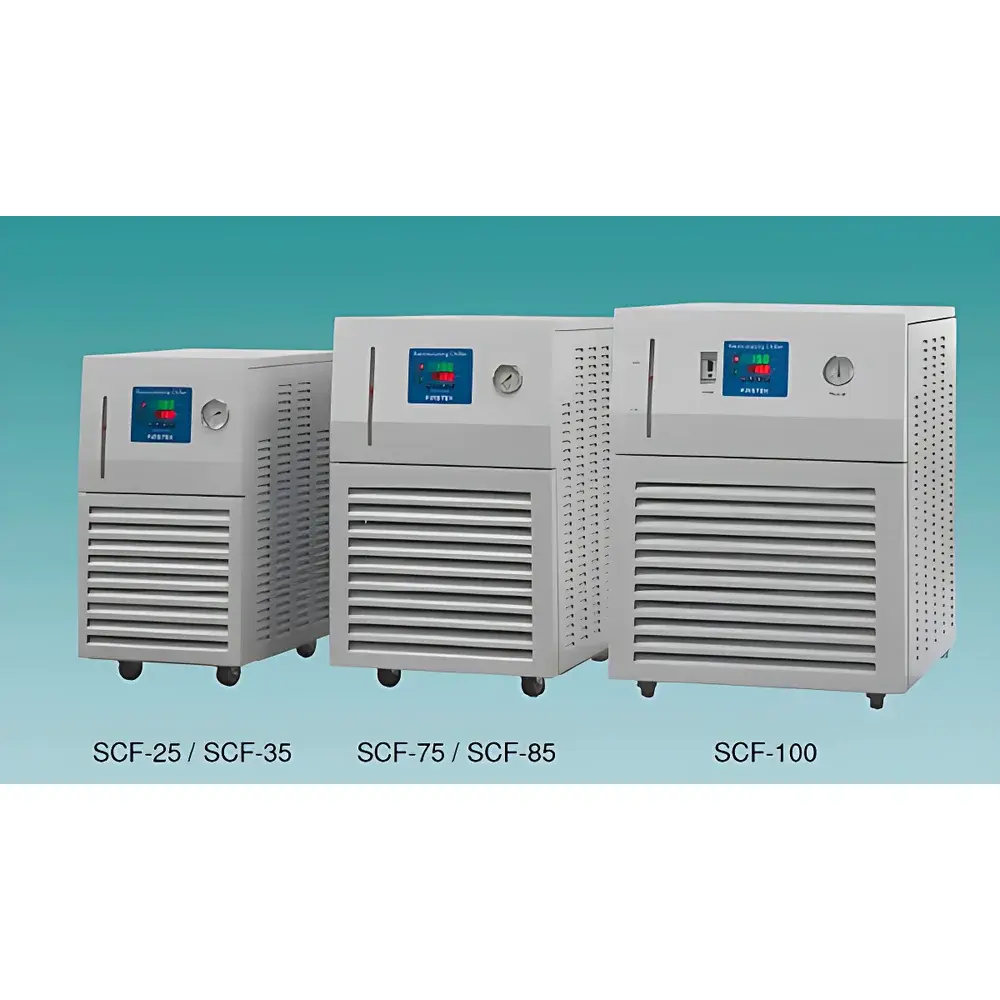
Firstek Scientific SCF Series Low-Temperature Circulating Water Bath
| Brand | SETARAM |
|---|---|
| Origin | Taiwan |
| Manufacturer Type | Authorized Distributor |
| Country of Origin | China (Manufactured in Taiwan) |
| Model | SCF Series |
| Temperature Range | +5 °C to +35 °C |
| Temperature Stability | ±0.1 °C |
| Cooling Capacity (at 20 °C) | 934–5740 W |
| Flow Rate | 14 L/min @ 3.5 kg/cm² (optional: 20 L/min @ 5.5 kg/cm²) |
| Reservoir Volume | 3.8 L |
| Dimensions (Reservoir) | 10 × 20 × 19 cm (W×D×H) |
| Overall Dimensions (SCF-25 to SCF-100) | 33×49×60 cm to 54×62×71 cm |
| Power Supply | 110/220 V, 50/60 Hz, 4–10 A |
Overview
The Firstek Scientific SCF Series Low-Temperature Circulating Water Bath is a precision-engineered closed-loop refrigeration and recirculation system designed to replace municipal tap water cooling in high-sensitivity laboratory instrumentation. Unlike open-bath or gravity-fed systems, the SCF series employs a hermetically sealed refrigeration circuit with PID-controlled temperature regulation, enabling stable thermal management across demanding analytical platforms. Its core function is to maintain consistent coolant temperature and pressure while delivering controlled flow rates—critical for instruments where thermal drift directly impacts signal stability, detector response, or sample integrity. The system operates within a calibrated range of +5 °C to +35 °C with ±0.1 °C temperature stability, making it suitable for both active cooling and precise thermostatic control applications in physical chemistry, materials characterization, and elemental analysis laboratories.
Key Features
- High-reproducibility temperature control via dual-sensor feedback loop and digital PID algorithm, ensuring minimal setpoint deviation under variable load conditions
- Stainless steel reservoir (3.8 L capacity) with corrosion-resistant internal plumbing and leak-proof quick-connect fittings compatible with deionized water and low-conductivity coolants
- Modular pump design supporting standard flow output of 14 L/min at 3.5 kg/cm²; optional high-flow configuration (20 L/min at 5.5 kg/cm²) for multi-instrument daisy-chaining or high-heat-load devices
- Integrated overtemperature, low-flow, and refrigerant pressure monitoring with automatic shutdown and visual/audible alarm signaling
- Front-panel digital display with intuitive menu navigation for temperature setpoint, real-time bath temperature, flow status, and system fault codes
- Compact footprint with vertically optimized chassis design—reservoir dimensions remain constant (10 × 20 × 19 cm) across all models, while main unit size scales incrementally to accommodate higher-capacity compressors and heat exchangers
Sample Compatibility & Compliance
The SCF series is engineered for direct integration with a broad spectrum of laboratory instrumentation requiring regulated coolant supply. It meets mechanical interface requirements for OEM-standard 1/4″–3/8″ NPT or BSPP ports found on laser sources, ICP-OES/ICP-MS plasma torches, TEM/SEM cold stages, NMR cryoprobes, GC/MS transfer lines, ultracentrifuge rotors, and vacuum diffusion pumps. All units comply with IEC 61010-1:2010 safety standards for electrical equipment for measurement, control, and laboratory use. Refrigerant circuits utilize R-404A or R-507 (subject to regional phase-out timelines), conforming to ASHRAE Standard 34 classification. While not certified for medical device use, the system supports GLP-compliant workflows when paired with validated logging protocols and audit-trail-enabled software (see Software & Data Management).
Software & Data Management
Standard operation requires no external software—temperature setpoints and operational parameters are managed locally via the embedded microcontroller interface. For integrated lab environments, optional RS-485 Modbus RTU or Ethernet TCP/IP communication modules enable remote monitoring and control through LabVIEW, MATLAB, or custom SCADA platforms. When used with compliant data acquisition systems, the SCF series supports 21 CFR Part 11–aligned electronic records when combined with time-stamped event logs, user-access controls, and immutable audit trails—facilitating traceability in regulated QA/QC and pharmaceutical development settings. Firmware updates are delivered via secure USB key and include version-locking to prevent unauthorized modification.
Applications
- Thermal stabilization of ICP plasma sources to minimize spectral drift and improve long-term precision in elemental quantification (ASTM D511, ISO 11885)
- Coolant supply for high-power diode-pumped solid-state (DPSS) lasers in spectroscopy and ablation systems
- Condenser temperature control in rotary evaporators and fractional distillation setups requiring sub-ambient condensation efficiency
- Temperature-regulated fluid delivery to differential scanning calorimeters (DSC), thermogravimetric analyzers (TGA), and dynamic mechanical analyzers (DMA)
- Heat extraction from high-voltage power supplies, RF amplifiers, and electron beam sources in surface science instrumentation
- Secondary cooling loop for cryogenic pre-cooling stages in ultra-high vacuum (UHV) systems and synchrotron beamline components
FAQ
What is the maximum allowable coolant conductivity for continuous operation?
Deionized water with resistivity ≥ 1 MΩ·cm is recommended; conductivity should remain below 1 µS/cm to prevent galvanic corrosion and sensor fouling.
Can the SCF series be operated in a nitrogen-purged enclosure?
Yes—the unit’s electronics and refrigeration components are rated for inert atmospheres; however, condensation management on external surfaces must be addressed separately.
Is the reservoir accessible for cleaning without disassembling the main unit?
Yes—a removable top cover provides full access to the stainless steel bath chamber and inlet/outlet manifolds for routine descaling and biocide treatment.
Does the system support external temperature feedback from the connected instrument?
Not natively; however, analog 0–10 V or 4–20 mA input can be enabled via optional I/O expansion module for cascade control configurations.
What maintenance intervals are specified for compressor oil and refrigerant charge?
Under normal lab conditions (8 hrs/day, 5 days/week), the sealed compressor requires no scheduled oil replacement; refrigerant charge verification is recommended every 24 months during preventive maintenance inspection.



