
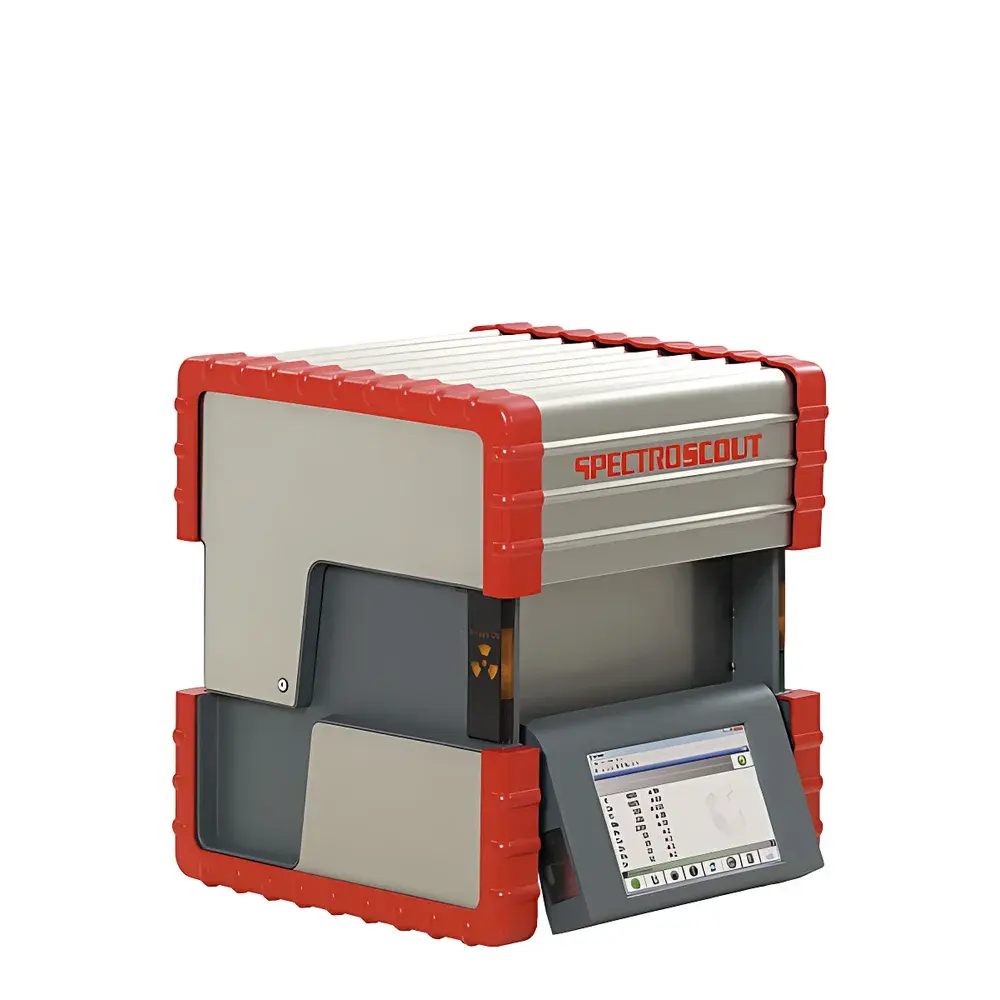
SPECTRO SCOUT Portable Energy Dispersive X-Ray Fluorescence Spectrometer
| Brand | SPECTRO |
|---|---|
| Origin | Germany |
| Model | SPECTRO SCOUT |
| Application | Field-Portable ED-XRF Analysis |
| Element Range | Na (11) to U (92) |
| Detection Range | ppm to 100% |
| Energy Resolution | <140 eV |
| Detector | Silicon Drift Detector (SDD) |
| Weight | 12 kg |
| Dimensions | 270 × 306 × 306 mm |
| Integrated Touchscreen PC | Yes |
| Battery-Operated | Yes |
| Optional Integrated Imaging System | Yes |
Overview
The SPECTRO SCOUT Portable Energy Dispersive X-Ray Fluorescence (ED-XRF) Spectrometer is an engineered field-deployable analytical instrument designed to deliver laboratory-grade elemental quantification in situ. Based on the fundamental principle of energy-dispersive X-ray fluorescence, the system irradiates a sample with high-energy X-rays from a microfocus X-ray tube, inducing characteristic secondary (fluorescent) X-ray emission from constituent elements. These emitted photons are resolved by a high-performance silicon drift detector (SDD), enabling simultaneous multi-element detection across the full range from sodium (Na, Z=11) to uranium (U, Z=92). Unlike handheld analyzers constrained by low-power excitation and limited geometry control, the SPECTRO SCOUT integrates a stabilized X-ray source, large-sample chamber (up to 100 mm diameter), and thermoelectrically cooled SDD — all within a ruggedized, transportable enclosure. Its architecture supports quantitative analysis at trace (ppm-level) through bulk (100%) concentrations without requiring vacuum or helium purge for light-element measurement, making it suitable for unprepared solids, soils, alloys, ores, filters, and liquid residues in environmental, geological, recycling, and precious metals applications.
Key Features
- Rugged, field-optimized mechanical design: IP54-rated enclosure with shock-absorbing housing, integrated handle, and single-strap carry configuration (12 kg total mass)
- Integrated computing platform: Onboard Windows-based touchscreen PC with real-time spectrum visualization, data storage, and embedded method libraries
- High-resolution detection: <140 eV Mn Kα energy resolution at 0°C, enabling clear peak separation for overlapping transitions (e.g., Pb L-lines vs. As K-lines)
- Flexible excitation: Adjustable X-ray tube voltage (up to 50 kV) and current (up to 1 mA) for optimized sensitivity across light and heavy elements
- Smart calibration workflow: iCAL (intelligent Calibration) technology enables full instrument standardization using only one reference sample in under 5 minutes
- Advanced quantification engine: TURBOQUANT software provides matrix-independent semi-quantitative analysis for unknown samples, with optional user-defined calibrations traceable to NIST SRMs
- Optional imaging module: Integrated CMOS camera with LED illumination and geotagged image capture for precise spatial correlation of measurement location and sample morphology
Sample Compatibility & Compliance
The SPECTRO SCOUT accommodates heterogeneous solid samples up to 40 mm in height and 100 mm in diameter, including irregular rocks, drill cores, slag fragments, scrap metal pieces, soil cores, and filter media. Liquid samples may be analyzed in disposable XRF cups with polymer films. No sample preparation—beyond homogenization or pelletizing for powders—is required for routine screening. The system complies with IEC 61000-6-3 (EMC emissions), IEC 61000-6-2 (immunity), and EN 61000-6-4 for industrial environments. Radiation safety conforms to DIN 54113 and meets EU Directive 2013/59/Euratom requirements for portable X-ray equipment; operational dose rates at 5 cm from the instrument surface remain below 1 µSv/h during measurement. Data integrity protocols support audit-ready workflows aligned with GLP and ISO/IEC 17025 documentation requirements.
Software & Data Management
SPECTRO SCOUT operates with SPECTRO’s proprietary SCOUT Software Suite, built on a modular architecture supporting both standalone operation and networked deployment. All spectra, quantitative reports, metadata (operator ID, GPS coordinates, timestamp, ambient temperature), and calibration logs are stored in encrypted SQLite databases compliant with FDA 21 CFR Part 11 principles (electronic signatures, audit trails, role-based access control). Export formats include CSV, PDF, XML, and ASTM E135-compliant spectral data files. Remote diagnostics, firmware updates, and method synchronization are supported via secure HTTPS connection. Optional SPECTRO LabLink integration enables direct transfer of results into LIMS platforms using ASTM WK56822-compliant web services.
Applications
- Geological exploration: Rapid in-field assay of exploration samples for pathfinder elements (e.g., Cu, Zn, Pb, As, Au), reducing reliance on off-site lab turnaround
- Environmental monitoring: Screening of contaminated soils, sediments, and dredged materials for regulated metals (Cd, Cr, Hg, Ni, Pb, Se) per EPA Method 6200 and ISO 13196
- Precious metals verification: Quantitative analysis of Au, Ag, Pt, Pd in jewelry, catalytic converters, and electronic scrap with certified uncertainty <5% RSD at 100 ppm
- Recycling & scrap sorting: Real-time grade identification of aluminum, stainless steel, copper alloys, and rare-earth-containing magnets
- Industrial hygiene: Analysis of airborne particulate matter collected on NIOSH-certified filters for occupational exposure assessment
- Regulatory compliance: Support for RoHS, WEEE, ELV, and China RoHS screening in manufacturing QA/QC environments
FAQ
Does the SPECTRO SCOUT require external power or can it operate solely on battery?
Yes — the instrument includes a rechargeable Li-ion battery pack rated for ≥6 hours of continuous analysis at typical operating conditions (30 kV / 0.5 mA), with hot-swap capability for extended field deployments.
Is vacuum or helium purge necessary for light-element analysis (e.g., Mg, Al, Si)?
No — the optimized X-ray tube output, high-transmission beryllium window, and low-noise SDD enable reliable detection of elements down to Na (Z=11) in air, eliminating gas-purge infrastructure.
Can calibration models developed on benchtop SPECTRO instruments be transferred to the SCOUT?
Yes — via the SPECTRO Calibration Transfer Utility, validated calibrations from SPECTRO MIDEX, TXRF, or LAB systems can be adapted and verified on SCOUT using certified reference materials.
What regulatory standards does the SCOUT support for reporting?
It supports method-specific reporting templates aligned with EPA 6200, ISO 12885, ASTM E1621, and EN 15309, with configurable uncertainty estimation per ISO/IEC 17025 Annex A.3.
How is measurement reproducibility ensured across different operators and sites?
Through hardware-based beam stabilization, automated internal reference checks before each measurement, and iCAL-driven daily performance verification — all logged with full traceability in the audit trail.




