
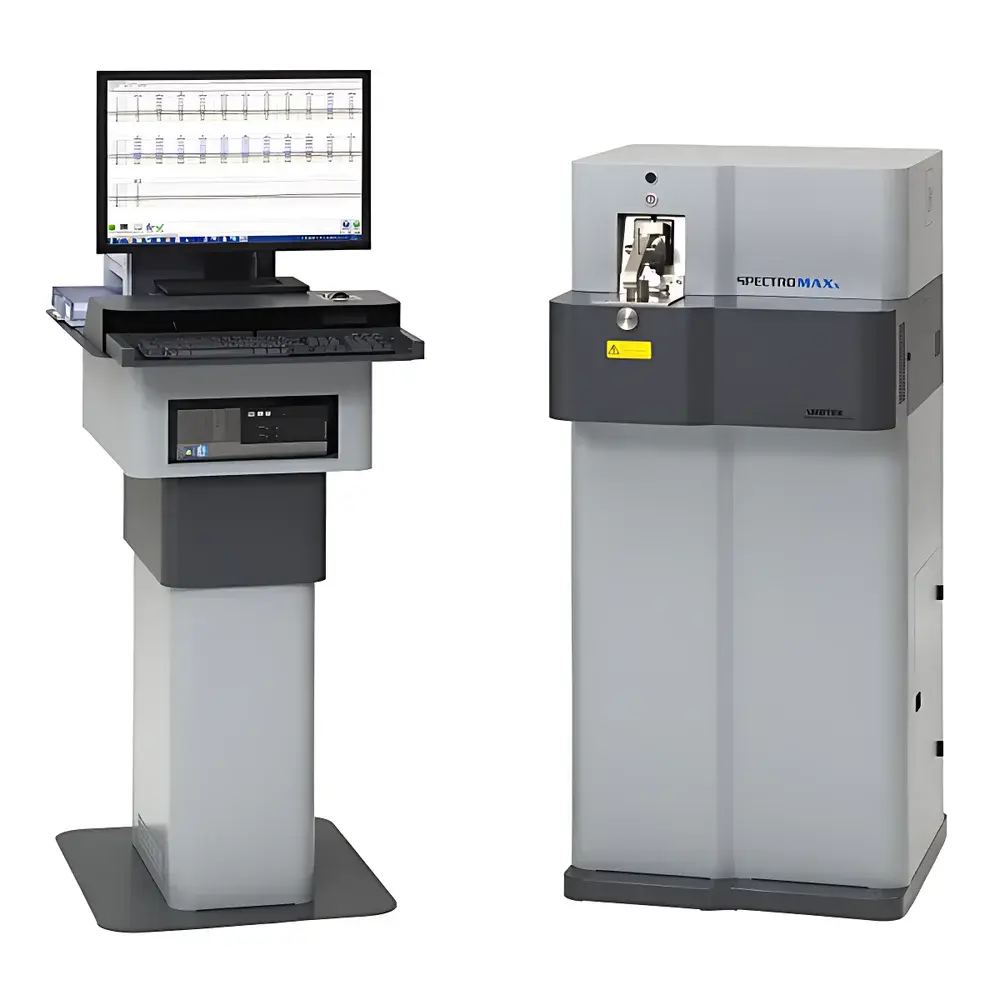
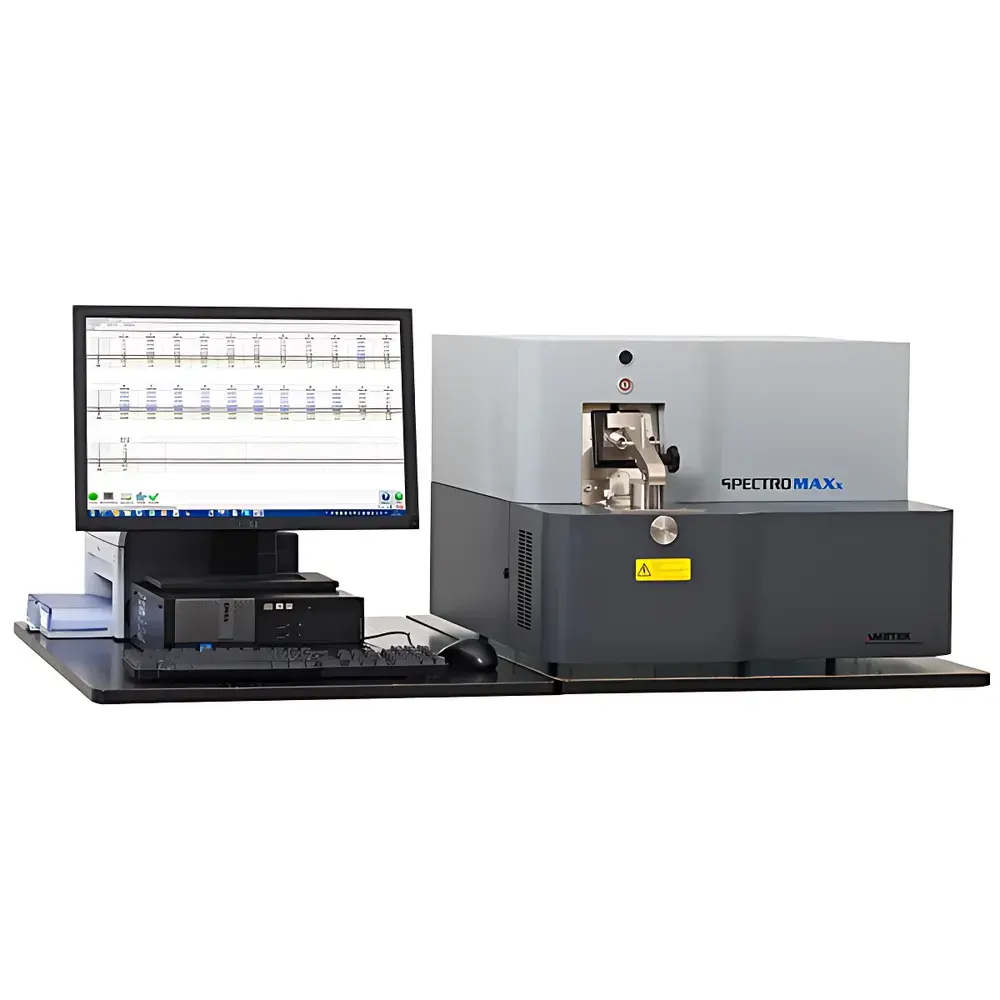
SPECTRO MAXx Direct Reading Optical Emission Spectrometer
| Brand | SPECTRO |
|---|---|
| Origin | Germany |
| Model | MAXx |
| Instrument Type | Floor-standing |
| Excitation Method | Spark |
| Detector Type | CCD (Charge-Coupled Device) |
| Focal Length | 400 mm |
| Grating Line Density | 3600 lines/mm |
| Wavelength Range | Customizable (140–670 nm) |
| Number of Channels | User-configurable |
| Optical Architecture | Optimized Paschen-Runge Mount |
| Environmental Control | Thermostatically Stabilized & Pressure-Compensated Enclosure |
| Argon Consumption | Reduced by up to 50% vs. conventional systems |
| Calibration Protocol | ICAL Intelligent Calibration (single-standard, multi-matrix) |
Overview
The SPECTRO MAXx is a high-performance floor-standing direct reading optical emission spectrometer (OES) engineered for precise, rapid elemental analysis of metallic alloys in foundry, metallurgical, and quality control laboratories. It operates on the principle of spark-induced plasma emission spectroscopy: a high-energy spark excites atoms in a solid metal sample, causing them to emit characteristic wavelengths of ultraviolet and visible light. These emissions are dispersed via a high-resolution Paschen-Runge optical system and detected with a thermoelectrically cooled CCD array, enabling simultaneous acquisition across the full spectral range from 140 nm to 670 nm. Designed and manufactured in Germany, the instrument integrates metrological rigor with operational efficiency—featuring a sealed, pressure- and temperature-stabilized optical chamber, robust mechanical architecture, and intelligent calibration logic that eliminates dependency on extensive standardization libraries.
Key Features
- Intelligent Calibration (ICAL): Replaces traditional two-point matrix calibration with a single-reference standard, reducing total calibration time per matrix from ~50 minutes to under 5 minutes while maintaining traceable accuracy across all major alloy systems (Fe, Al, Cu, Ni, Ti, Mg, Zn).
- Optimized Paschen-Runge Optical System: 400 mm focal length with 3600 lines/mm holographic grating delivers high spectral resolution and signal-to-noise ratio; dual optical paths extend effective wavelength coverage without mechanical reconfiguration.
- Spark Stand Engineering: Open-access design accommodates irregular, oversized, or non-planar samples (e.g., castings, billets, forgings); motorized XYZ sample stage with grounded safety circuitry ensures repeatable positioning and operator protection.
- Argon Efficiency Architecture: Internal volume reduction combined with laminar-flow gas dynamics cuts argon consumption by ≥50%; “Zero-Flow Standby” mode fully shuts off argon during idle periods and initiates automated purge prior to analysis initiation.
- Maintenance-Optimized Design: Tool-free access to optical windows enables rapid lens cleaning or replacement; low particulate deposition in the spark chamber extends cleaning intervals and reduces downtime.
- Digital Plasma Generator: Fully programmable spark source with microsecond-level pulse control ensures stable excitation across diverse matrix types and surface conditions.
Sample Compatibility & Compliance
The SPECTRO MAXx supports standardized and non-standard metallic specimens—including rods, wires, thin sheets (<1 mm), and irregular castings—via interchangeable fixtures and matrix-specific calibration curves. Sample preparation follows ISO 11577, ASTM E415, and EN 10315 guidelines. The instrument complies with IEC 61000-6-3 (EMC), IEC 61010-1 (safety), and meets requirements for GLP/GMP environments through audit-ready software logging, electronic signature support (21 CFR Part 11 compliant configuration available), and full traceability of calibration events, measurement parameters, and maintenance records.
Software & Data Management
Controlled by SPECTRO’s proprietary Spark Analyzer Vision software, the system provides real-time spectral visualization, automated peak identification, multivariate interference correction, and statistical process control (SPC) integration. All raw spectral data are stored in vendor-neutral formats (e.g., HDF5) alongside metadata (operator ID, timestamp, instrument state, gas flow logs). Software supports LIMS connectivity via ASTM E1384-compliant interfaces and offers configurable reporting templates aligned with ISO/IEC 17025 documentation requirements.
Applications
The SPECTRO MAXx is routinely deployed for incoming material verification, melt-process monitoring, final product certification, and failure analysis in steelmaking, aluminum recycling, aerospace component manufacturing, and automotive casting facilities. Its ability to quantify major, minor, and trace elements—including C, P, S, N, B, Sn, Pb, and rare earths—in Fe-, Al-, Cu-, Ni-, and Ti-based matrices makes it suitable for compliance testing against ASTM A751, ISO 4949, EN 10027, and JIS G 0551 specifications.
FAQ
What standards does the SPECTRO MAXx support for calibration verification?
It supports certified reference materials (CRMs) traceable to NIST, BAM, or IRMM, and is validated per ISO/IEC 17025 clause 5.9 for method verification.
Can the instrument analyze coated or plated samples?
Yes—with appropriate spark stand accessories and dedicated calibration curves, provided coating thickness remains within detection depth limits (~5–10 µm for typical spark erosion rates).
Is remote diagnostics supported?
Yes—via secure TLS-encrypted connection, enabling authorized service engineers to perform health checks, firmware updates, and spectral alignment verification without onsite visits.
How often is optical recalibration required?
Under normal operating conditions and stable environmental control, wavelength calibration drift is <0.002 nm/month; routine verification is recommended quarterly using internal Ne/Ar lamp references.
Does the system support custom spectral line selection?
Yes—users may define analytical lines, background positions, and interference corrections per element/matrix combination within the software’s method editor.






