
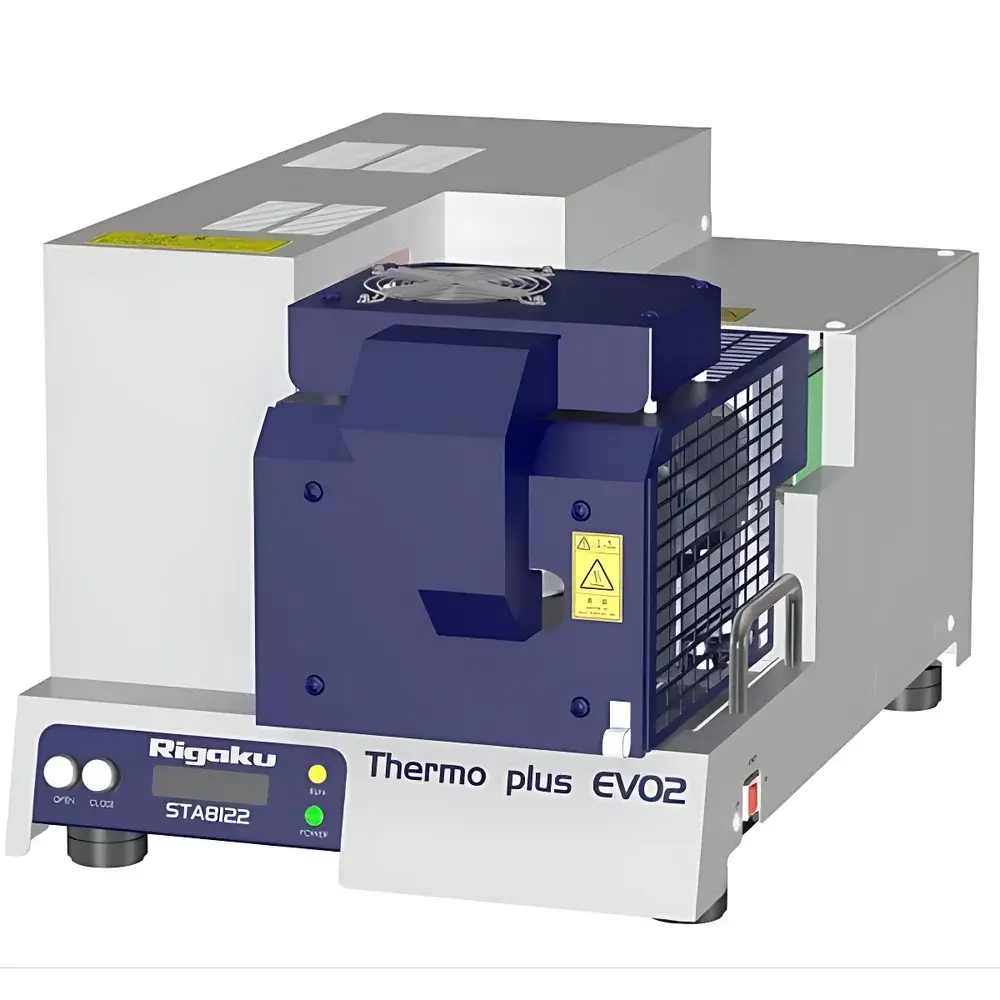
Rigaku DSC8231 Simultaneous Thermal Analyzer
| Key | Brand: Rigaku |
|---|---|
| Origin | Japan |
| Model | DSC8231 |
| Temperature Range (Standard) | RT to 1100 °C |
| Temperature Range (High-Temp Option) | RT to 1500 °C |
| Sample Observation Range | Ambient to 1000 °C |
| Furnace Configuration | Horizontal dual-compartment |
| Balance Type | Horizontal differential triple-coil balance |
| Control Modes | Stepwise Isothermal Analysis (SIA), Constant Rate Control (CRC), Sample-Controlled TG (SCTG) |
| Dimensions (Core Unit) | 350 × 310 × 669 mm (W × H × D) |
| Weight (Core Unit) | 28 kg |
| Power Supply | 1Ø, AC 100–120 V / 200–240 V, 50/60 Hz, 15 A |
Overview
The Rigaku DSC8231 Simultaneous Thermal Analyzer is an advanced horizontal-configured thermogravimetric-differential thermal analysis (TG-DTA) system engineered for high-precision, real-time concurrent measurement of mass change and thermal effects during controlled heating or cooling. Based on the principle of horizontal differential triple-coil electromagnetic compensation, the instrument achieves exceptional baseline stability and minimizes drift induced by mechanical vibration, convection currents, or furnace thermal gradients. This architecture enables reproducible detection of minute mass changes (<0.1 µg resolution typical) and accurate identification of endothermic/exothermic transitions—including glass transitions, melting, crystallization, dehydration, decomposition, oxidation, and solid-state reactions—across a broad temperature span. The DSC8231 supports conversion of DTA signals to differential scanning calorimetry (DSC) output via calibration with certified reference metals (e.g., In, Sn, Zn), fulfilling ASTM E794, ISO 11357, and USP requirements for quantitative enthalpy determination.
Key Features
- Horizontal differential triple-coil balance system: Eliminates buoyancy-induced drift and ensures long-term weight stability under dynamic thermal conditions.
- Compact dual-zone furnace design: Enables rapid heating rates up to 100 °C/min and efficient cooling between runs, reducing cycle time without compromising thermal homogeneity.
- Sample-Controlled Thermogravimetry (SCTG): Standard implementation of two adaptive thermal control modes—Constant Rate Control (CRC) for maintaining fixed mass-loss velocity, and Stepwise Isothermal Analysis (SIA) for holding temperature at defined mass-change thresholds.
- Integrated sample observation unit (optional): Equipped with a high-resolution CCD camera and coaxial illumination, permitting real-time visual monitoring of morphological evolution, discoloration, bloating, cracking, or sintering during thermal events—correlating physical behavior directly with TG/DTA curves.
- Modular expandability: Compatible with optional intelligent auto-sampler (Rigaku SmartLoader™), gas switching modules (N2, O2, Ar, synthetic air), and humidity-controlled environments for advanced reaction atmosphere studies.
Sample Compatibility & Compliance
The DSC8231 accommodates standard platinum, alumina, and quartz crucibles (up to 100 µL capacity), supporting solids, powders, fibers, thin films, and small-volume liquids. It complies with GLP/GMP data integrity requirements through audit-trail-enabled software (ThermoAnalysis Suite v5.x), including electronic signatures, user-access levels, and 21 CFR Part 11–compliant data archiving. All calibration procedures adhere to ISO/IEC 17025 traceability standards using NIST-traceable reference materials. Routine verification follows ASTM E1131 (TG) and ASTM E1269 (heat capacity) protocols.
Software & Data Management
Control and analysis are performed via Rigaku’s ThermoAnalysis Suite—a Windows-based platform offering synchronized acquisition of TG, DTA/DSC, derivative (DTG), and video streams. The software provides automated peak deconvolution, kinetic modeling (e.g., Kissinger, Ozawa-Flynn-Wall), multi-step reaction fitting, and customizable report generation compliant with ISO 14001 and ICH Q5C guidelines. Raw data are stored in vendor-neutral ASCII format; metadata (instrument settings, calibration logs, operator ID, timestamps) are embedded per ICH M7 and FDA data retention mandates.
Applications
- Pharmaceutical solid-state characterization: Polymorph screening, hydrate/solvate stability, excipient compatibility, and degradation pathway elucidation.
- Materials science: Ceramic sintering kinetics, polymer thermal stability, carbon black oxidation, battery cathode/anode decomposition, and metal oxide reduction mechanisms.
- Geological and environmental analysis: Clay mineral dehydration, carbonate decomposition, fly ash reactivity, and soil organic matter thermal fractions.
- Quality control labs: Batch-to-batch consistency assessment per USP , EP 2.2.34, and JP 17 thermal analysis monographs.
FAQ
Can the DSC8231 be upgraded from standard (1100 °C) to high-temperature (1500 °C) operation post-purchase?
Yes—furnace assembly, sensor package, and crucible holder can be field-retrofitted with manufacturer-supplied high-temp kits, subject to electrical and cooling infrastructure verification.
Is the sample observation module compatible with inert or reactive atmospheres?
Yes—the optical viewport is sealed and rated for use under N2, Ar, O2, CO, or forming gas up to 1000 °C; purge gas flow is independently regulated via mass flow controllers.
Does the system support automatic baseline correction during extended isothermal holds?
Yes—software-driven dynamic baseline compensation adjusts for long-term drift using pre- and post-run reference segments, ensuring quantitative accuracy over 100+ hour experiments.
What level of cybersecurity compliance does the ThermoAnalysis Suite meet?
The software conforms to IEC 62443-3-3 SL2 requirements for industrial control systems, including encrypted local database storage, TLS 1.2 communication for remote diagnostics, and role-based access controls aligned with NIST SP 800-53 Rev. 5.



