
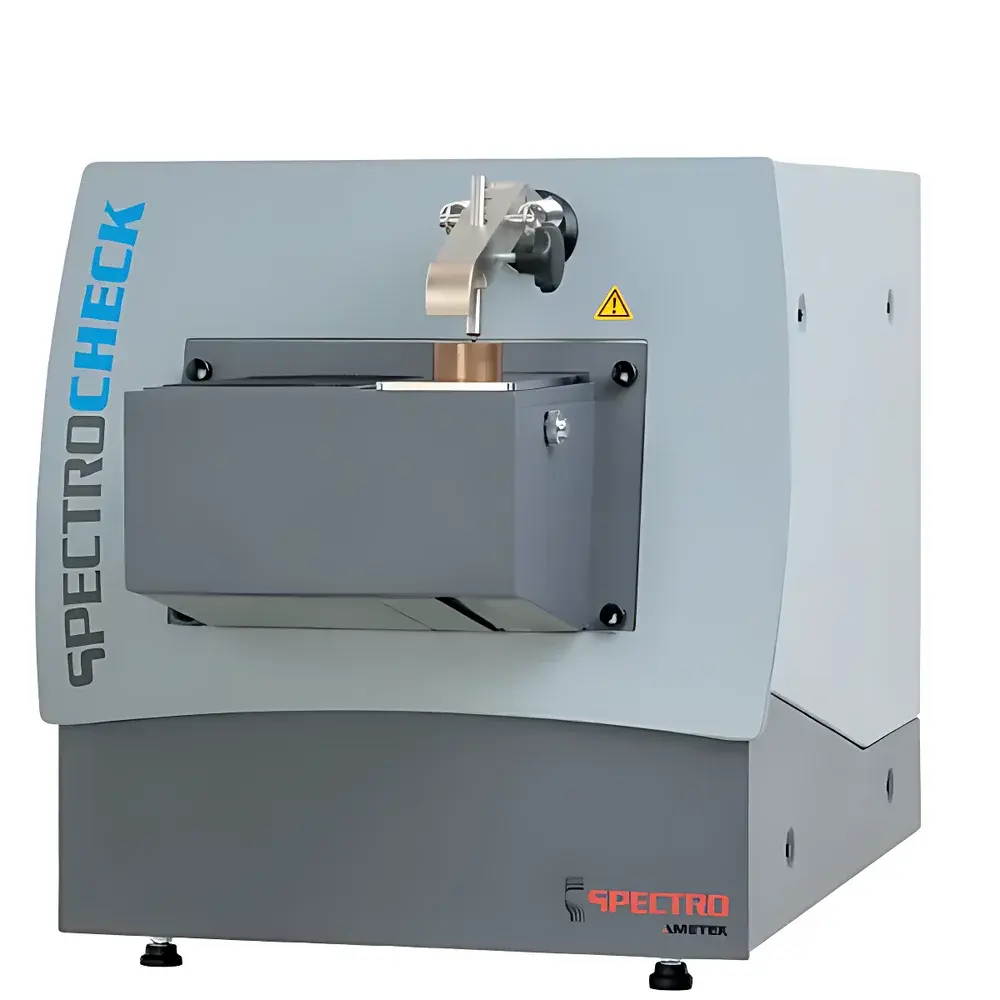
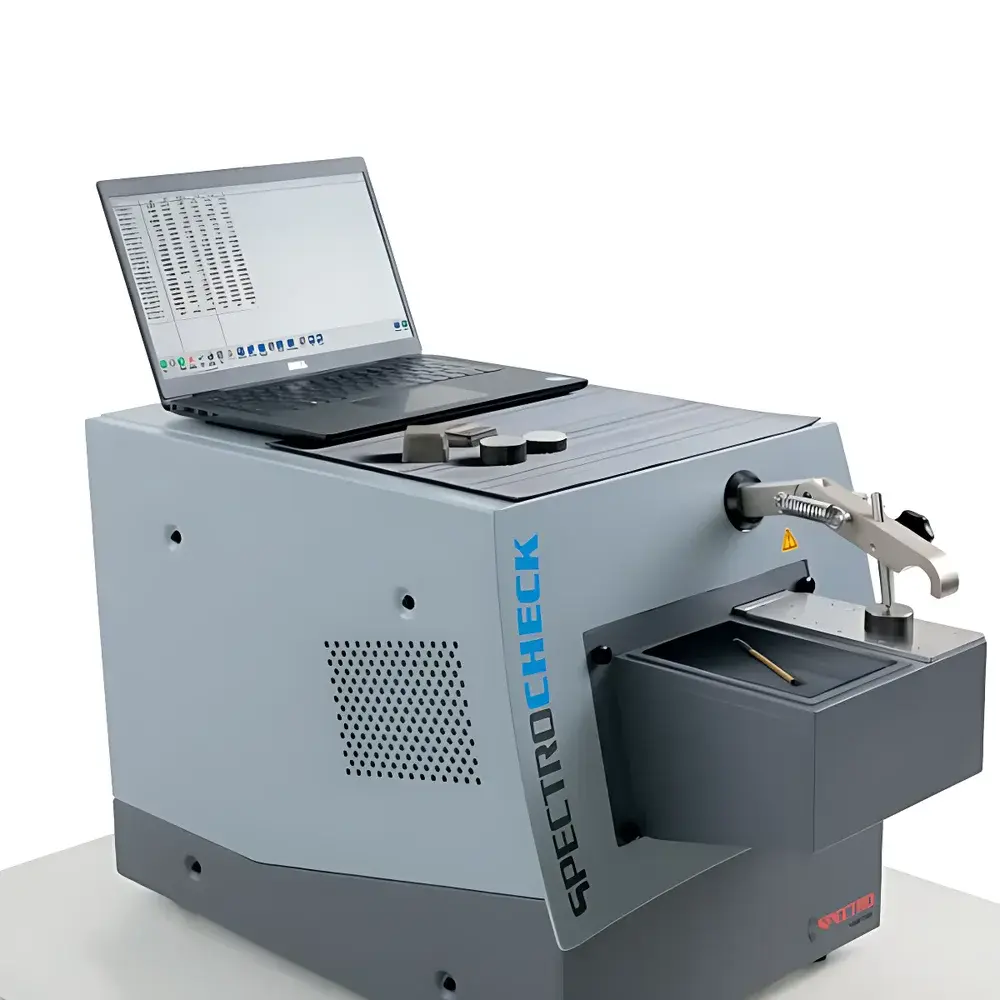
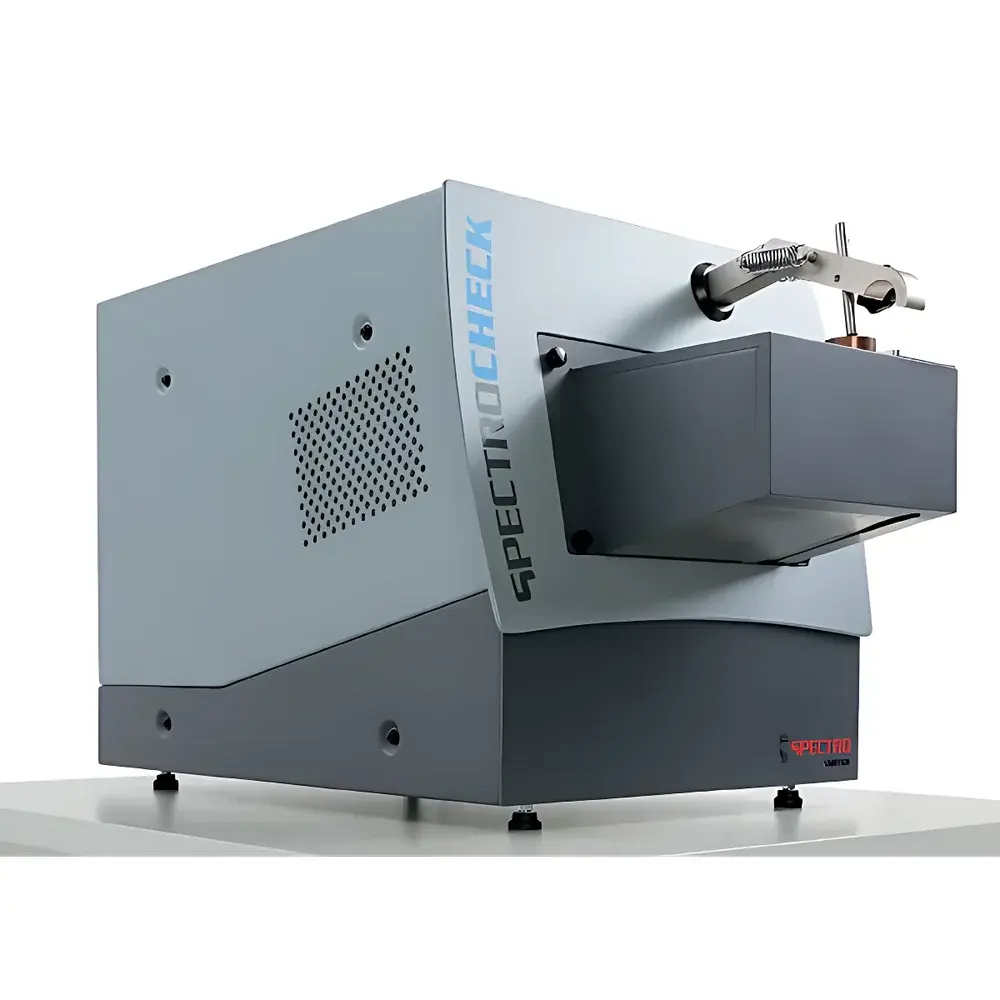
SPECTRO CHECK Direct-Reading Optical Emission Spectrometer (OES)
| Brand | SPECTRO |
|---|---|
| Origin | Germany |
| Model | SPECTRO CHECK |
| Instrument Type | Benchtop |
| Excitation Source | Spark |
| Detector Configuration | Dual Detector (PMT + CCD) |
| Focal Length | 1000 mm |
| Grating Groove Density | 3600 lines/mm |
| Wavelength Range | 120–589 nm |
| Spectral Coverage | Full-Spectrum Acquisition |
| Compliance | Designed and manufactured in Germany per ISO 9001-certified production processes |
Overview
The SPECTRO CHECK is a benchtop direct-reading optical emission spectrometer (OES) engineered for precision elemental analysis of metallic alloys—primarily ferrous, aluminum, and copper-based materials—in foundry, metal fabrication, and quality control laboratories. It operates on the principle of spark-induced atomic emission spectroscopy: a high-energy spark excites atoms at the sample surface, causing them to emit characteristic wavelengths of ultraviolet and visible light. These emissions are dispersed by a high-resolution Czerny-Turner monochromator with a 1000 mm focal length and 3600 lines/mm grating, then simultaneously detected across the full spectral range (120–589 nm) using a hybrid dual-detector architecture—photomultiplier tubes (PMTs) for high-sensitivity quantitative lines and a charge-coupled device (CCD) for broad spectral coverage and interference diagnostics. The optical chamber is thermally stabilized and continuously purged with argon to maintain UV transmission stability—critical for accurate detection of key elements such as C, P, S, and N below 200 nm.
Key Features
- German-engineered benchtop OES platform, fully designed and manufactured in Kleve, Germany under ISO 9001 quality management systems
- Dual-detection system combining PMT and CCD technologies for optimal signal-to-noise ratio, dynamic range, and spectral fidelity
- Patented SWIFT (Selected Wavelength Imaging Feedback Technology) optical design enabling real-time wavelength alignment correction and long-term calibration stability
- Thermally isolated optical bench with active temperature control (±0.1 °C), minimizing thermal drift and ensuring reproducible results over extended operation cycles
- Integrated argon flush system maintaining <1 ppm oxygen content in the optical path—essential for stable UV performance and low detection limits
- Modular hardware architecture: plug-in excitation modules, customizable spark stand configurations, and field-upgradable detector assemblies
- ICAL (Intelligent Calibration Logic) system enabling rapid, single-standard recalibration—reducing maintenance downtime and eliminating multi-point standardization routines
Sample Compatibility & Compliance
The SPECTRO CHECK is optimized for solid conductive metallic samples conforming to ASTM E415, ISO 11577, and EN 10315 standards. It supports standardized disk, rod, and billet geometries (Ø10–40 mm, thickness ≥4 mm) with minimal surface preparation requirements. Sample introduction is via a robust, ergonomically designed spark stand featuring automatic electrode alignment, pressure-controlled argon sealing, and integrated safety interlocks compliant with IEC 61010-1. All firmware and software comply with EU Machinery Directive 2006/42/EC and electromagnetic compatibility (EMC) directive 2014/30/EU. Data integrity features—including audit trails, user access levels, electronic signatures, and export logs—support adherence to GLP, GMP, and FDA 21 CFR Part 11 requirements when configured with optional compliance software packages.
Software & Data Management
SPECTRO’s proprietary analytical software provides an icon-driven, menu-free interface built around workflow-centric operation. Primary functions—including measurement initiation, grade identification, pass/fail evaluation, and report generation—are accessible via dedicated toolbar buttons without hierarchical navigation. Spectral visualization tools allow real-time overlay of reference and sample spectra, peak identification, and interference assessment. Quantitative analysis employs matrix-matched calibrations traceable to NIST SRM reference materials, with optional multivariate regression (PLS) for complex alloy systems. Data export supports CSV, XML, and PDF formats; instrument logs include full metadata (operator ID, timestamp, environmental conditions, spark parameters). Remote diagnostics, firmware updates, and method synchronization are supported via secure HTTPS-based cloud connectivity (optional).
Applications
- Routine QC/QA in iron, steel, and stainless-steel foundries for C, Si, Mn, P, S, Cr, Ni, Mo, Cu, and trace elements
- Alloy verification and scrap sorting in aluminum die-casting and extrusion facilities (e.g., Al-Si, Al-Mg, Al-Cu series)
- Grade identification and composition certification for copper-brass, bronze, and nickel-based superalloys
- Incoming material inspection in automotive and aerospace Tier-1 suppliers requiring AS9100 or IATF 16949-aligned reporting
- Research and development labs performing comparative metallurgical studies with multi-element correlation analysis
FAQ
Is the SPECTRO CHECK suitable for regulatory-compliant reporting in certified laboratories?
Yes—when equipped with the optional Compliance Pack, it meets data integrity requirements of ISO/IEC 17025, FDA 21 CFR Part 11, and EU Annex 11 through full audit trail logging, role-based access control, and electronic signature support.
What maintenance intervals are recommended for routine operation?
Optical chamber purge gas filters require replacement every 6 months; spark electrodes are consumables with typical lifespans of 5,000–10,000 sparks depending on matrix. ICAL-based recalibration is performed quarterly or after major environmental shifts—no lamp or grating alignment needed.
Can the instrument analyze non-conductive or coated samples?
No—it requires electrically conductive, flat, and clean metallic surfaces. Coated or painted samples must be mechanically abraded prior to analysis; non-metals (e.g., ceramics, polymers) fall outside its operational scope.
How does the dual-detector architecture improve analytical performance?
The PMT delivers sub-ppm detection limits for critical elements (e.g., C in low-alloy steels), while the CCD captures the entire spectrum for interference monitoring, background correction, and future method expansion without hardware modification.
Is remote support and software update capability included?
Standard firmware and software updates are available via SPECTRO’s secure customer portal. Remote diagnostic sessions require prior authorization and are conducted under encrypted VNC protocols—no unsolicited access is permitted.





