
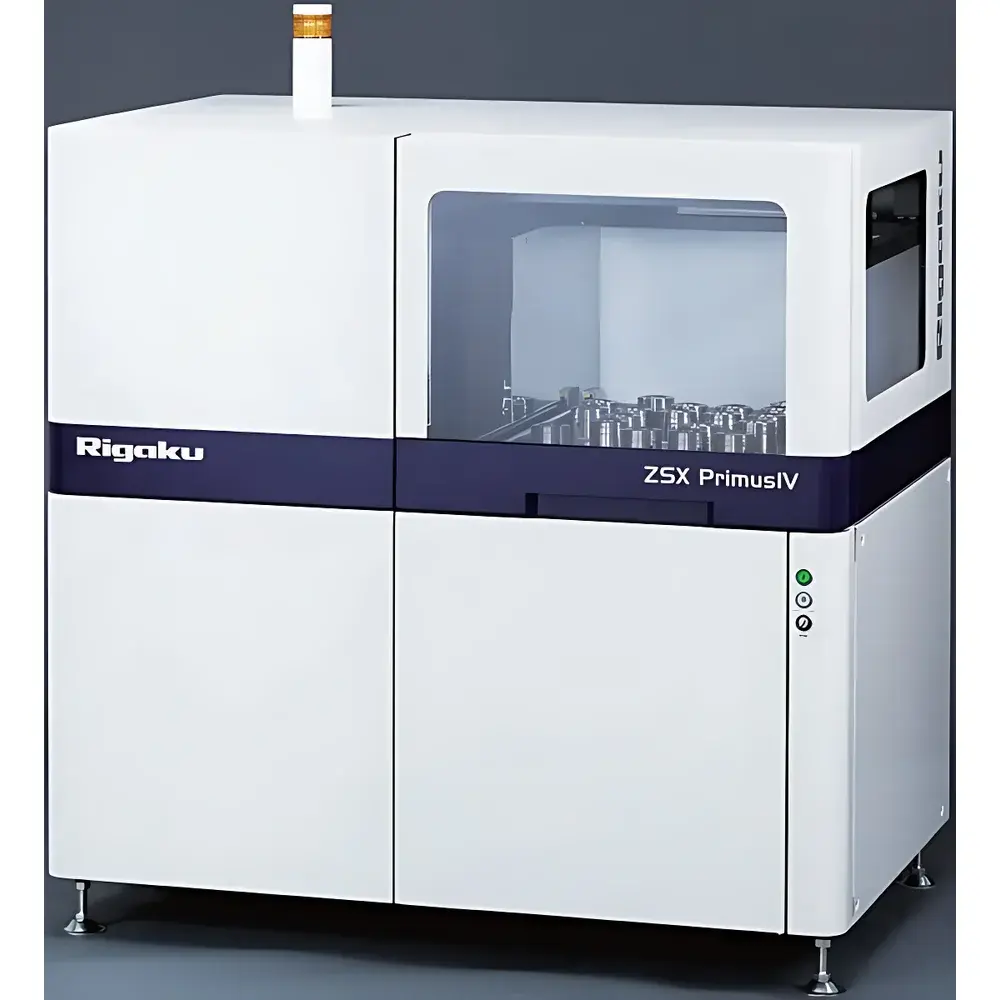
Rigaku ZSX Primus IV Wavelength Dispersive X-Ray Fluorescence Spectrometer
| Brand | Rigaku |
|---|---|
| Origin | Japan |
| Model | ZSX Primus IV |
| Instrument Type | Floor-standing |
| X-ray Tube Power | 4 kW |
| Elemental Range | Be to U |
| Scan Speed | 2400°/min |
| Detector Linear Range | SC 1800 kcps, FPC 3000 kcps |
| Beryllium Window Thickness | 30 µm |
| Goniometer Angular Reproducibility | ±0.0001° |
Overview
The Rigaku ZSX Primus IV is a high-performance, floor-standing wavelength dispersive X-ray fluorescence (WDXRF) spectrometer engineered for precision elemental quantification across the full periodic range—from beryllium (Be, Z=4) to uranium (U, Z=92). Utilizing Bragg diffraction from analyzing crystals to resolve characteristic X-ray lines with exceptional spectral resolution, the ZSX Primus IV delivers metrologically traceable results for major, minor, and trace constituents in solid, powdered, and fused-bead samples. Its inverted optical architecture—where the X-ray tube, sample stage, and analyzer crystals are arranged above the detector—eliminates beam path contamination risks inherent in conventional horizontal configurations. This design ensures long-term stability of intensity calibration, reduces maintenance downtime, and extends operational lifetime of critical optics. The system integrates a 4 kW high-power X-ray tube with a proprietary 30 µm ultra-thin beryllium exit window, enabling superior excitation efficiency and detection limits for light elements (e.g., C, N, O, F, Na, Mg, Al, Si), where conventional WDXRF systems often exhibit compromised sensitivity.
Key Features
- Inverted optical geometry minimizes contamination of collimators, crystals, and detectors—no routine cleaning required; vacuum integrity maintained via helium-sealed optical chamber
- High-precision goniometer with angular reproducibility of ±0.0001° ensures long-term peak position stability and inter-laboratory method transferability
- Digital Multi-Channel Analyzer (D-MCA) provides real-time pulse processing, dead-time correction, and background modeling for enhanced counting statistics
- 2400°/min rapid scanning capability enables high-throughput sequential analysis without sacrificing resolution or accuracy
- 30 µm Be window X-ray tube delivers optimized low-Z element excitation and sub-ppm detection limits for Na–F in optimized configurations
- Integrated mapping module supports high-resolution elemental distribution analysis (XRF imaging) with spatial resolution down to 500 µm
Sample Compatibility & Compliance
The ZSX Primus IV accommodates a broad range of sample forms—including pressed pellets, fused borate glasses, metals, alloys, ceramics, geological matrices, polymers, and thin films—without requiring vacuum evacuation for most analyses (He purge optional for light elements). Sample handling is fully compatible with ISO 22036, ASTM E1621, and ASTM E2700 standards for WDXRF methodology validation. The instrument’s hardware and software architecture support GLP/GMP environments: audit trails, user access control, electronic signatures, and 21 CFR Part 11-compliant data archiving are enabled through optional Rigaku DataCenter software modules. All calibration protocols and measurement sequences are documented per ISO/IEC 17025 requirements for accredited testing laboratories.
Software & Data Management
ZSX Guidance Expert System software serves as the central analytical interface—embedding decades of XRF physics knowledge into automated method setup. Operators input only sample type, target elements, and expected concentration ranges; the software autonomously selects optimal crystals, detectors (SC or FPC), collimators, voltage/current settings, and background positions. It automatically resolves line overlaps (e.g., Ti Kβ / V Kα), applies matrix corrections (absorption, enhancement), and generates validated calibration curves. EZ-Scan mode enables rapid qualitative/semi-quantitative screening of unknowns using fundamental parameter (FP) algorithms—SQX software performs full FP quantification including secondary fluorescence, variable atmosphere effects (air/He/vacuum), particle size corrections, and heterogeneous sample modeling. All spectra, methods, and reports are stored in a relational database with version-controlled metadata and export compliance to ASTM E1348 and ISO 12099 formats.
Applications
The ZSX Primus IV is deployed in R&D, quality control, and regulatory compliance laboratories across metallurgy, cement, mining, environmental monitoring, catalyst development, and semiconductor materials characterization. It routinely performs certified reference material (CRM) validation, RoHS/ELV screening (Pb, Cd, Hg, Cr⁶⁺, Br), geochemical profiling (major oxides + REEs), alloy grade identification (stainless steels, superalloys), and thin-film thickness/composition analysis. Its mapping functionality supports failure analysis (e.g., corrosion layer stratification, inclusion chemistry), homogeneity assessment in pharmaceutical excipients, and micro-domain composition studies in battery cathode materials.
FAQ
Does the ZSX Primus IV require liquid nitrogen cooling for detectors?
No—the SC (scintillation) and FPC (flow-proportional counter) detectors operate at ambient temperature with Peltier-based stabilization.
Can it analyze liquids or powders directly?
Yes; powders are analyzed as pressed pellets or fused beads; liquids require specialized cells with ultrathin polymer windows and He purging for light-element detection.
Is remote operation supported?
Yes—via secure RDP or VNC connections; full instrument control, method editing, and report generation are accessible over LAN/WAN.
What maintenance intervals are recommended?
X-ray tube replacement every ~2 years under typical use; crystal alignment verification annually; no routine optical cleaning due to inverted geometry.
How does it handle overlapping spectral lines?
ZSX Guidance employs iterative deconvolution with physically constrained fitting models and built-in interference databases to resolve complex overlaps (e.g., S Kα/Pb Mα, Ca Kα/Ti Kβ) during quantification.





