
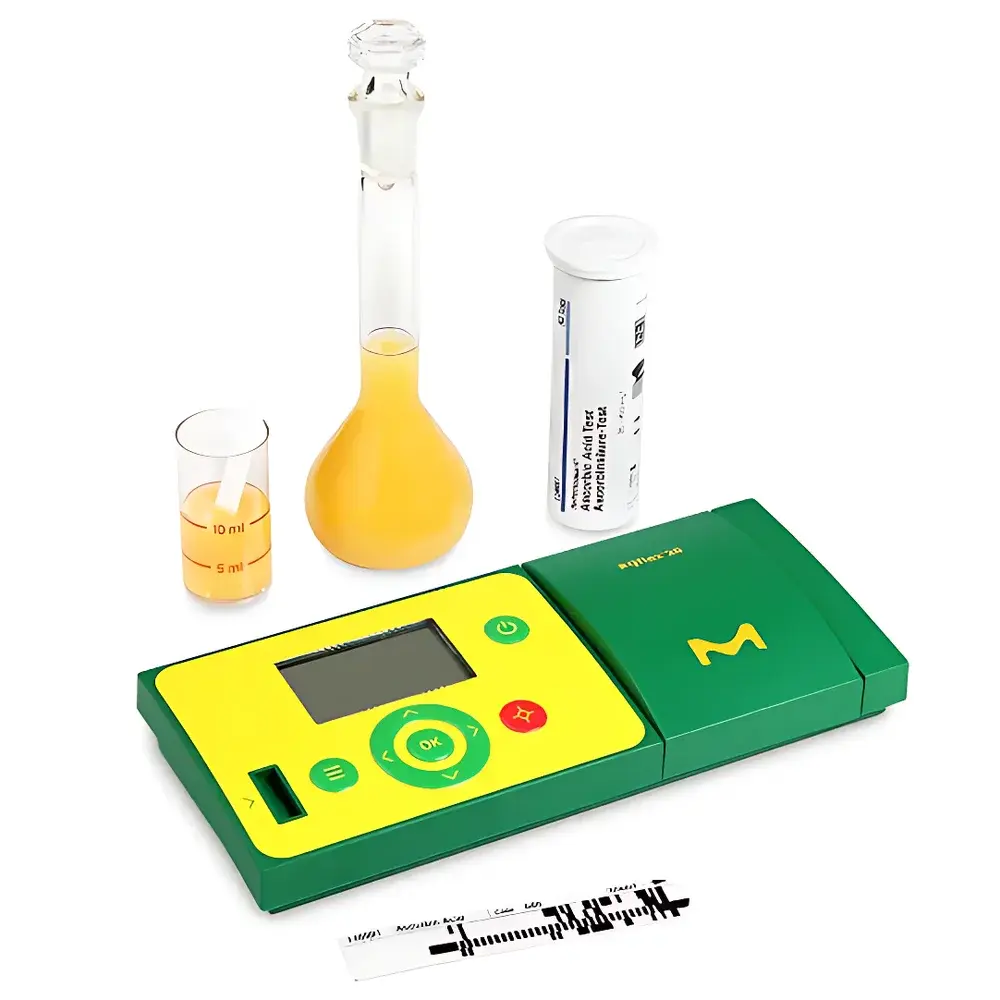
Supelco® RQflex® 20 Reflectometer
| Brand | Supelco |
|---|---|
| Origin | Germany |
| Model | RQflex® 20 |
| Instrument Type | Portable Reflectometric Water Quality Analyzer |
| Target Analytes | Hydrogen Peroxide, Peracetic Acid, Nitrate, Nitrite, Phosphate, Potassium, Ammonia-N, Free Chlorine, Vitamin C, Lactic Acid, Total Sugar |
| Compliance | Designed for field-deployable semi-quantitative and quantitative reflectometric analysis per ISO 15306, DIN EN ISO 11885, and EPA-approved colorimetric methods |
Overview
The Supelco® RQflex® 20 Reflectometer is a handheld, battery-powered optical analyzer engineered for rapid, on-site quantification of key water quality and process hygiene parameters using reflectometric strip-based chemistry. It operates on the principle of diffuse reflectance photometry: when a reagent-impregnated test strip is exposed to a sample, a colorimetric reaction occurs; the instrument measures the intensity of reflected light at specific wavelengths (typically 470 nm, 540 nm, and 610 nm) from the dried reaction zone and converts it into concentration values via pre-calibrated polynomial algorithms. Unlike spectrophotometers requiring cuvettes or complex optics, the RQflex® 20 employs a robust LED–photodiode optical path optimized for ambient-light resilience and minimal user intervention. Its design prioritizes operational reliability in non-laboratory environments—field sites, production floors, wastewater lift stations, and agricultural testing points—where portability, speed (<60 s per test), and immunity to vibration or temperature drift (operating range: 5–40 °C) are critical. The device is not a standalone analytical platform but an integrated component of Merck’s Reflectoquant® system, requiring proprietary test strips validated for matrix-specific interferences and lot-to-lot consistency.
Key Features
- Compact, ergonomic housing with IP65-rated ingress protection against dust and water splashes
- Integrated rechargeable lithium-ion battery supporting ≥1,000 measurements per charge
- High-contrast monochrome LCD display with intuitive icon-driven menu navigation in 12 languages
- Onboard memory storing up to 500 measurement records with timestamp, strip lot ID, and operator code
- Auto-zero function and built-in reference calibration using dedicated blank strips before each batch
- Dual-mode operation: single-parameter mode for routine checks and multi-parameter mode for sequential analysis (e.g., H₂O₂ + PAA + residual chlorine in CIP rinse validation)
- USB 2.0 interface compliant with Windows-based data export via Merck’s RQ-Data software (v3.2+)
Sample Compatibility & Compliance
The RQflex® 20 accepts liquid samples across diverse matrices—including potable water, wastewater effluent, cleaning-in-place (CIP) rinse solutions, nutrient solutions, soil extracts, and food processing brines—provided turbidity remains below 50 NTU and suspended solids are minimized by filtration (0.45 µm). Each analyte-specific Reflectoquant® test strip undergoes rigorous validation per ISO/IEC 17025-accredited protocols, with documented limits of detection (LOD), working ranges, and cross-reactivity profiles published in Merck’s Certificate of Analysis. For regulated environments, the system supports GLP-compliant workflows: strip lot traceability, electronic signature-capable data export, and audit-ready CSV reports meeting FDA 21 CFR Part 11 requirements when used with RQ-Data software and appropriate access controls. It aligns with ASTM D1253 (residual chlorine), ISO 6777 (nitrate/nitrite), and EN 14895 (peracetic acid in disinfectants).
Software & Data Management
RQ-Data software serves as the central hub for method configuration, result review, statistical evaluation (mean, SD, CV%), and regulatory reporting. Users can define custom calibration curves, assign sample IDs with location metadata, and generate PDF certificates compliant with ISO 17025 clause 7.8. All raw reflectance values (R%, ΔR%) are retained alongside calculated concentrations, enabling retrospective reprocessing if updated calibration coefficients become available. Data synchronization supports both manual USB transfer and optional Bluetooth-enabled wireless upload to secure enterprise LIMS platforms via Merck’s RQ-Cloud gateway (subscription required). Audit trails record every parameter change, calibration event, and data export action with user ID and timestamp.
Applications
- Hygiene & Sanitation Validation: Quantification of hydrogen peroxide (0.1–1,000 mg/L) and peracetic acid (0.5–200 mg/L) in pharmaceutical CIP cycles and food-grade surface disinfection protocols
- Agricultural Nutrient Management: Field-level assessment of phosphate (0.1–5 mg/L PO₄-P), potassium (1–100 mg/L), and ammonia-nitrogen (0.05–10 mg/L) in irrigation water and soil leachates
- Food & Beverage Process Control: Monitoring nitrate/nitrite levels in cured meats, vitamin C stability in juices, lactic acid accumulation in fermentation tanks, and total sugar content in syrups
- Environmental Field Screening: Rapid detection of nutrient enrichment (eutrophication indicators) and disinfectant residuals in surface water monitoring programs
FAQ
Does the RQflex® 20 require external calibration standards?
No—each Reflectoquant® test strip incorporates a built-in reference field and is factory-calibrated per lot. Users perform only a blank strip calibration prior to each measurement session.
Can the instrument store calibration curves for multiple strip types simultaneously?
Yes—the internal memory retains up to 20 preloaded calibration sets corresponding to Merck’s full Reflectoquant® strip portfolio.
Is the RQflex® 20 suitable for use in explosive atmospheres?
No—it is not ATEX or IECEx certified. Operation is restricted to non-hazardous locations per IEC 60079-0.
How often must the optical sensor be cleaned?
The LED and photodiode window should be wiped with lint-free tissue and isopropyl alcohol after every 50 measurements or when visible residue accumulates.
What is the shelf life of unopened Reflectoquant® test strips?
Typically 18–24 months when stored at 2–8 °C in original aluminum pouches; expiration dates are laser-printed on each package.







