
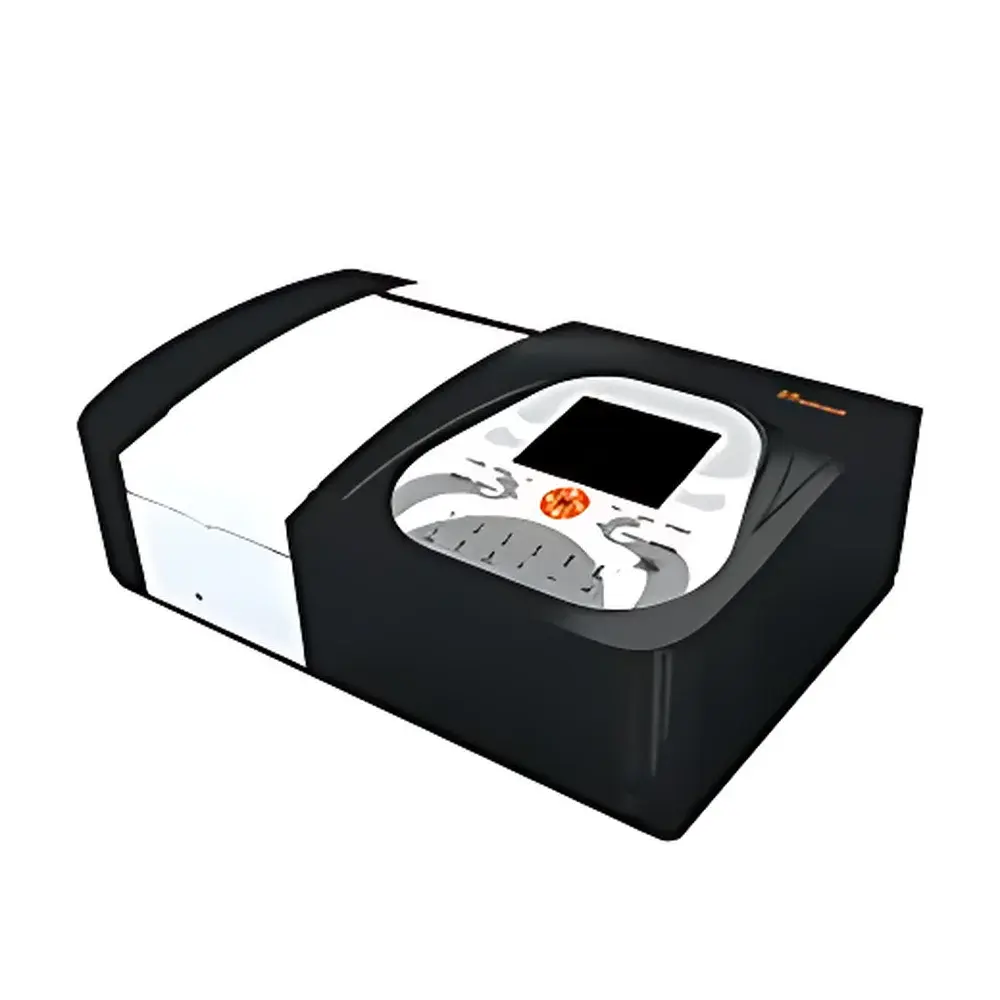
Hanon i9 Dual-Beam Ultraviolet-Visible Spectrophotometer
| Brand | Hanon |
|---|---|
| Origin | Shandong, China |
| Model | i9 |
| Optical System | Dual-beam |
| Detector | Photodiode Array (PDA) |
| Wavelength Range | 190–1100 nm |
| Wavelength Accuracy | ±0.1 nm @ 656.1 nm (D₂ line), ±0.3 nm across full range |
| Wavelength Repeatability | ≤0.1 nm |
| Spectral Bandwidth | 0.5 / 1.0 / 2.0 / 4.0 / 5.0 nm (motorized, user-selectable) |
| Stray Light | ≤0.03% T |
| Photometric Accuracy | ±0.2% T |
| Photometric Repeatability | ≤0.15% T |
| Baseline Flatness | ±0.001 A |
| Drift | ±0.0004 A/h @ 500 nm |
| Noise | ±0.0005 A |
| Photometric Range | 0–200% T, –4.0 to +4.0 A, 0–9999 C |
| Wavelength Setting | Automatic |
| Scan Speed | High/Medium/Low (3 modes) |
| Data Interface | USB |
| Display | 320 × 240 pixel LCD |
| Light Sources | Imported deuterium and tungsten lamps |
| Detector | Imported silicon photodiode |
| Power Supply | AC 220 V/50 Hz or 110 V/60 Hz |
| Dimensions | 625 × 430 × 210 mm |
| Weight | 28 kg |
Overview
The Hanon i9 Dual-Beam Ultraviolet-Visible Spectrophotometer is a precision optical instrument engineered for high-fidelity absorbance, transmittance, and concentration measurements across the ultraviolet, visible, and near-infrared spectral regions (190–1100 nm). Based on a true dual-beam optical architecture—where sample and reference beams traverse separate, parallel optical paths simultaneously—the i9 eliminates time-dependent drift and compensates for source intensity fluctuations in real time. This design ensures superior photometric stability and reproducibility, particularly during extended kinetic assays or temperature-sensitive analyses. The system employs a high-stability imported deuterium lamp for UV emission and a tungsten-halogen lamp for visible/NIR output, coupled with a high-resolution monochromator and a photodiode array detector enabling rapid spectral acquisition without mechanical scanning limitations. Its robust mechanical construction—including a suspended optical bench and reinforced baseplate—minimizes sensitivity to ambient vibration and thermal deformation, supporting consistent performance in shared laboratory environments.
Key Features
- Dual-beam optical configuration with real-time reference compensation for enhanced baseline stability and long-term measurement fidelity
- Motorized, five-step spectral bandwidth selection (0.5, 1.0, 2.0, 4.0, and 5.0 nm) optimized for resolution/sensitivity trade-offs across diverse sample types
- High-precision wavelength calibration traceable to NIST-certified standards; ±0.1 nm accuracy at the deuterium 656.1 nm line and ±0.3 nm across full range
- 24-bit analog-to-digital conversion delivering high dynamic range and low-noise signal digitization (±0.0005 A RMS noise)
- Integrated 320 × 240-pixel backlit LCD display enabling standalone operation—no PC required for routine photometric, quantitative, or multi-wavelength measurements
- Full-featured PC software suite supporting spectral scanning, kinetics, DNA/protein quantification (A₂₆₀/A₂₈₀), and method validation per ISO 17025 and CLSI EP10-A3 guidelines
- Compliance-ready architecture: audit trail logging, electronic signatures, and data integrity controls aligned with FDA 21 CFR Part 11 and GLP/GMP documentation requirements
Sample Compatibility & Compliance
The i9 accommodates standard 10-mm pathlength cuvettes (quartz, glass, or plastic), microvolume adapters (down to 1 µL), and optional fiber-optic probes for in-situ or flow-cell applications. It supports liquid, colloidal, and homogenized solid extracts across pharmaceutical QC, food safety testing, environmental water analysis, polymer characterization, and biochemical research. All optical components meet RoHS directives, and lamp housings are designed for safe, tool-free replacement. Instrument validation protocols include wavelength accuracy verification (using holmium oxide and didymium filters), photometric linearity assessment (neutral density filters), and stray light evaluation (sodium nitrite solution at 340 nm)—fully compatible with ASTM E275, ISO 6059, and USP spectrophotometer qualification frameworks.
Software & Data Management
The Hanon i9 is supplied with proprietary SpectraLab Pro software, a Windows-based application supporting method creation, sequence automation, and compliance-driven data handling. Raw spectral data are stored in vendor-neutral .csv and .jdx formats, while processed reports include metadata such as operator ID, timestamp, instrument serial number, calibration status, and environmental conditions (optional external sensor integration). The software implements role-based access control, electronic signature workflows, and immutable audit trails with timestamped event logs—enabling full traceability for regulatory submissions under FDA, EMA, or MHRA oversight. Data export supports LIMS integration via ODBC and HL7-compatible interfaces.
Applications
- Pharmaceutical: Active pharmaceutical ingredient (API) assay, excipient compatibility screening, dissolution profile monitoring, and stability-indicating method development
- Food & Beverage: Colorimetric quantification of anthocyanins, carotenoids, and nitrites; protein content estimation via Lowry or Bradford assays
- Environmental: COD, phosphate, nitrate, and heavy metal (e.g., Cr⁶⁺, Cd²⁺) determination in wastewater per EPA Method 4500 series
- Academic Research: Enzyme kinetics (e.g., NADH oxidation), ligand-binding studies, nanoparticle size estimation via surface plasmon resonance modeling
- Materials Science: Thin-film thickness calculation from interference fringes; bandgap energy estimation for semiconductor nanomaterials
FAQ
What wavelength calibration standards are recommended for routine verification?
NIST-traceable holmium oxide (Ho₂O₃) and didymium glass filters are recommended for wavelength verification at multiple points (241.1, 279.4, 287.5, 333.7, 360.9, 418.5, 460.0, 484.5, 536.2, and 637.5 nm).
Does the i9 support GLP-compliant data archiving?
Yes—SpectraLab Pro includes configurable audit trail settings, electronic signature enforcement, and encrypted database storage compliant with 21 CFR Part 11 Annex 11 requirements.
Can the instrument perform kinetic measurements over extended durations?
Yes—its dual-beam design and thermal-stabilized optics enable stable absorbance tracking for up to 24 hours, with drift specified at ±0.0004 A/h at 500 nm.
Is the photodiode array detector cooled?
No—the i9 uses an uncooled high-linearity silicon photodiode array optimized for signal-to-noise ratio across 190–1100 nm; thermoelectric cooling is not required due to low dark current design.
How is stray light performance validated?
Stray light is measured using a 50 g/L sodium nitrite solution in distilled water at 340 nm (ASTM E387); the i9 achieves ≤0.03% T, meeting ISO 6059 Class I specifications.
Related Products



