
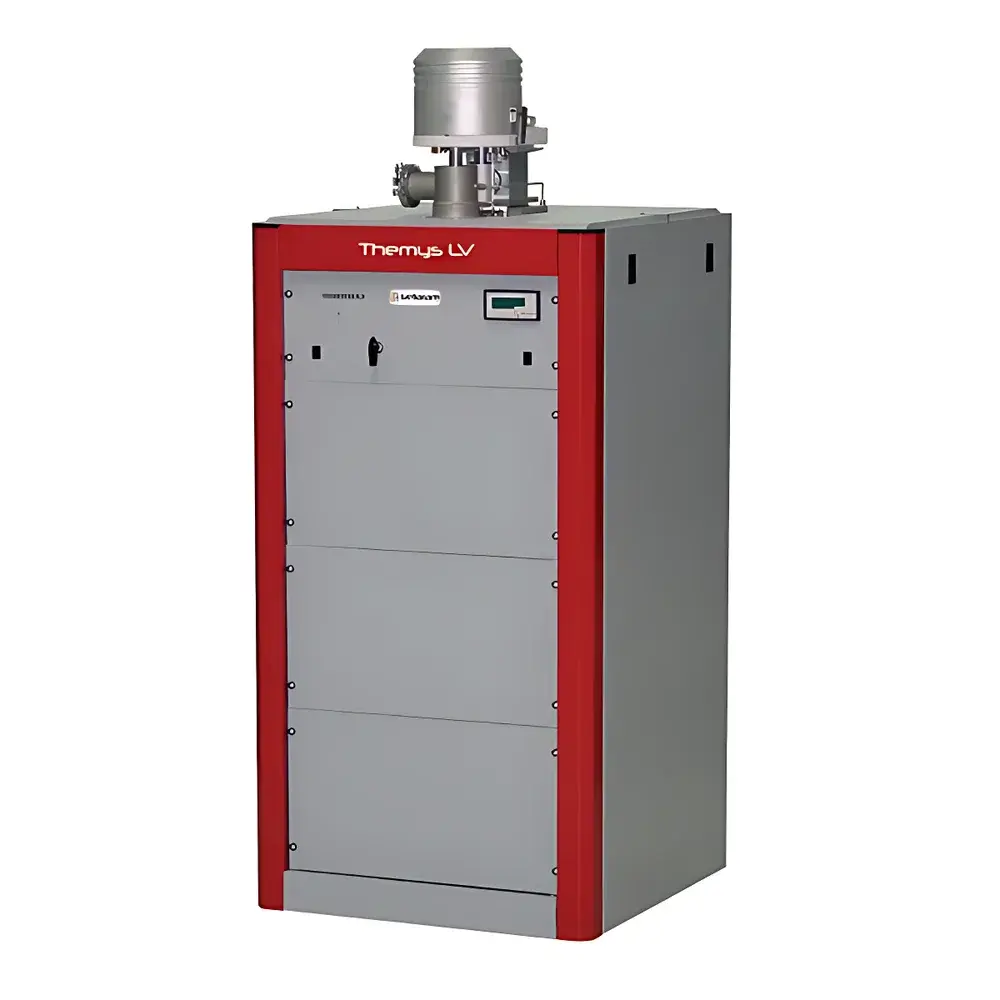
SETARAM THEMYS LV High-Capacity Integrated Thermal Analyzer
| Brand | SETARAM |
|---|---|
| Origin | France |
| Model | THEMYS LV |
| Temperature Range | Room Temp to 2000 °C (TGA/DTA/TG-DTA), up to 1600 °C (TG-DSC/DSC/TMA) |
| Sample Capacity | Up to 100 g / 18.1 mL |
| Balance Sensitivity | 0.02 µg |
| Heating/Cooling Rate | 0.01–20 K/min |
| Maximum Crucible Volume | 18.1 mL |
| TMA Resolution | 1.6 nm |
| TMA Measurement Range | ±6 mm |
| Gas Control | 3-channel MFC-controlled gas lines (including optional corrosive gas path) |
| Vacuum Capability | Primary vacuum (< 5×10⁻² mbar), secondary vacuum optional |
| Balance Load Capacity | ±200 mg (low-load mode), ±2000 mg (high-load mode) |
| DSC/DTA Accuracy | ±2% (heat flow), ±1 °C (temperature, calibrated vs. metal standards) |
Overview
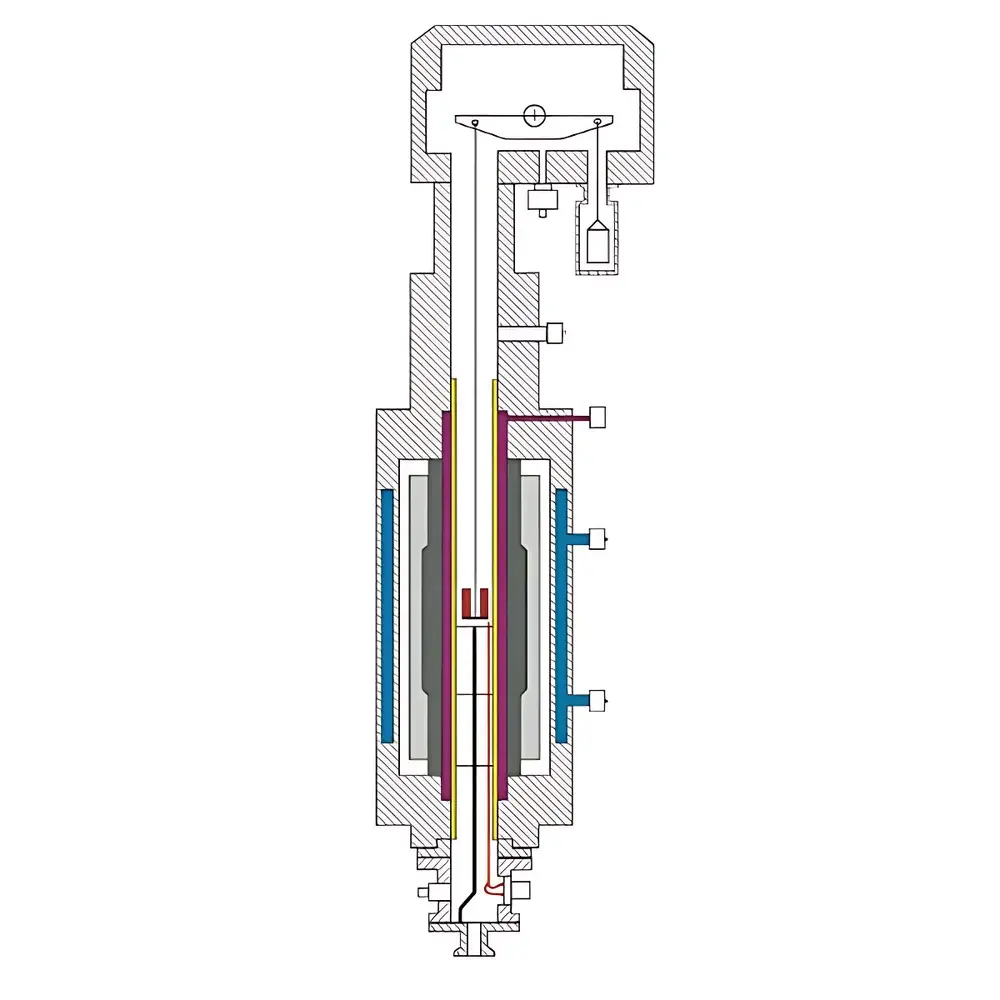
The SETARAM THEMYS LV is a high-capacity, high-temperature integrated thermal analyzer engineered for rigorous materials characterization under extreme thermal conditions. Based on the proven THEMYS platform, the LV variant incorporates a reinforced vertical suspension microbalance, a large-volume graphite furnace, and modular sensor architecture to support simultaneous or sequential thermogravimetric analysis (TGA), differential thermal analysis (DTA), differential scanning calorimetry (DSC), thermomechanical analysis (TMA), and evolved gas analysis (EGA) coupling. Its core measurement principle relies on high-stability electromagnetic force compensation for mass determination, coupled with precision thermocouple-based temperature control and symmetric thermal field design to minimize convection artifacts. With a maximum operating temperature of 2000 °C in inert or reducing atmospheres—and 1600 °C under oxidizing or DSC-compatible conditions—the instrument is purpose-built for applications demanding both thermal robustness and metrological fidelity, including refractory material development, metallurgical oxidation kinetics, high-temperature waste decomposition, and advanced ceramic sintering studies.
Key Features
- Ultra-High-Temperature Capability: Single-zone graphite furnace certified to 2000 °C (inert/vacuum), with extended stability across 1600–2000 °C for long-duration TGA/DTA runs—validated per ISO 11358 and ASTM E1131.
- High-Load Precision Balance: Dual-range electromagnetic suspension balance (±200 mg / ±2000 mg) with 0.02 µg resolution; optimized geometry minimizes buoyancy effects and enhances gas–sample interaction uniformity.
- Large Uniform Temperature Zone: ≥80 mm height × 20 mm diameter isothermal region enables representative analysis of bulk industrial samples (e.g., cast alloys, slag fragments, composite preforms) without segmentation.
- Modular Sensor Interchangeability: Seamless switching between TGA, DTA, DSC, and TMA modules using common furnace and gas manifold infrastructure—reducing cross-contamination risk and calibration overhead.
- Advanced Gas Management System: Three independently controlled mass flow controllers (MFCs); programmable gas switching during ramp/hold steps; dedicated corrosion-resistant line for Cl₂, HCl, SO₂, or HF-containing atmospheres (optional).
- Vacuum-Ready Architecture: Integrated primary vacuum (< 5×10⁻² mbar) with optional turbomolecular pump upgrade; compatible with dynamic vacuum TGA and low-pressure reaction kinetics studies.
Sample Compatibility & Compliance
The THEMYS LV accommodates heterogeneous, high-density, or geometrically irregular specimens—including metallic ingots, mineral aggregates, spent catalysts, and ceramic monoliths—within crucibles ranging from 220 µL (for high-sensitivity DSC) to 18.1 mL (for macro-scale TGA). All standard ceramic (Al₂O₃, SiC) and metal (Pt, Ir, W) crucibles are traceably certified for thermal stability and inertness. The system supports GLP-compliant operation through audit-trail-enabled software (CALISTO), full electronic signatures (21 CFR Part 11 compliant), and automated calibration routines traceable to NIST-standard reference materials (e.g., Ni, In, Zn, Al₂O₃). It meets ISO 11357 (DSC), ISO 11358 (TGA), ASTM E1131 (TGA), ASTM E794 (DSC), and ASTM E831 (TMA) requirements out-of-the-box.
Software & Data Management
CALISTO v6.x provides unified control, real-time data visualization, and multi-technique synchronization. Users define complex temperature programs—including multi-step ramps, isothermal holds, and cooling cycles—with independent gas composition profiles per segment. Raw data (mass, temperature, heat flow, displacement) are stored in vendor-neutral HDF5 format with embedded metadata (instrument configuration, calibration history, operator ID). Batch processing supports derivative analysis (dm/dt, d²m/dt²), peak deconvolution (DSC), baseline correction (TGA), and CTE calculation (TMA). Export modules generate ASTM-compliant reports and integrate with LIMS via OPC UA or CSV/Excel APIs. All method files and raw datasets are version-controlled and encrypted at rest.
Applications
- High-temperature oxidation and hot-corrosion behavior of Ni-based superalloys and refractory metals (e.g., Mo, Nb, Ta) under simulated turbine environments.
- Thermal stability and decomposition pathways of municipal solid waste (MSW), battery black mass, and end-of-life photovoltaic modules.
- Sintering kinetics and phase evolution in UO₂, ThO₂, and advanced nuclear fuel forms under controlled Ar/H₂ atmospheres.
- Decomposition enthalpy and reaction stoichiometry of metal–organic frameworks (MOFs) and coordination polymers above 1000 °C.
- Creep and thermal expansion anisotropy in fiber-reinforced ceramic matrix composites (CMCs) under mechanical load (TMA–TGA co-analysis).
- Real-time coupling with FTIR or quadrupole MS for evolved gas speciation during coal pyrolysis or polymer degradation.
FAQ
What is the maximum recommended sample mass for quantitative TGA accuracy?
For optimal signal-to-noise ratio and thermal lag mitigation, SETARAM recommends ≤50 g for routine high-precision TGA. However, the system maintains linearity and repeatability up to the full 100 g capacity when analyzing dense, thermally conductive materials (e.g., steel chips, tungsten powder) under slow heating rates (≤2 K/min).
Can the THEMYS LV perform simultaneous TG-DSC below 1000 °C?
Yes—using the dedicated TG-DSC sensor module (rated to 1600 °C), the instrument delivers synchronized mass loss and heat flow data with baseline separation validated per ISO 11357-3. Calibration uses certified indium, zinc, and synthetic sapphire standards.
Is helium the only acceptable purge gas for high-temperature TGA?
No—while helium is preferred for its high thermal conductivity and inertness, argon, nitrogen (for non-oxidizing studies), hydrogen (reducing), and forming gas (5% H₂/95% N₂) are routinely used. Corrosive gases require the optional chemically resistant gas kit and quartz-lined furnace liner.
How is temperature accuracy verified above 1500 °C?
Via in-situ calibration using high-purity platinum (melting point 1768.3 °C) and iridium (2447 °C) reference standards, monitored by dual-wavelength pyrometry integrated into the furnace viewport. Results are logged and traceable to national metrology institutes.
Does the system support automated sample loading for unattended operation?
The THEMYS LV is manually loaded; however, it integrates with third-party robotic autosamplers (e.g., Anton Paar RHEOCUT, Netzsch ROBO-STA) via TTL/RS232 interface and custom API scripting in CALISTO.



