
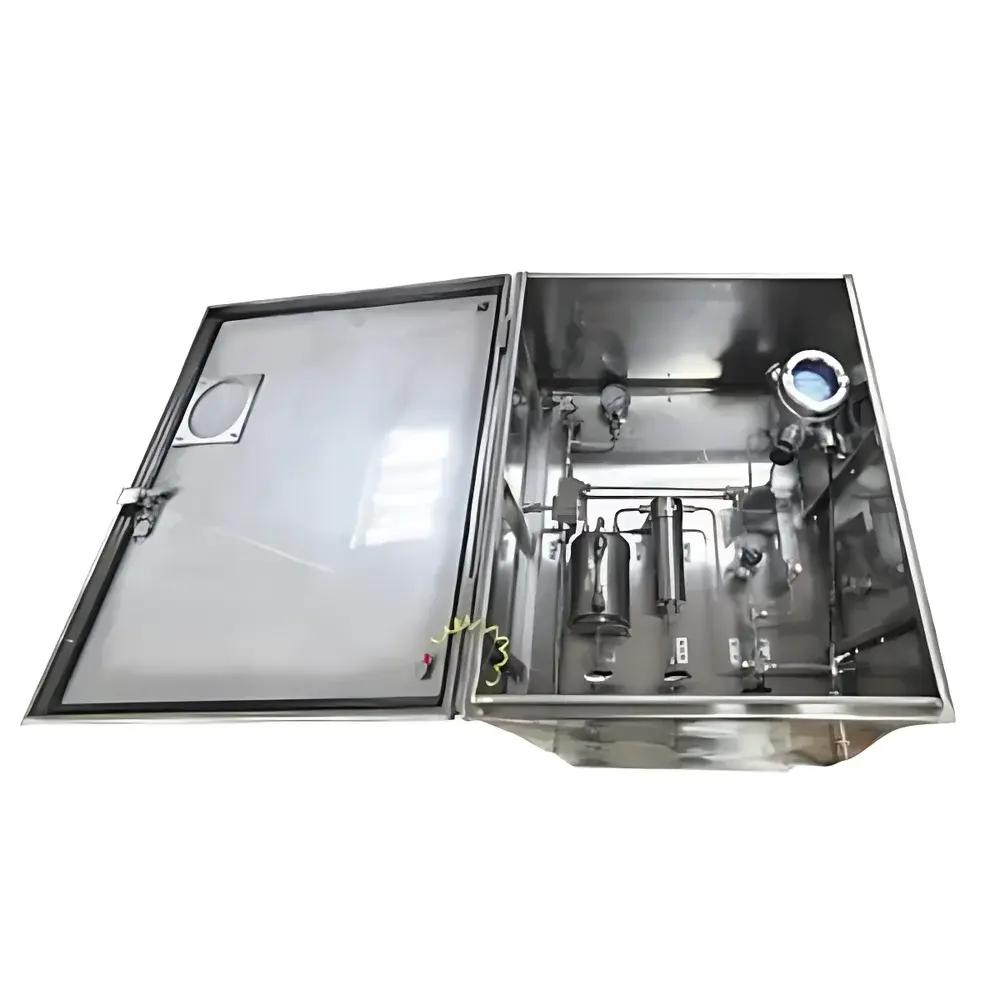
PERIC Customizable Combustible Gas Detector Model 5
| Brand | PERIC |
|---|---|
| Origin | Hebei, China |
| Manufacturer Type | OEM/ODM Manufacturer |
| Regional Classification | Domestic (China) |
| Model | Custom Model 5 |
| Pricing | Available Upon Request |
Overview
The PERIC Customizable Combustible Gas Detector Model 5 is an engineered solution designed for continuous, reliable monitoring of combustible hydrocarbon vapors—specifically C9–C12 aliphatic alkanes—in high-risk nuclear fuel reprocessing off-gas streams. It operates on the principle of dual-beam, dual-source non-dispersive infrared (NDIR) absorption spectroscopy, where two independent infrared light paths—one sample and one reference—are simultaneously measured to compensate for optical drift, dust deposition, and source aging. This architecture ensures long-term baseline stability in environments characterized by intermittent high-concentration emissions, acidic contaminants, moisture ingress, and stringent intrinsic safety requirements. The detector is deployed downstream of a fully passive, explosion-proof pretreatment system, eliminating all electrical components from hazardous sampling zones and complying with IEC 60079-0 and IEC 60079-11 for Group IIA/IIB, T4 temperature class applications.
Key Features
- Explosion-safe sampling architecture: Jet vacuum pump (no moving electrical parts in Zone 1/2) enables active draw-through sampling without spark or thermal ignition risk.
- Dual-source, dual-beam NDIR optics: Two matched IR emitters and detectors provide real-time signal referencing, delivering <1% FS zero drift over 30 days and <±2% reading accuracy across 0–100% LEL range for C9–C12 alkanes.
- Integrated 316L stainless steel pretreatment train: Acid scrubber (NaOH-based), condensate trap, and sintered metal particulate filter (5 µm absolute) remove HNO₃ vapor, water aerosols, and radioactive particulates prior to sensor exposure.
- Modular calibration interface: Supports span gas injection via NIST-traceable certified standards (e.g., n-nonane in air, 50% LEL) with automatic zero/span validation logging.
- Ruggedized field enclosure: IP66-rated, 316L housing with welded seams and high-temperature elastomer seals rated for –20°C to +60°C ambient operation.
Sample Compatibility & Compliance
The Model 5 is validated for quantitative detection of saturated aliphatic hydrocarbons within the C9–C12 carbon chain range—including n-nonane, n-decane, n-undecane, and n-dodecane—as defined in ASTM D2879 and ISO 8573-5 for hydrocarbon vapor analysis. Its pretreatment system meets ANSI/ISA-12.12.01 for non-incendive component installation and supports compliance with nuclear facility QA programs per 10 CFR 50 Appendix B and ASME NQA-1. All wetted materials are documented under ASTM A240 and pass ASTM G124 corrosion testing in simulated PUREX off-gas matrices containing ≤10 ppm HNO₃ and ≤3 g/m³ water vapor.
Software & Data Management
The detector interfaces via 4–20 mA analog output and Modbus RTU (RS-485) to central SCADA or DCS platforms. Firmware includes configurable alarm thresholds (pre-alarm, alarm, fault), event-triggered data logging (up to 30 days at 1-min intervals), and audit-trail-enabled configuration changes compliant with FDA 21 CFR Part 11 requirements when integrated with validated host systems. Calibration history, sensor diagnostics (source intensity, detector responsivity, path-length verification), and maintenance alerts are timestamped and exportable as CSV for GLP/GMP documentation.
Applications
- Off-gas monitoring in PUREX-based nuclear fuel reprocessing facilities (e.g., dissolver off-gas, solvent extraction vent streams).
- Continuous surveillance of alkane-rich process vents in radiochemical separation plants handling irradiated fuel elements.
- Hazardous area installations requiring SIL 2-capable combustible gas detection per IEC 61508 and IEC 61511.
- Integration into engineered safety features (ESFs) for early warning of solvent accumulation exceeding 20% LEL in confinement zones.
FAQ
Is this detector certified for use in nuclear regulatory environments?
Yes—the design adheres to 10 CFR 21, 10 CFR 50, and IAEA SSG-24 guidance for instrumentation in fuel cycle facilities. Documentation packages include seismic qualification reports (IEEE 344), EMI/EMC test summaries (IEC 61000-6-2/-4), and radiation tolerance data (10⁴ Gy total dose).
Can the pretreatment system handle HNO₃-laden streams?
Yes—the NaOH-coated acid scrubber module is sized for continuous removal of ≤10 ppmv nitric acid vapor at 100 L/min flow; performance is verified per ASTM D5197 and supported by third-party corrosion rate testing.
What calibration gases are recommended for field verification?
NIST-traceable n-decane in synthetic air (certified to ±1.5% uncertainty), delivered in aluminum-lined permeation tubes or compressed gas cylinders meeting ISO 6141 purity standards (≥99.995%).
Does the system support remote diagnostics?
Yes—Modbus registers expose real-time optical path health metrics, pump status, temperature-compensated signal ratios, and diagnostic error codes (e.g., “Filter clog”, “Source degradation >15%”).
Related Products







