
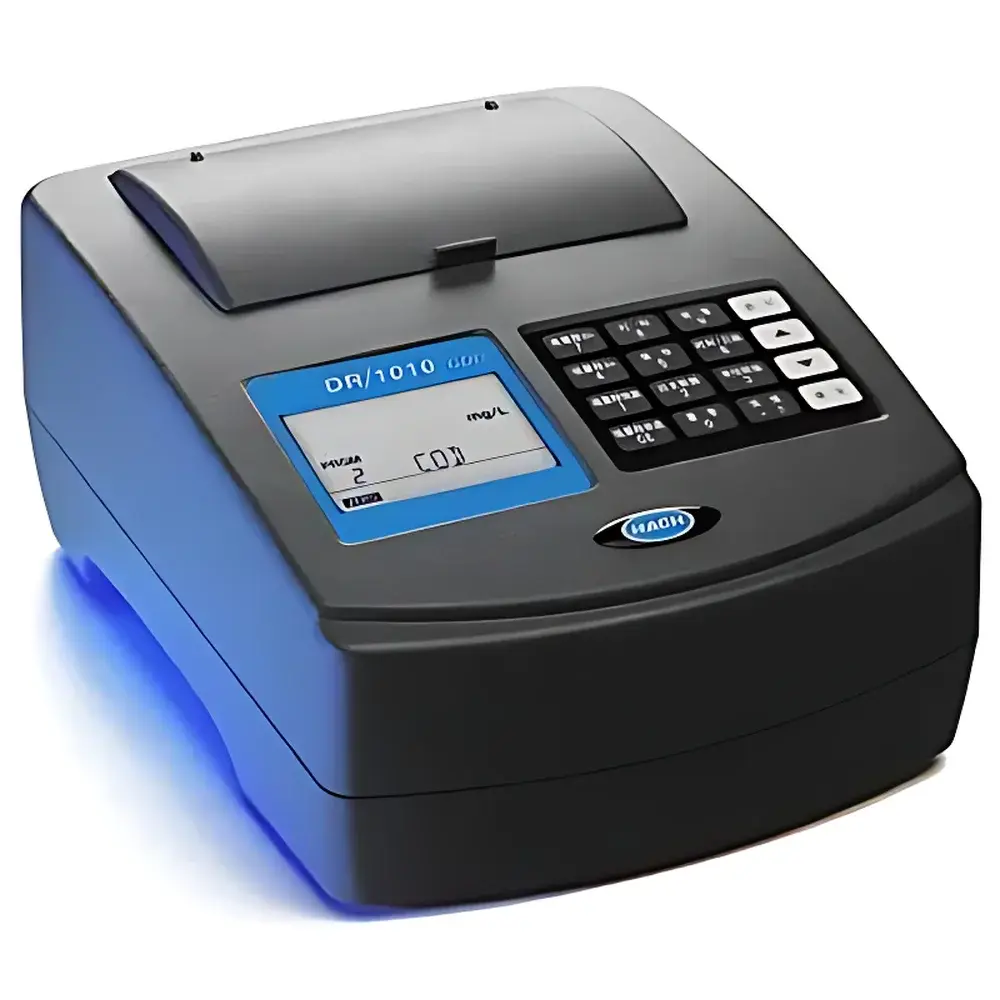
Hach DR1010 COD Analyzer
| Brand | Hach |
|---|---|
| Origin | USA |
| Model | DR1010 |
| Instrument Type | Benchtop Laboratory Analyzer |
| Measurement Principle | Spectrophotometric (Dichromatic Absorption at 420 nm and 610 nm) |
| Wavelength Accuracy | ±1 nm |
| Photometric Linearity | ±0.002 A (0–1 A) |
| Photometric Repeatability | ±0.005 A (0–1 A) |
| Photometric Accuracy | ±0.005 A at 1.0 ABS |
| Light Source | LED |
| Detector | Silicon Photodiode |
| Display | 4-digit LCD, 1.5 cm character height |
| Optical Range | 0–2 A |
| Drift | <1.0% at 420 nm |
| Power Supply | 6 VDC adapter (190–240 VAC/50 Hz) or 4 × AA alkaline batteries |
| Battery Life | Up to 6 months (typical usage) |
| Operating Temperature | 0–50 °C |
| Storage Temperature | −20–60 °C |
| Relative Humidity | ≤80% at 40 °C |
| Enclosure Rating | IP41 |
| Dimensions | 24.0 × 19.8 × 12.0 cm |
| Weight | 2.0 kg |
| Data Interface | RS232 serial port |
| Readout Modes | % Transmittance, Absorbance, Concentration |
Overview
The Hach DR1010 COD Analyzer is a benchtop spectrophotometric instrument engineered for precise, reliable, and compliant chemical oxygen demand (COD) determination in water and wastewater samples. It operates on the principle of dichromatic absorption photometry—measuring absorbance at two fixed wavelengths (420 nm and 610 nm) following digestion with standardized Hach COD reagents. This dual-wavelength approach compensates for interferences such as turbidity and color, significantly enhancing measurement robustness across diverse sample matrices. Designed in alignment with China’s environmental monitoring standards—including the “Rapid Digestion Spectrophotometric Method for COD Determination” (HJ/T 399-2007)—the DR1010 supports both rapid (e.g., 15-min heated digestion) and classical (2-hour digestion) protocols. Its architecture integrates optical stability, thermal management, and user-guided workflow logic to ensure reproducible results under routine laboratory conditions and field-deployable scenarios.
Key Features
- Dual-wavelength photometry (420 nm and 610 nm) with automatic wavelength selection per test program, minimizing matrix interference and improving quantification accuracy for low- and high-range COD samples.
- Built-in calibration curves compliant with Hach’s certified COD methods; supports user-defined curve creation and storage for method customization and regulatory traceability.
- Integrated reagent blank correction and standard adjustment functions to compensate for batch-to-batch reagent variability and instrument baseline drift.
- Intuitive icon-driven interface with real-time visual prompts during digestion, measurement, and data review—reducing operator error and training overhead.
- Dual power architecture: AC adapter (6 VDC output, 190–240 VAC/50 Hz) for lab use and four AA alkaline batteries for mobile deployment—enabling uninterrupted operation in remote sampling sites or emergency response settings.
- RS232 serial interface for direct data transfer to PCs or microprinters; supports ASCII-formatted output compatible with LIMS integration and GLP-compliant audit trails.
- IP41-rated enclosure with reinforced housing and sealed optical path—designed for durability in humid, dust-prone environments typical of municipal labs and industrial effluent monitoring stations.
Sample Compatibility & Compliance
The DR1010 accommodates a broad spectrum of aqueous matrices, including domestic sewage, industrial process water, surface water, and treated effluents. Its optical design and digestion protocol compatibility allow analysis across standard Hach COD ranges (e.g., 0–150 mg/L, 0–1500 mg/L, and 0–15,000 mg/L) when paired with corresponding vial-based reagents (e.g., LCK series). The system adheres to fundamental performance criteria outlined in ISO 6060:1989 (Water quality — Determination of chemical oxygen demand), and its operational methodology aligns with U.S. EPA Method 410.4 (COD by Closed Reflux Colorimetric Procedure) and ASTM D1253-22 (Standard Test Method for Chemical Oxygen Demand of Water). While not FDA 21 CFR Part 11–certified out-of-the-box, its data export capability and user-accessible calibration logs support implementation within GxP-aligned workflows where electronic records are subject to internal validation.
Software & Data Management
The DR1010 operates without embedded software beyond firmware-controlled measurement routines—ensuring deterministic behavior and minimal maintenance overhead. All calibration parameters, user-defined curves, and up to 500 test records are stored internally in non-volatile memory. Data retrieval occurs via RS232 using terminal emulation (e.g., PuTTY or Hach’s legacy LogSoft utility), exporting time-stamped entries in comma-delimited format. Each record includes sample ID, method number, wavelength used, absorbance values, calculated concentration, and operator-assigned notes. For laboratories requiring enhanced data governance, the device supports manual linkage to validated third-party LIMS platforms through structured CSV ingestion—facilitating audit-ready reporting, trend analysis, and QC charting per ISO/IEC 17025 requirements.
Applications
- Routine compliance monitoring of influent and effluent streams in municipal wastewater treatment plants.
- Industrial pretreatment verification for electroplating, food processing, textile dyeing, and pharmaceutical manufacturing facilities.
- Environmental impact assessment (EIA) field surveys requiring portable yet metrologically sound COD quantification.
- Academic and research laboratories conducting kinetic studies of organic pollutant degradation or evaluating novel oxidation processes.
- Regulatory inspection units performing rapid verification testing during unannounced facility audits.
FAQ
Does the DR1010 require annual factory recalibration?
No—its LED light source and silicon photodiode detector exhibit long-term spectral stability. Users perform daily verification using supplied calibration standards; full optical verification is recommended every 12 months or after physical shock.
Can the DR1010 be used with non-Hach COD reagents?
It is calibrated exclusively for Hach LCK-series vials. Substitution with third-party reagents invalidates method compliance and voids traceability to certified reference materials.
Is the instrument compatible with modern Windows/macOS operating systems?
Yes—via RS232-to-USB adapters and standard terminal emulators. No proprietary drivers are required.
What is the maximum allowable chloride interference level?
When used with Hach’s mercury-free high-range reagents (e.g., LCK 314), chloride tolerance is up to 2000 mg/L. For higher concentrations, chloride removal pretreatment (e.g., precipitation or distillation) is necessary prior to analysis.
How does the DR1010 handle turbid or colored samples?
The dual-wavelength algorithm inherently corrects for non-specific absorbance contributions; however, samples exceeding 100 NTU turbidity should be centrifuged or filtered before digestion to prevent particulate interference in the final measurement.
Related Products







