
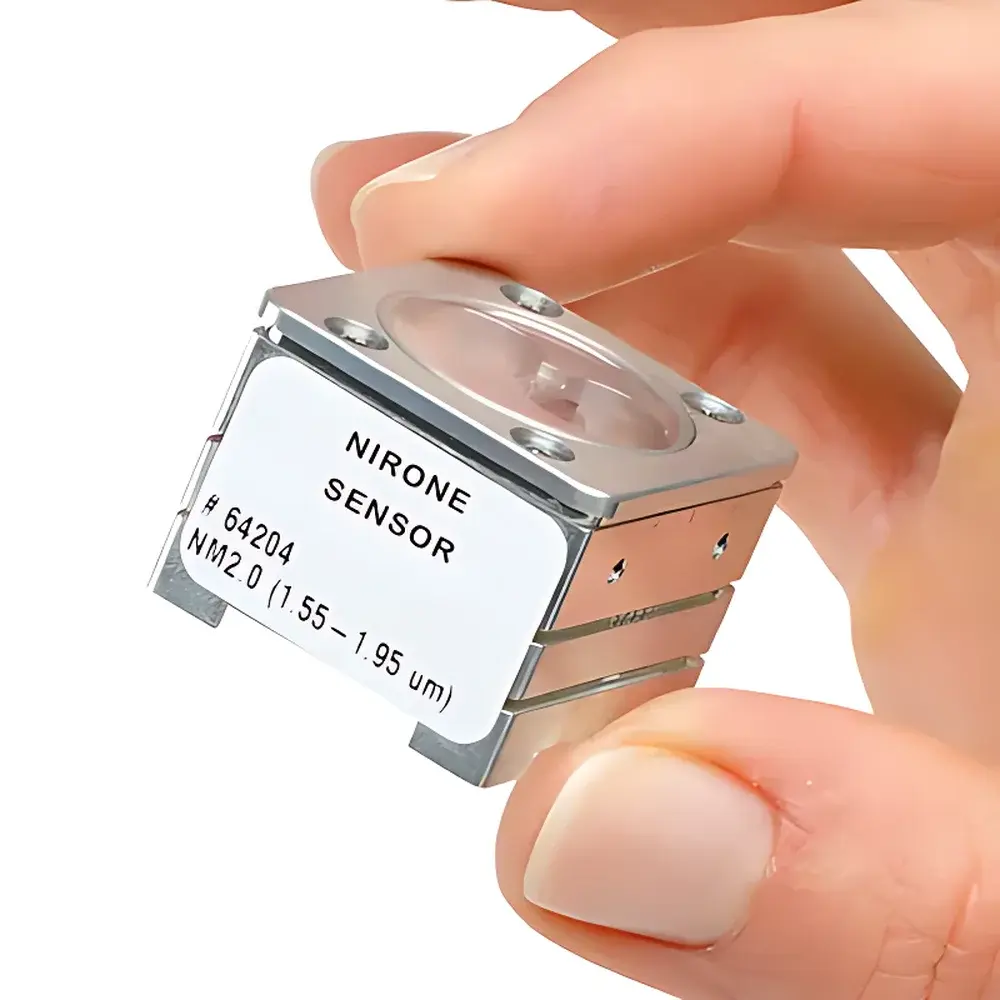
Spectral Engines NIRONE SENSOR Miniature Smart Near-Infrared Spectral Sensor
| Origin | Finland |
|---|---|
| Manufacturer Type | Authorized Distributor |
| Origin Category | Imported |
| Model | NIRONE SENSOR |
| Instrument Type | Portable |
| Application Domain | General-purpose (Universities & Research Labs) |
| Operating Principle | MEMS-based Fabry–Pérot Interferometer |
| Wavelength Ranges | 1150–1350 nm (S 1.4) |
| Scan Speed | <50 ms per spectrum |
| Spectral Sampling Interval | Adjustable from 1–10 nm |
| Measurement Modes | Diffuse Reflectance & Transmission |
| Chemometrics Software | NIRSA |
Overview
The Spectral Engines NIRONE SENSOR is a miniature, intelligent near-infrared (NIR) spectral sensor engineered for high-fidelity, embedded spectroscopic analysis in compact and resource-constrained environments. Unlike conventional benchtop or portable spectrometers relying on grating or linear-array detector architectures, the NIRONE SENSOR employs a monolithic, micro-electro-mechanical systems (MEMS)-based Fabry–Pérot interferometer as its core optical filtering element. This fully programmable, voltage-tuned interference filter enables precise, stepwise wavelength selection across five discrete spectral bands—each optimized for distinct chemical absorption features in the short-wave NIR region (1150–2450 nm). The sensor integrates a single-pixel InGaAs photodetector, eliminating inter-pixel gaps inherent to linear arrays and thereby delivering superior signal uniformity, higher effective optical throughput, and enhanced signal-to-noise ratio (SNR) under equivalent illumination conditions. Designed explicitly for OEM integration, the NIRONE SENSOR operates without moving parts, offers millisecond-scale wavelength switching (<1 ms), and maintains wavelength stability of <0.1 nm/°C via on-board thermal compensation algorithms—ensuring measurement repeatability across ambient temperature fluctuations typical in field-deployed or instrument-embedded applications.
Key Features
- MEMS Fabry–Pérot interferometer with full electronic tunability and no mechanical wear
- Five interchangeable spectral configurations (S 1.4 to S 2.5), covering 1150–2450 nm with FWHM resolution ranging from 12–28 nm depending on band
- Single-pixel InGaAs detector architecture enabling high SNR (>15,000 for S 1.4 at 0.1 ms integration, >7,500 for S 2.0/S 2.2) under calibrated external illumination
- Ultra-compact form factor: 25 × 25 × 17.5 mm, mass <15 g, PCB-mountable with dual M2 screw holes and 25 × 25 mm footprint
- Low-power operation: <300 mW nominal, <1.1 W peak; compatible with battery-powered and edge-computing platforms
- Dual optical interfaces: SMA fiber coupling (400 µm core, 0.22 NA) and integrated diffuse reflectance optics (2–25 mm working distance)
- Multi-protocol digital interface: UART (3.3 V), I²C (3.3 V), and TTL-compatible trigger I/O for synchronized acquisition
- On-device temperature compensation and real-time spectral calibration support
Sample Compatibility & Compliance
The NIRONE SENSOR supports both diffuse reflectance and transmission measurement geometries, making it suitable for solid, semi-solid, and liquid samples—including powders, granules, films, pastes, and suspensions—without requiring sample homogenization or dilution. Its modular front-end optics allow rapid adaptation to application-specific sampling requirements (e.g., contact probes, non-contact standoff heads, flow cells). While the sensor itself is not certified as a standalone analytical instrument, its hardware and firmware architecture align with foundational requirements for regulated environments: stable spectral output traceable to NIST-traceable reference standards, deterministic timing control, and reproducible scan sequencing. When integrated into final instruments, the NIRONE SENSOR enables compliance with ISO 14787 (optical properties of materials), ASTM E1655 (standard practices for NIR quantitative analysis), and USP & Ph. Eur. general chapters on spectroscopic methods. Data integrity is preserved through deterministic frame synchronization and timestamped spectral metadata—facilitating alignment with GLP/GMP documentation workflows and FDA 21 CFR Part 11 audit trail readiness when paired with compliant host software.
Software & Data Management
Spectral Engines provides the NIRSA chemometrics software suite for method development, calibration modeling, and spectral preprocessing—including baseline correction, scatter correction (MSC, SNV), derivative transformation, and PLS regression. NIRSA supports import/export of standard formats (CSV, JCAMP-DX, ASD .asd) and enables cross-platform model portability between development and embedded deployment. For system integrators, the SensorControl PC application delivers full low-level control via USB interface—allowing real-time parameter adjustment (integration time, step size, scan range, averaging), live spectral visualization, and firmware updates. All communication protocols are documented in open API specifications (C/C++, Python bindings available), supporting seamless integration into LabVIEW, MATLAB, or custom C++/Rust instrument control stacks. Raw spectral data streams are delivered in binary-packed format with embedded metadata headers—enabling deterministic parsing and minimal latency in real-time process monitoring applications.
Applications
- Embedded quality control in pharmaceutical tablet coating thickness and API concentration monitoring
- In-line moisture and fat content analysis in food processing lines (e.g., dairy powder, meat products, baked goods)
- Material identification and sorting in recycling facilities (plastics, textiles, composites)
- Soil nutrient mapping and organic matter quantification in precision agriculture sensors
- Portable handheld analyzers for academic research, teaching labs, and field-deployed environmental monitoring
- OEM integration into medical devices for non-invasive tissue oximetry or glucose screening prototypes
- Real-time polymer curing degree assessment in additive manufacturing and composite layup processes
FAQ
Is the NIRONE SENSOR suitable for regulatory-compliant quantitative analysis?
Yes—when embedded into a validated instrument platform with documented calibration procedures, reference standards, and audit-trail-capable software, the NIRONE SENSOR meets technical prerequisites for use in GxP environments.
Can multiple NIRONE SENSOR units be synchronized for multi-point measurements?
Yes—the digital trigger input/output interface supports hardware-level synchronization across up to 8 units with sub-millisecond timing alignment.
What is the recommended integration time for optimal SNR in low-light conditions?
Integration time is user-configurable from 10 µs to 100 ms; optimal settings depend on illumination intensity and required spectral resolution—typical values range from 1–10 ms for ambient-lit reflectance measurements.
Does the sensor require recalibration after thermal cycling?
No—on-board thermal compensation algorithms continuously correct for wavelength drift, maintaining calibration stability over 10–50 °C operating range without manual intervention.
Is fiber-optic coupling mandatory, or can free-space optics be used?
Both are supported: SMA-terminated fiber (400 µm core) is standard; custom free-space collimators or lens assemblies can be mounted via the replaceable front optic module.




