
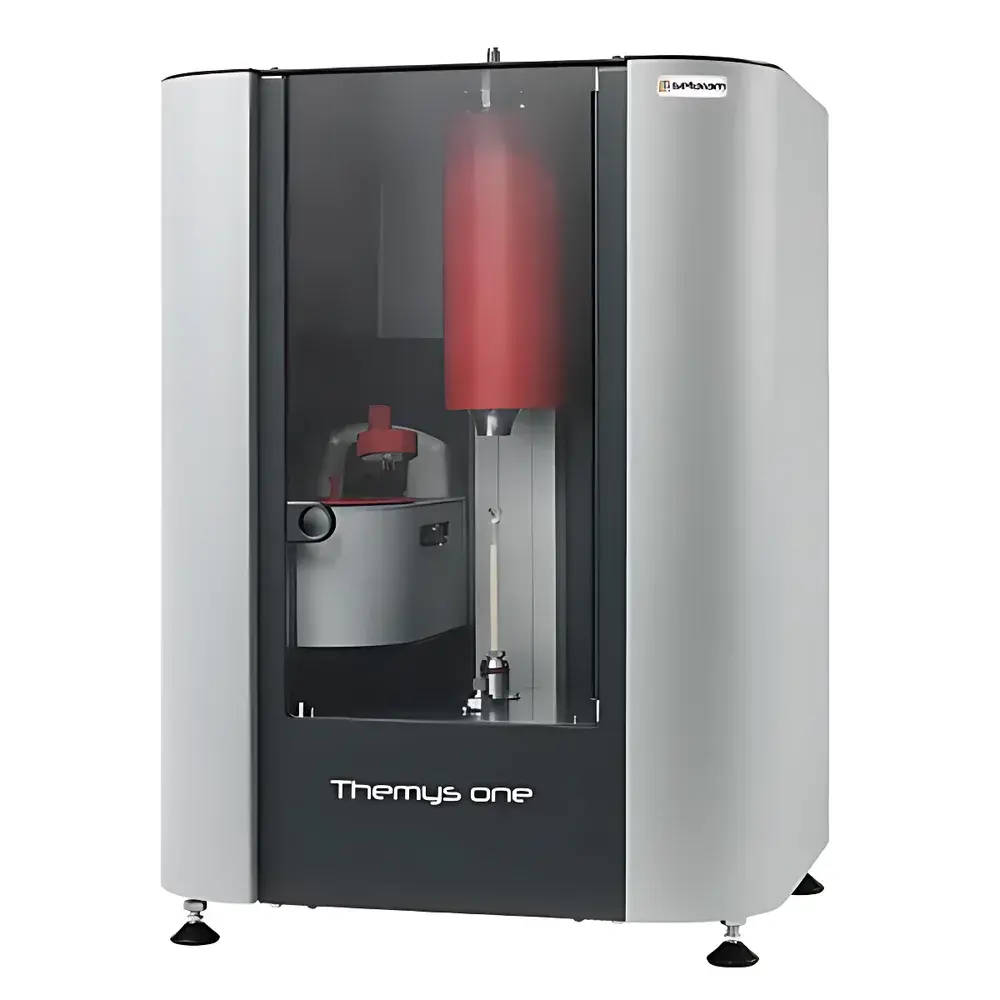
SETARAM Themys One Simultaneous Thermal Analyzer
| Brand | SETARAM |
|---|---|
| Origin | France |
| Model | Themys One |
| Temperature Range | RT–1150°C / RT–1600°C |
| Heating Rate | 0.01–100 °C/min |
| Atmosphere | Inert or reactive gas |
| Compliance | ASTM E1131, ISO 11358, USP <1227>, ISO 17972 (Cp), GLP/GMP-ready software architecture |
Overview
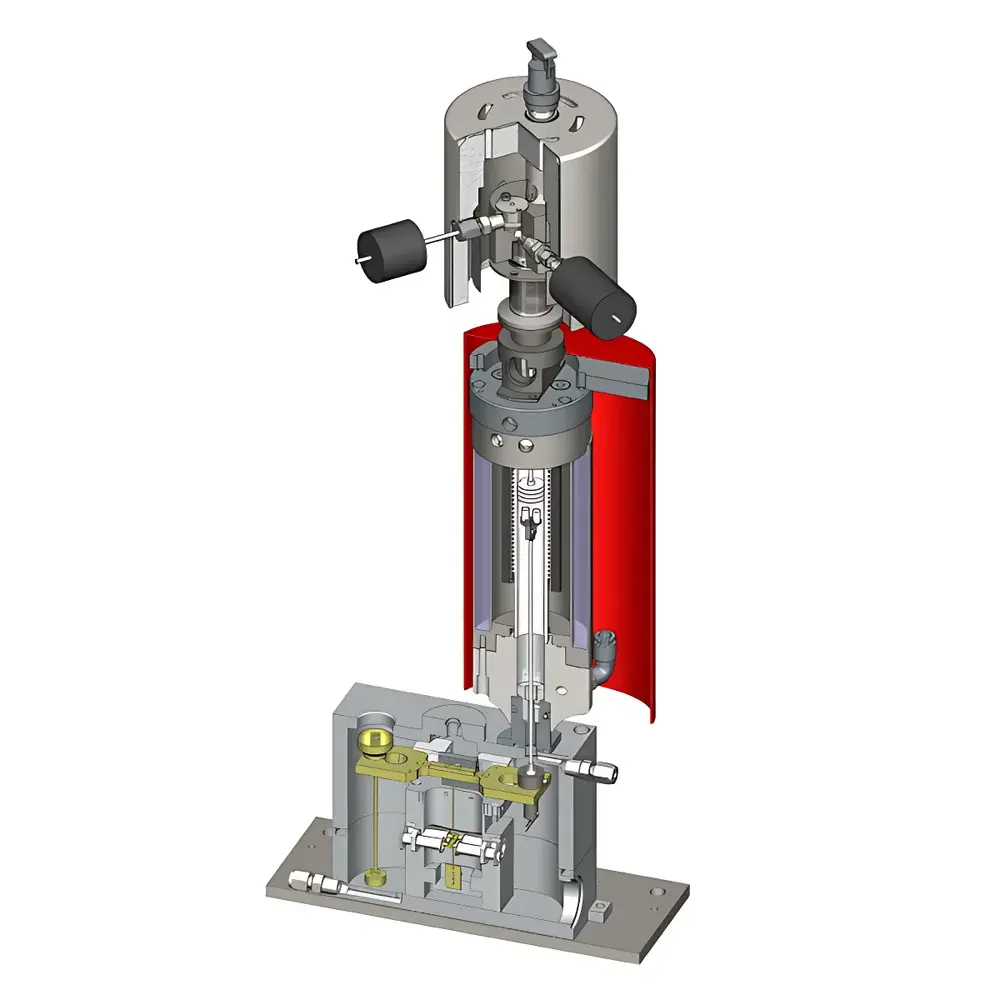
The SETARAM Themys One is a vertically configured, high-precision simultaneous thermal analyzer (STA) engineered for rigorous thermogravimetric analysis (TGA), differential scanning calorimetry (DSC), differential thermal analysis (DTA), and absolute specific heat capacity (Cp) measurement in a single, unified platform. Operating on the principle of coupled microbalance–furnace architecture with top-loading geometry, it integrates a high-stability suspension-filament balance and a robust metal furnace capable of continuous operation up to 1600 °C. Its core measurement methodology relies on real-time mass tracking under controlled thermal ramping (TGA), combined with high-sensitivity heat flow detection (DSC/DTA) and 3D-calorimetric sensor arrays (Cp). Unlike conventional horizontal STA systems, the vertical design minimizes convection artifacts, improves baseline stability, and enables seamless coupling with evolved gas analysis (EGA) tools—FTIR, MS, GC-MS, or hybrid FTIR-MS—via a thermostatically regulated transfer line (maintained at 300 °C to prevent condensation). The instrument meets foundational requirements for regulatory-compliant thermal characterization in pharmaceutical development, battery materials R&D, catalyst screening, and advanced ceramics qualification.
Key Features
- Single-furnace architecture supporting dual temperature ranges: RT–1150 °C (standard) and RT–1600 °C (high-temp option), with cooling from 1150 °C to 50 °C in ≤30 min and 1600 °C to 50 °C in ≤32 min
- High-resolution microbalance: ±1000 mg dynamic range, 0.02 µg resolution, optimized for low-mass-loss detection in catalytic decomposition or polymer degradation studies
- Modular, plug-and-play sensor system: Interchangeable DTA, DSC, TGA, and 3D Cp sensors installed in seconds without recalibration
- 3D Calvet-type Cp sensor featuring 10 thermocouple pairs surrounding a 380 µL crucible; delivers ≤2% absolute error across RT–1600 °C per ISO 17972 and ASTM E1269
- Integrated gas control module: Dual standard inlets (up to 200 mL/min each); optional triple-gas manifold with independent auxiliary flow (0.3–16 mL/min) for precise reactive atmosphere blending
- Ultra-low vacuum capability: <10−1 mbar base pressure; optional active vacuum regulation down to 30 mbar for controlled oxidative or pyrolytic environments
- Water-cooled furnace jacket: Ensures operator safety, thermal stability, and extended component lifetime during prolonged high-temperature runs
Sample Compatibility & Compliance
The Themys One accommodates a broad spectrum of solid and powdered samples—from hygroscopic pharmaceutical intermediates and lithium-ion cathode precursors to refractory oxides and fossil fuel residues—using crucibles fabricated from Pt, Al2O3, or Pt–Rh (up to 1600 °C). Its vertical sample loading eliminates gravitational settling errors common in horizontal systems and ensures reproducible positioning for quantitative Cp and enthalpy measurements. Regulatory alignment includes full support for 21 CFR Part 11-compliant audit trails via CALISTO software, automated calibration logs traceable to NIST standards, and method validation templates aligned with ICH Q5C, USP , and ISO 11358-1 for polymer thermal stability assessment. All sensor exchanges are automatically registered in the audit trail, satisfying GLP and GMP documentation requirements for QC laboratories.
Software & Data Management
Controlled exclusively by SETARAM’s CALISTO v6.x platform—a Windows-based, multi-user, role-secured application—the Themys One provides full experimental automation, real-time data visualization, and post-run deconvolution. CALISTO supports method templating, sequence scheduling (including conditional branching based on mass loss thresholds), and integrated peak deconvolution for overlapping DSC transitions. Raw data files (.cal) are stored in vendor-neutral HDF5 format with embedded metadata (instrument ID, sensor serial, gas composition, calibration history). Export options include ASCII, CSV, and XML for LIMS integration. For regulated environments, CALISTO implements electronic signatures, user access levels (admin/operator/analyst), and immutable audit logs compliant with FDA 21 CFR Part 11 Annex 11 and EU GMP Annex 11.
Applications
- Thermal stability and decomposition kinetics of polymers, composites, and flame-retardant formulations (ASTM E2550)
- Phase transition mapping and crystallinity quantification in APIs and excipients (USP , Ph. Eur. 2.2.43)
- Catalyst activation/deactivation profiling under programmed gas atmospheres (H2, O2, CO, NH3)
- Specific heat capacity determination of nuclear fuels, superalloys, and molten salt candidates (ISO 17972, ASTM E1269)
- Carbonization behavior and ash content analysis in coal, biomass, and municipal waste feedstocks
- Real-time evolved gas analysis (EGA) for reaction mechanism elucidation—e.g., solvent desorption pathways in MOFs or SEI layer formation in solid-state batteries
FAQ
What distinguishes the Themys One from conventional STA instruments?
Its vertical top-loading architecture, combined with suspension-filament balance design and integrated 3D Calvet Cp sensor, delivers superior baseline stability, reduced buoyancy effects, and direct compatibility with high-temperature EGA coupling—without external purging or complex alignment.
Can the Themys One perform true simultaneous TGA-DSC below 100 °C?
Yes. With appropriate sensor selection (e.g., NiCr–Constantan DSC sensor), it achieves stable heat flow detection down to ambient temperature, enabling glass transition (Tg) and cold-crystallization analysis in amorphous polymers.
Is vacuum operation supported during Cp measurements?
Vacuum (<10−1 mbar) is fully compatible with Cp mode; however, for optimal accuracy above 1000 °C, inert gas purge (Ar or He) is recommended to suppress radiative heat losses.
How does automatic sensor recognition work in the Themys One+ configuration?
Each sensor contains an embedded EEPROM chip storing calibration coefficients, thermal time constants, and crucible compatibility data; CALISTO reads this upon insertion and auto-configures acquisition parameters and safety limits.
Does the system support ISO 17972-compliant Cp certification?
Yes. The 3D Calvet sensor, 380 µL crucible geometry, and programmable 100 °C/min heating/cooling rates satisfy all instrumental prerequisites defined in ISO 17972:2015 for absolute Cp determination across the full temperature range.
Related Products



