
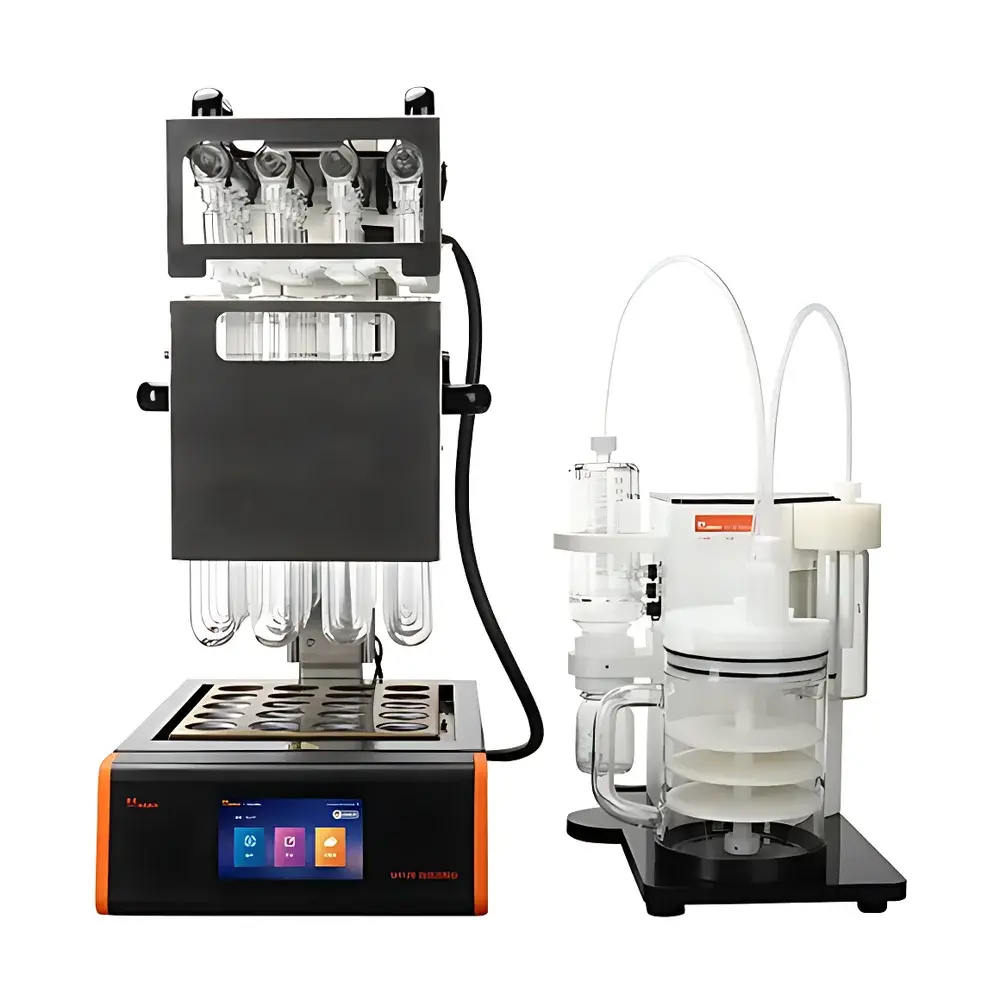
Hanon SH520/SH508 Automated Block Digestion System
| Brand | Hanon |
|---|---|
| Origin | Shandong, China |
| Model | SH520 / SH508 |
| Automation Level | Fully Automatic |
| Digestion Positions | 20 or 8 per batch |
| Temperature Range | Ambient +5°C to 450°C |
| Temperature Control Accuracy | ±1°C |
| Heating Principle | Electric Tubular Heater with Conductive Aluminum Block |
| Reagent Channels | 20 or 8 per batch |
| Digestion Vessels | 300 mL (SH520), 300/380 mL (SH508) |
| Power Rating | 2950 W (SH520), 1400 W (SH508) |
| Dimensions (L×W×H) | 305×590×151 mm (SH520), 328×440×151 mm (SH508) |
| Net Weight | 21 kg (SH520), 15 kg (SH508) |
| Data Connectivity | Wi-Fi & USB |
| Compliance | FDA 21 CFR Part 11–compliant audit trail and user permission management |
| Cooling | Optional motorized lift module with independent cooling rack |
| Exhaust Treatment | Integrated WD03 acid fume extraction system (standard) + optional S403 dual-mode (cooling + chemical neutralization) absorption unit |
| Housing | Electropolished stainless steel with PTFE-coated exterior |
| Storage | ≥8 GB internal flash memory |
Overview
The Hanon SH520 and SH508 Automated Block Digestion Systems are precision-engineered instruments designed for reproducible, unattended sample digestion in compliance with standardized wet-chemistry protocols—including Kjeldahl nitrogen determination, heavy metal analysis (e.g., EPA Method 3050B, 3051A), and total digestible nutrient quantification. These systems operate on the principle of conductive heating via high-stability electric tubular heaters embedded within a machined aluminum digestion block, ensuring uniform thermal distribution across all positions. Unlike open-flame or microwave-based digestion, block digestion provides deterministic, scalable, and method-transferable thermal profiles—critical for GLP/GMP-regulated laboratories performing routine QC/QA testing in food, environmental, agricultural, and pharmaceutical sectors. The modular architecture supports two throughput configurations: the SH520 accommodates 20 × 300 mL digestion tubes per run; the SH508 handles either 8 × 300 mL or 8 × 380 mL vessels—optimized for labs balancing capacity with benchtop footprint constraints.
Key Features
- Fully automated workflow integration: Android-based HMI synchronizes digestion block temperature control, motorized lift module (optional), WD03 exhaust evacuation, and S403 chemical absorption subsystems via real-time CAN bus communication.
- Precision thermal management: Fuzzy adaptive PID algorithm dynamically adjusts ramp rates based on load mass and thermal inertia; maintains ±1°C stability across full 5–450°C operating range.
- Corrosion-resistant construction: PTFE-coated housing, PFA-sealed digestion chamber lid (WD03), and fluoropolymer-lined fluid pathways ensure long-term compatibility with concentrated H₂SO₄, HNO₃, HClO₄, and mixed-acid matrices.
- Intelligent safety architecture: Dual-stage overtemperature cutoff, current surge detection, pressure monitoring (via sealed vessel interface), and door-open interlock prevent thermal runaway or reagent ejection.
- Comprehensive data governance: Built-in 8+ GB NAND flash stores complete method parameters, time-stamped temperature logs, and graphical heating curves; supports 500+ user-defined methods and 20+ preloaded ASTM/ISO-compliant templates.
- Regulatory-ready software: Audit trail functionality meets FDA 21 CFR Part 11 requirements—including electronic signatures, role-based access control (admin/operator/technician tiers), and immutable operation logs.
Sample Compatibility & Compliance
The SH520/SH508 accommodates standard borosilicate or quartz digestion tubes (300 mL and 380 mL variants), compatible with both open-vessel and semi-closed reflux configurations. Its thermal profile fidelity enables validation against ISO 8585 (food analysis), ASTM D5133 (lubricant metals), and USP (heavy metals in pharmaceuticals). Exhaust treatment complies with OSHA PEL and EU Directive 2004/108/EC electromagnetic compatibility standards. All firmware and calibration records are traceable to NIST-traceable reference thermometers and certified reference materials (CRMs).
Software & Data Management
The embedded Android OS runs Hanon Digilab v3.2 firmware, supporting local method editing, cloud synchronization (via HTTPS-encrypted API), and remote diagnostics. Data export formats include CSV (for LIMS ingestion), PDF (audit-ready reports), and PNG (heating curve overlays). USB host port enables direct backup to FAT32-formatted drives; Wi-Fi module supports WPA2-Enterprise authentication for secure lab network integration. Firmware updates are digitally signed and verified prior to installation.
Applications
- Kjeldahl nitrogen determination in cereals, dairy, and feedstuffs per AOAC 984.13 and ISO 5983-1.
- Total arsenic, cadmium, lead, and mercury quantification in soil and sediment per EPA 3050B and EN 13657.
- Digestion of biological tissues (liver, muscle) for ICP-MS trace element analysis.
- Preparation of polymer ash residues for halogen content screening (ASTM D5887).
- Decomposition of catalysts and ceramics prior to XRF analysis.
FAQ
Does the SH520/SH508 support method validation per ISO/IEC 17025?
Yes—the instrument’s documented uncertainty budget, traceable calibration certificates, and full audit trail functionality enable compliance with clause 7.7 of ISO/IEC 17025:2017.
Can digestion methods be shared across multiple instruments in a networked lab?
Yes—cloud-synced methods and historical datasets are accessible via Hanon’s centralized Digilab Portal, supporting cross-site harmonization and version-controlled method libraries.
Is the WD03 exhaust system sufficient for perchloric acid digestion?
WD03 is rated for H₂SO₄/HNO₃ mixtures; for HClO₄ applications, the S403 dual-mode absorption system (with chilled condensation + NaOH scrubbing) is mandatory and must be configured as primary exhaust.
What maintenance intervals are recommended for long-term reliability?
Heater block calibration verification every 6 months; PFA seals replaced annually or after 500 cycles; aluminum block surface inspection for pitting every 200 runs.
How is cooling managed post-digestion to prevent thermal shock to glassware?
The optional motorized lift module raises the digestion rack immediately after program completion, enabling rapid convective cooling; an auxiliary passive cooling station (S402) may be deployed for accelerated equilibration to ambient temperature.



