
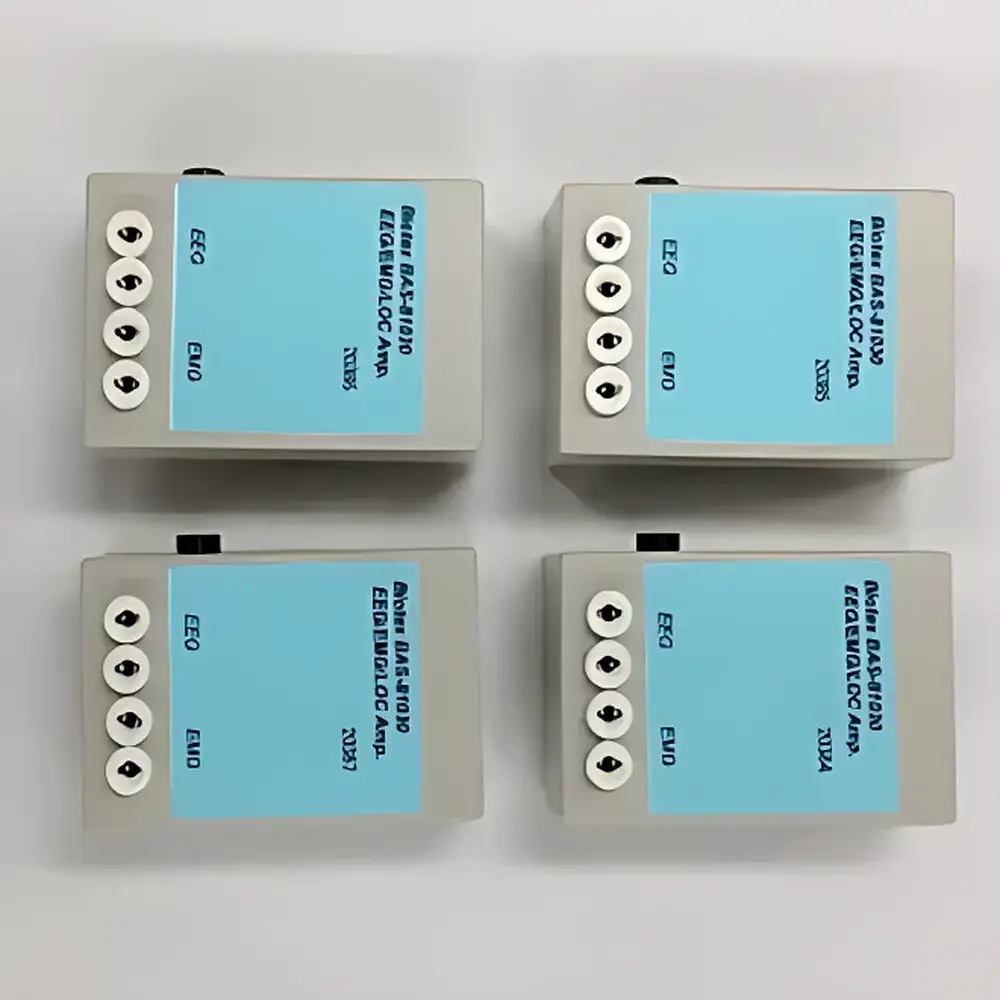
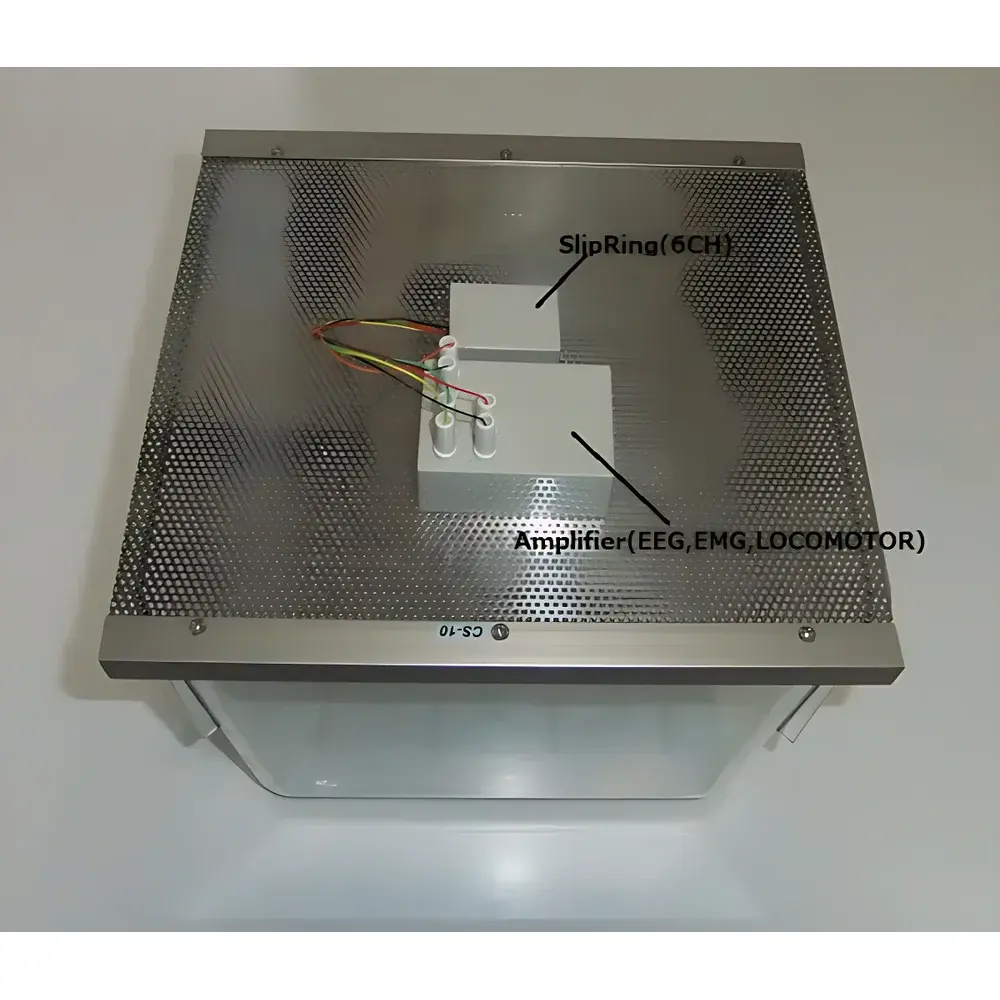
Kissei BAS Series Head-Mounted Electrophysiological Amplifier
| Brand | Kissei |
|---|---|
| Origin | Japan |
| Model | BAS Series |
| Channel Configuration | 2-Channel (1×EEG + 1×EMG) or 3-Channel (2×EEG + 1×EMG) |
| Compliance | CE-marked for research use only |
| Intended Use | Chronic in vivo electrophysiology in freely moving rodents |
Overview
The Kissei BAS Series Head-Mounted Electrophysiological Amplifier is a compact, low-noise, battery-powered signal conditioning system engineered for chronic, tether-free neural and muscular recording in awake, freely behaving small animals—primarily rats and mice. Designed in collaboration with Biotex Co., Ltd. (Japan), the amplifier implements high-fidelity analog signal amplification, filtering, and impedance buffering directly at the electrode interface to minimize motion-induced artifacts, cable capacitance effects, and electromagnetic interference. Its head-mounted architecture eliminates the need for slip-ring commutators or heavy tethered cables, thereby preserving natural locomotion, social interaction, and ethologically valid behavioral expression during long-term EEG/EMG acquisition. The device operates on the principle of differential amplification with programmable gain and hardware-based bandpass filtering, optimized for the spectral characteristics of cortical EEG (0.5–100 Hz) and skeletal muscle EMG (10–1,000 Hz) signals.
Key Features
- Ultra-compact, lightweight design (< 3.5 g body weight; < 1.2 cm³ volume) compatible with standard rodent skull-mounting protocols and chronic cranial window preparations.
- Dual configuration options: 2-channel variant supports simultaneous acquisition of one EEG channel (e.g., frontal-parietal cortex) and one bipolar EMG channel (e.g., nuchal or hindlimb musculature); 3-channel variant adds a second EEG channel for interhemispheric or regional comparison.
- Programmable gain range: 100× to 10,000× (switch-selectable), with input-referred noise < 1.8 µVRMS (0.5–100 Hz bandwidth, measured at 1 kΩ source impedance).
- Integrated hardware filters: 0.5 Hz high-pass (Butterworth, 2nd order) and 100 Hz / 1 kHz low-pass (user-selectable), plus optional 50/60 Hz notch filter for ambient line-noise suppression.
- Onboard lithium-polymer battery providing > 48 hours of continuous operation at nominal gain settings; USB-C rechargeable with charge-status LED indicator.
- Biocompatible housing (medical-grade PEEK and silicone-coated PCB) certified for implantation-compatible mounting; IP54-rated against dust and splashing water during behavioral assays.
Sample Compatibility & Compliance
The BAS Series amplifier is validated for use with standard stainless-steel or tungsten microwire electrodes (50–100 µm diameter), screw electrodes (0.9 mm pitch), and miniature EMG needle pairs. It supports acute and chronic implantation paradigms under IACUC- or AAALAC-accredited animal facilities. While not intended for human clinical use, the system conforms to ISO 14971:2019 (risk management for medical devices) and meets essential requirements of the EU Medical Device Regulation (MDR) Annex I for Class I non-invasive research equipment. All firmware and calibration procedures comply with GLP-aligned documentation standards, including version-controlled calibration logs and traceable gain verification using NIST-traceable reference signals.
Software & Data Management
Raw analog output is delivered via low-jitter, shielded micro-USB or analog BNC interface to external data acquisition systems (e.g., National Instruments USB-6363, Tucker-Davis Technologies RZ2, or Intan Technologies RHD2000 series). Kissei provides open-source MATLAB and Python SDKs (GitHub-hosted) supporting real-time streaming, timestamp synchronization via TTL pulse output, and metadata embedding (animal ID, session start time, channel mapping). Data files are saved in HDF5 format with embedded ontological annotations compliant with BIDS-EEG extension specifications. Audit trails—including amplifier configuration changes, battery voltage logging, and thermal drift compensation events—are recorded per GLP requirement and exportable for regulatory review.
Applications
- Longitudinal seizure monitoring in genetic or chemically induced epilepsy models (e.g., pilocarpine, kainic acid).
- Circadian dynamics of sleep-wake architecture via combined EEG/EMG scoring (Wake, NREM, REM classification per AASM guidelines).
- Motor circuit dysfunction assessment in Parkinson’s disease (6-OHDA), Huntington’s (R6/2), or spinal cord injury models.
- Pharmacokinetic-pharmacodynamic correlation studies evaluating CNS-active compounds (e.g., benzodiazepines, antipsychotics) with simultaneous behavioral video tracking.
- Optogenetic-electrophysiological closed-loop experiments when paired with compatible laser drivers and photodetector interfaces.
FAQ
Is the BAS Series amplifier compatible with wireless telemetry systems?
No—it is a wired headstage designed for direct analog output to external DAQ hardware. Wireless transmission requires integration with third-party transmitters (e.g., DSL-2000 series) and is not natively supported.
Can the device be sterilized for surgical implantation?
The housing and electrode interface components withstand ethylene oxide (EtO) sterilization and low-temperature hydrogen peroxide plasma cycles; autoclaving is prohibited.
What is the maximum recommended electrode impedance for stable recordings?
Optimal performance is achieved with electrode impedances between 0.2 MΩ and 2 MΩ at 1 kHz; higher impedances may increase thermal noise and susceptibility to motion artifact.
Does the amplifier support differential referencing across EEG channels?
Yes—each EEG channel features independent programmable reference selection (common reference, linked ears, or digitally switchable local reference).
Is FDA 21 CFR Part 11 compliance available?
While the amplifier itself is not a regulated medical device, its software SDK and audit-log framework support Part 11–aligned electronic record workflows when deployed within validated laboratory information management systems (LIMS).
Related Products




