
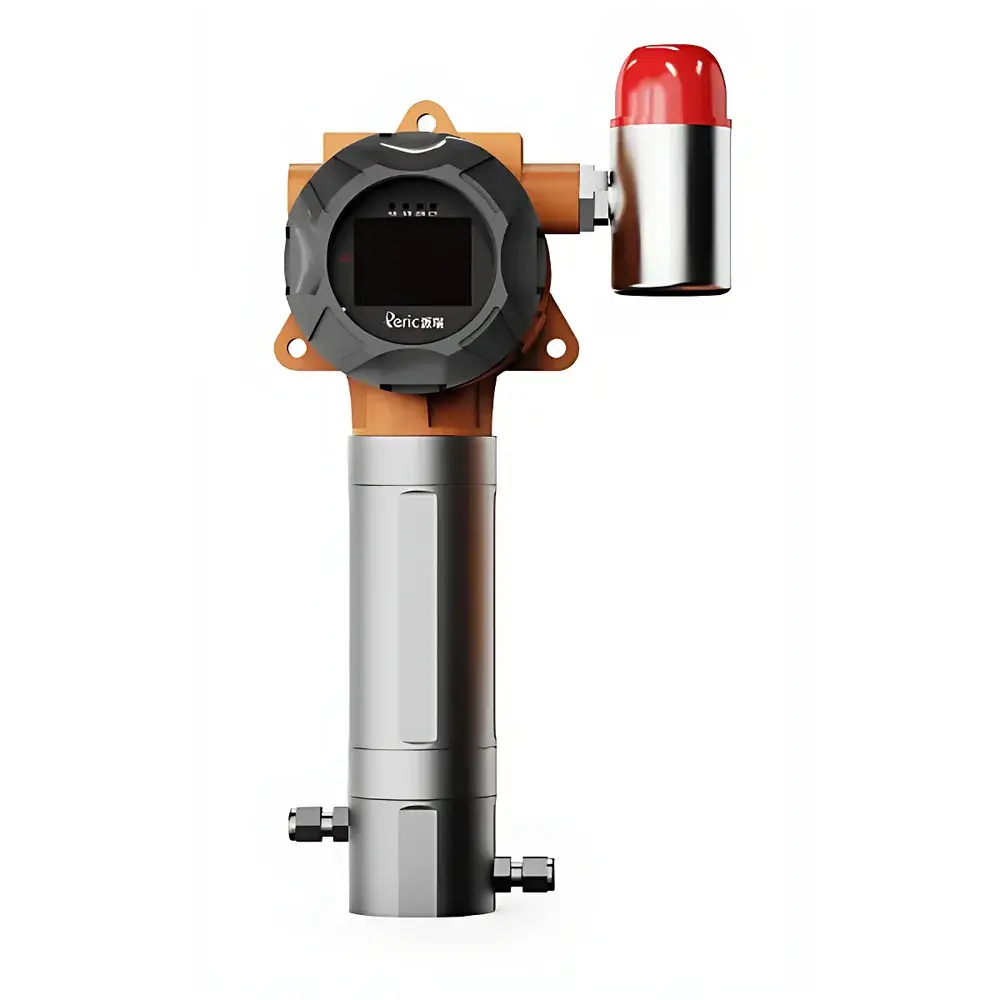
PERIC GNF-TR-DP Aluminum Oxide Capacitive Dew Point Analyzer
| Brand | PERIC |
|---|---|
| Model | GNF-TR-DP |
| Sensor Principle | Ultra-Thin Aluminum Oxide Capacitive |
| Measurement Range | –100 °C to +20 °C (Td) |
| Accuracy | ±2 °C @ +20 °C to –60 °C Td |
| Repeatability | ±0.5 °C |
| Stability | ±1% F.S. / 7 days |
| Response Time (63% / 90%) | 5 s / 10 s (–60 °C → –20 °C Td) |
| Explosion Protection | Ex db IIC T6 Gb (ATEX-compliant) |
| Ingress Protection | IP66 |
| Power Supply | 24 V DC |
| Communication Interface | TTL-level Serial Port |
| Analog Output | 4–20 mA (hardware-ready, software-configurable) |
| Mechanical Interface | M20×1.5 thread (display unit) |
| Operating Ambient Temperature | –10 °C to +50 °C |
| Relative Humidity | <90% RH (non-condensing) |
| Sample Pressure | Atmospheric ±10% (vented to ambient) |
| Sample Flow Rate | 3–5 L/min |
| Sensor Lifetime | >2 years (normal operation) |
| Instrument Lifetime | >5 years (normal operation) |
Overview
The PERIC GNF-TR-DP is a high-stability, intrinsically safe aluminum oxide capacitive dew point analyzer engineered for continuous, trace-level moisture monitoring in hydrogen and oxygen streams within electrolytic hydrogen production systems. It operates on the principle of dielectric constant change in a hygroscopic aluminum oxide sensing layer—where water vapor adsorption alters capacitance in direct proportion to partial pressure of water, enabling precise dew point (Td) determination across an extended range from –100 °C to +20 °C. Designed specifically for post-purification verification in green hydrogen infrastructure, the instrument meets stringent requirements for safety-critical gas quality assurance—ensuring compliance with ISO 8573-1 Class 1 (≤0.2 ppmv H2O) and ASTM D7443 for compressed gas moisture analysis. Its ultra-thin sensor architecture minimizes thermal mass and accelerates response dynamics while maintaining long-term baseline stability under cyclic exposure to dry process gases.
Key Features
- Intrinsically safe design certified to Ex db IIC T6 Gb per EN 60079-1 and EN 60079-0—fully compliant with ATEX Directive 2014/34/EU for Zone 1 hazardous areas.
- IP66-rated enclosure ensures reliable operation in outdoor, high-humidity, and washdown-prone environments typical of electrolyzer skids and modular hydrogen plants.
- Capacitive aluminum oxide sensor with proprietary surface passivation delivers low drift (<±1% F.S./7 days) and immunity to CO2, hydrocarbons, and non-condensable gases—critical for hydrogen purity validation where cross-sensitivity must be eliminated.
- Optimized thermal management enables stable performance across ambient temperatures from –10 °C to +50 °C without active temperature control—reducing power demand and field maintenance burden.
- Dual-stage flow conditioning integrated into the sample interface ensures laminar, pressure-stabilized flow at 3–5 L/min—meeting ISO 8573-3 requirements for representative sampling of low-moisture gases.
- Modular hardware architecture separates sensing head (M20×1.5 mount) from display/control unit, facilitating retrofit installation and sensor replacement without system shutdown.
Sample Compatibility & Compliance
The GNF-TR-DP is validated for use with high-purity hydrogen (≥99.999%), oxygen (≥99.8%), and inert carrier gases such as nitrogen and argon. It is insensitive to trace levels of O2, H2, CO, CO2, and CH4, eliminating false positives in electrolysis off-gas streams. All wetted materials—including the 1/4″ NPT inlet/outlet ports and Φ6 stainless steel compression fittings—conform to ASTM A269 TP316L specifications for corrosion resistance and leach-free operation. The analyzer supports GLP/GMP-aligned data integrity through hardware-enforced audit trails in future firmware updates and complies with IEC 61508 SIL 2 functional safety requirements when deployed in safety instrumented systems (SIS) for hydrogen purity interlocks.
Software & Data Management
The embedded firmware provides local configuration via TTL serial interface (RS-232 compatible), supporting ASCII command protocol for integration into PLC-based SCADA architectures (e.g., Siemens S7, Rockwell ControlLogix). Real-time dew point values, sensor status flags, and diagnostic logs are accessible via Modbus RTU over the same interface. The 4–20 mA analog output is factory-calibrated and configurable for linear or square-root scaling—enabling direct connection to DCS trend historians without signal conditioning. All calibration events, zero/span adjustments, and alarm thresholds are timestamped and stored in non-volatile memory, satisfying FDA 21 CFR Part 11 requirements for electronic records when paired with validated host systems.
Applications
- Final quality verification of PEM and alkaline electrolyzer product hydrogen (post-dryer, pre-compression) to meet ISO 14687-2 Grade A (≤0.1 ppmv H2O) for fuel cell applications.
- Moisture monitoring in oxygen vent streams to prevent condensation-induced corrosion in downstream piping and storage vessels.
- Continuous validation of desiccant dryer performance in hydrogen purification loops—supporting predictive maintenance scheduling based on Td drift trends.
- Commissioning and periodic verification of hydrogen refueling station (HRS) dispensers per SAE J2719 and ISO 19880-1 moisture limits.
- Research-grade moisture profiling in lab-scale electrolysis test benches requiring sub-ppb resolution and long-term repeatability.
FAQ
What is the recommended calibration frequency for the GNF-TR-DP in continuous hydrogen service?
Annual two-point calibration (using certified –40 °C and –70 °C dew point reference gases) is recommended; however, field verification using NIST-traceable chilled mirror standards every 6 months is advised for GMP-regulated operations.
Can the analyzer operate at elevated sample pressures beyond atmospheric?
No—the instrument is designed for ambient-pressure sampling only. Positive or negative pressure deviations exceeding ±10% require external pressure regulation upstream of the inlet to maintain sensor integrity and measurement accuracy.
Is the sensor susceptible to poisoning by siloxanes or amine-based contaminants?
The ultra-thin Al2O3 layer exhibits high resistance to silicone-based compounds and amines common in biogas-derived feedstocks; however, direct exposure to >1 ppmv trimethylamine or octamethylcyclotetrasiloxane (D4) is not recommended without upstream activated carbon filtration.
Does the unit support remote firmware updates or diagnostics via Ethernet or wireless?
Not natively—current hardware supports only TTL serial and 4–20 mA interfaces. Remote access requires integration with a field gateway (e.g., MQTT-enabled edge controller) that bridges the serial port to cloud platforms.
How does the response time specification account for varying ambient temperature conditions?
The stated response times (63%/90%) are measured at 20 °C ambient and 1 bar absolute sample pressure. At lower ambient temperatures (<5 °C), stabilization time increases by ~15% per 10 °C drop due to reduced thermal conductivity in the sensor stack.




