
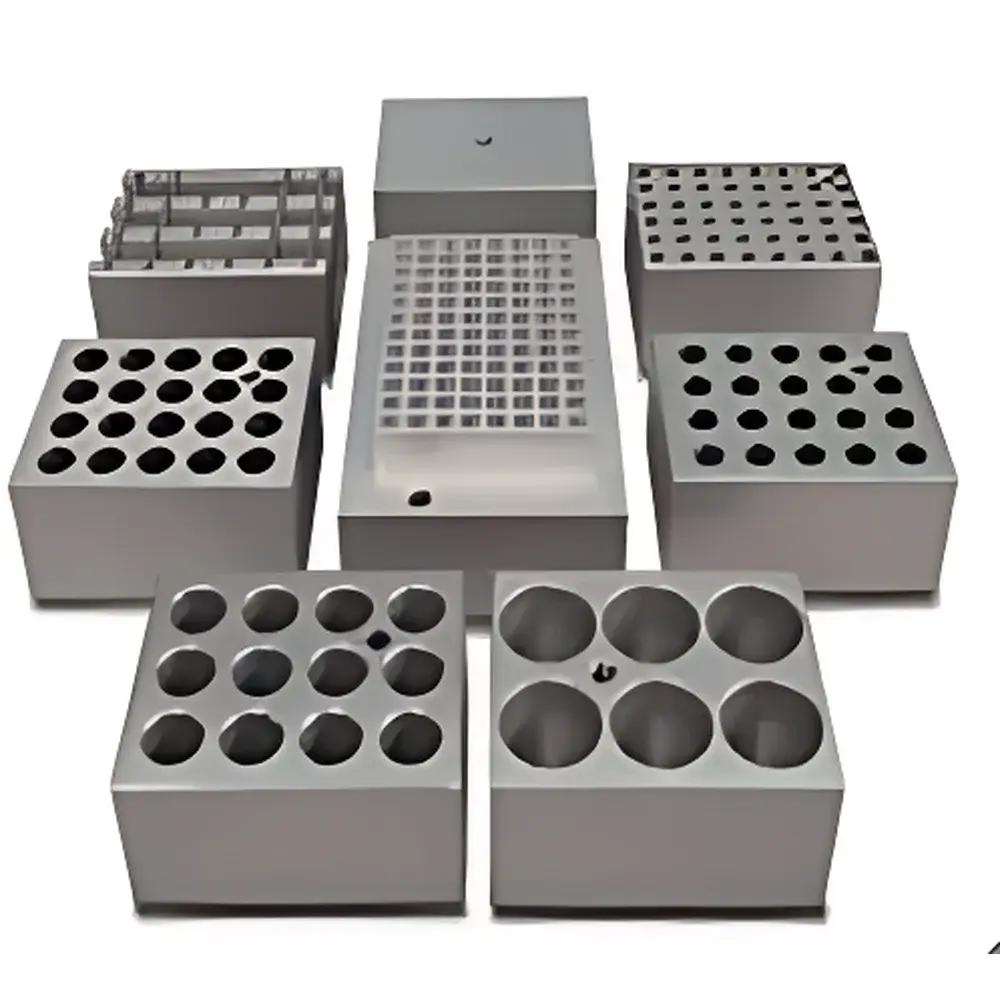
Aluminum Block for Dry Bath Heaters – SHT Series, Anodized Aluminum Heat Transfer Block
| Origin | Germany |
|---|---|
| Manufacturer Type | Authorized Distributor |
| Origin Category | Imported |
| Model | SHT Series Aluminum Block |
| Price | Available Upon Request |
Overview
The SHT Series anodized aluminum blocks are precision-engineered thermal transfer modules designed exclusively for integration with laboratory dry bath heaters. These blocks serve as the critical interface between the heater’s heating element and sample containers—ensuring uniform, stable, and reproducible temperature distribution across all wells. Constructed from high-purity 6061-T6 aluminum and subjected to hard anodization (Type III), each block exhibits exceptional thermal conductivity (~237 W/m·K), dimensional stability across operating ranges (−10 °C to 150 °C), and resistance to corrosion from common lab solvents, acids, and condensation. Unlike generic metal inserts, SHT blocks are manufactured to ISO 2768-mK general tolerances, with bore geometries optimized for tight thermal coupling—minimizing air gaps and reducing thermal lag during ramping or hold phases. Their standardized footprint enables seamless compatibility across leading dry bath platforms, including Thermo Scientific, Eppendorf ThermoMixer, Benchmark Scientific, and similar Peltier- or resistive-heated systems.
Key Features
- Anodized 6061-T6 aluminum construction for enhanced surface hardness (HV 500+), chemical resistance, and long-term thermal cycling integrity
- Precision-bored wells with ±0.05 mm diameter tolerance and 9° conical taper (where specified) to ensure optimal contact with conical-bottom microtubes (e.g., 0.2 mL, 0.5 mL, 1.5 mL)
- Standardized external dimensions: 75 mm (W) × 95 mm (D) × 50 mm (H) for all models except SHT/96 and SHT/384 (150 mm × 95 mm × 61 mm)
- Thermally optimized wall thickness and base depth to balance heat-up rate, temperature homogeneity (< ±0.3 °C across wells at 37 °C), and mechanical rigidity
- Non-reflective matte black anodized finish to reduce ambient light interference in fluorescence-sensitive assays
- Traceable lot numbering and RoHS-compliant material certification supplied with each shipment
Sample Compatibility & Compliance
SHT blocks support a comprehensive range of tube formats used in molecular biology, clinical diagnostics, and analytical chemistry workflows—including skirted and non-skirted PCR plates, conical microcentrifuge tubes (0.2–2.0 mL), glass vials, and custom disposable cups. Each well geometry is validated against IEC 61000-4-2 (ESD immunity) and ASTM D3359 (adhesion testing for anodized coatings). Blocks comply with ISO 13485:2016 requirements for medical device accessories and meet USP extractables testing thresholds for polypropylene- and polyethylene-compatible contact surfaces. For GLP/GMP environments, blocks are compatible with documented calibration procedures per ISO/IEC 17025 and support audit-ready traceability when paired with calibrated dry bath units featuring 21 CFR Part 11–compliant firmware.
Software & Data Management
While the aluminum blocks themselves are passive thermal components, their standardized dimensions and thermal mass characteristics are embedded in the thermal profile libraries of major dry bath control software suites—including Thermo Fisher’s MyBath™, Eppendorf’s VisioNize Lab Suite, and Benchmark’s SmartLink™. This enables automatic recognition of block type during protocol setup, triggering pre-validated ramp/hold parameters and compensating for thermal inertia differences between 12-mm and 384-well configurations. All SHT part numbers (e.g., SHT1/22, SHT1/96) are cross-referenced in LIMS-compatible inventory modules and support barcode-scanned asset tracking within enterprise laboratory informatics systems.
Applications
- Enzymatic reactions requiring precise incubation (e.g., restriction digests, ligations, cDNA synthesis)
- Cell culture sample thawing and pre-warming under controlled thermal gradients
- Stability studies of biologics and small molecules in accelerated degradation protocols
- High-throughput nucleic acid purification workflows using 96-well and 384-well plate formats
- Calibration verification of thermocouple probes and IR thermometers via multi-point well referencing
- Pre-analytical sample conditioning for HPLC, GC, and LC-MS workflows where tube-to-tube thermal variance must remain below ±0.2 °C
FAQ
Are SHT aluminum blocks compatible with oil baths or water baths?
No—these blocks are engineered specifically for dry bath heaters with planar heating plates. Submersion in liquid media compromises anodized layer integrity and introduces thermal interface resistance.
Can I use the same SHT block across different dry bath models?
Yes, provided the heater’s mounting footprint and clamping mechanism accommodate the standard 75 × 95 mm base (or 150 × 95 mm for high-density plates). Always verify mechanical clearance and thermal load specifications with your instrument OEM.
Do SHT blocks require recalibration of the dry bath unit?
No—but users must select the correct block ID in the instrument’s software to apply validated thermal compensation algorithms for accurate setpoint delivery.
Is cleaning validation data available for SHT blocks?
Yes—certified cleaning protocols (using 70% ethanol, 1% SDS, or 0.1 M NaOH) and residue testing reports (via TOC and HPLC-UV) are available upon request for GxP-regulated labs.
What is the maximum recommended operating temperature for continuous use?
150 °C for standard anodized SHT blocks; extended exposure above this threshold may accelerate oxide layer fatigue and reduce long-term dimensional repeatability.



