
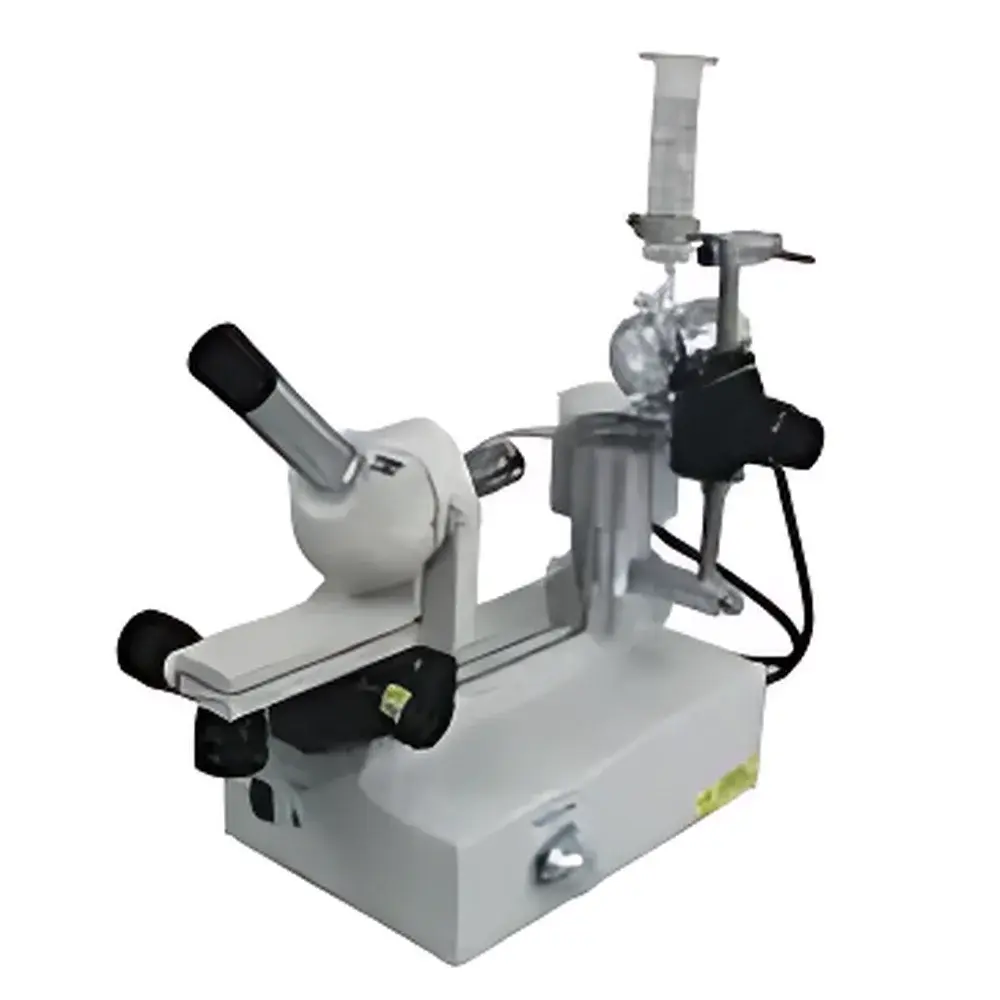
Narishige EG-402 Glass Micropipette Grinder
| Brand | Narishige |
|---|---|
| Model | EG-402 |
| Origin | Japan |
| Microscope Magnification | 30× (10× eyepiece + 3× objective) |
| Micropipette Positioning | Full XYZ translation + continuous 360° rotational adjustment |
| Micropipette Approach Range | ~47 mm |
| Microscope Stage Travel | X: ~7 mm, Y: 30 mm, Z: ~8 mm |
| Grinding Wheel Speed | 50–2000 rpm (continuously adjustable) |
| Grinding Medium | Diamond-coated abrasive wheel |
| Compatible Capillary Diameter | 1.0–1.5 mm |
Overview
The Narishige EG-402 Glass Micropipette Grinder is a precision-engineered instrument designed for reproducible fabrication of fine-tipped glass micropipettes used in electrophysiology, microinjection, patch-clamp recording, and single-cell manipulation. It operates on the principle of controlled mechanical grinding using a rotating diamond-coated abrasive wheel under continuous water-mediated cooling—ensuring minimal thermal stress, consistent tip geometry, and high repeatability across successive pipettes. Unlike flame-based pullers, the EG-402 enables deterministic shaping of tip diameter, bevel angle, and wall thickness without altering glass composition or inducing annealing-related structural relaxation. Its integrated stereo-microscope (30× total magnification) provides real-time visual feedback during grinding, while the fully adjustable XYZ + 360° rotational manipulator allows precise alignment of capillary orientation relative to the grinding surface—critical for producing asymmetric bevels or side-opening configurations required in intracellular recording and nanoinjection.
Key Features
- High-resolution stereomicroscope with 10× wide-field eyepieces and 3× objective lens (30× total magnification), optimized for depth perception and ergonomic viewing during extended operation.
- Motorized diamond grinding wheel with continuously variable speed control (50–2000 rpm), enabling optimization of material removal rate and surface finish for diverse glass types (e.g., borosilicate, aluminosilicate, filamented quartz).
- Three-axis micromanipulator with calibrated linear travel: X (~7 mm), Y (30 mm), Z (~8 mm); combined with full 360° rotational freedom for capillary mounting, supporting complex tip geometries including angled bevels, flat tips, and tapered openings.
- Integrated water humidifier system delivering consistent, low-flow coolant directly to the grinding interface—preventing localized overheating, minimizing glass chipping, and extending wheel service life.
- Rigid aluminum alloy frame with vibration-damped base, engineered for stability during fine-positioning tasks; compatible with standard optical tables and anti-vibration platforms.
- Capillary holder accepts standard 1.0–1.5 mm outer-diameter glass capillaries (e.g., GC150F-10, BF150-86-10), with secure clamping and repeatable axial centering.
Sample Compatibility & Compliance
The EG-402 is validated for use with borosilicate (e.g., Kimax®, Pyrex®) and aluminosilicate glass capillaries commonly employed in neurophysiology and developmental biology applications. Its mechanical grinding methodology avoids organic solvent exposure or thermal degradation pathways—making it suitable for labs adhering to GLP-compliant documentation practices where traceability of fabrication parameters (speed, position, duration) is required. While the instrument itself does not carry CE or FDA 510(k) certification as a medical device, its design conforms to IEC 61000-6-2 (immunity) and IEC 61000-6-3 (emission) standards for laboratory equipment. All mechanical adjustments are lockable via knurled thumbscrews, supporting audit-ready setup reproducibility per ISO/IEC 17025 guidelines for testing laboratories.
Software & Data Management
The EG-402 is a manually operated, analog-controlled instrument with no embedded firmware or digital interface. All operational parameters—including wheel speed, capillary position, and grinding duration—are set and recorded externally by the user. This architecture eliminates software validation overhead and supports seamless integration into regulated environments governed by FDA 21 CFR Part 11, where electronic records must undergo rigorous qualification. Users typically log grinding conditions in bound lab notebooks or LIMS-integrated spreadsheets, referencing batch numbers, operator ID, date/time, and observed tip morphology (e.g., SEM verification). Optional third-party digital calipers or USB microscopes may be used for post-grind metrology, with data exported in CSV or TIFF format for archival.
Applications
- Preparation of low-resistance patch-clamp pipettes with sub-micron tip openings and smooth inner walls for high-fidelity current recording.
- Fabrication of beveled micropipettes for intracellular injection in oocytes, embryos, and cultured neurons—reducing membrane damage and improving seal formation.
- Production of side-opening pipettes for localized drug delivery or simultaneous aspiration/recording in slice electrophysiology.
- Custom shaping of recording electrodes for extracellular arrays and chronic implantable probes requiring defined taper profiles.
- Research-grade prototyping of microfluidic interconnects and nanoscale fluidic channels fabricated from pulled-and-ground capillaries.
FAQ
What types of glass capillaries are compatible with the EG-402?
The EG-402 accepts standard 1.0–1.5 mm outer-diameter glass capillaries, including borosilicate (e.g., Narishige GD-1, Sutter BF150-86-10) and aluminosilicate varieties. Wall thickness and filament presence do not impede operation, though optimal grinding outcomes require consistent capillary concentricity.
Is the water humidifier system optional or integrated?
The water humidifier is factory-integrated and non-removable; it delivers a regulated, low-volume stream (<1 mL/min) to the grinding zone via a gravity-fed reservoir and silicone tubing—no external pump required.
Can the EG-402 produce sub-micron tip diameters?
Yes—when combined with post-grind heat-polishing (using a separate microforge), tip diameters below 500 nm can be reliably achieved. The EG-402 alone produces tips ranging from ~1 µm to >10 µm, depending on grinding duration, speed, and approach angle.
Does Narishige provide calibration services or traceable documentation?
Narishige offers factory calibration certificates upon request (at additional cost), documenting stage linearity, microscope magnification accuracy, and wheel speed tolerance (±2% at 1000 rpm). On-site recalibration is supported by authorized service centers in North America, EMEA, and APAC regions.
How does the EG-402 compare to laser-based micropipette fabricators?
Unlike laser systems—which rely on localized thermal ablation—the EG-402 uses mechanical abrasion, eliminating concerns about glass recrystallization, carbon residue, or UV-induced surface modification. It offers superior control over bevel geometry and is more cost-effective for mid-throughput labs performing routine pipette preparation.



