
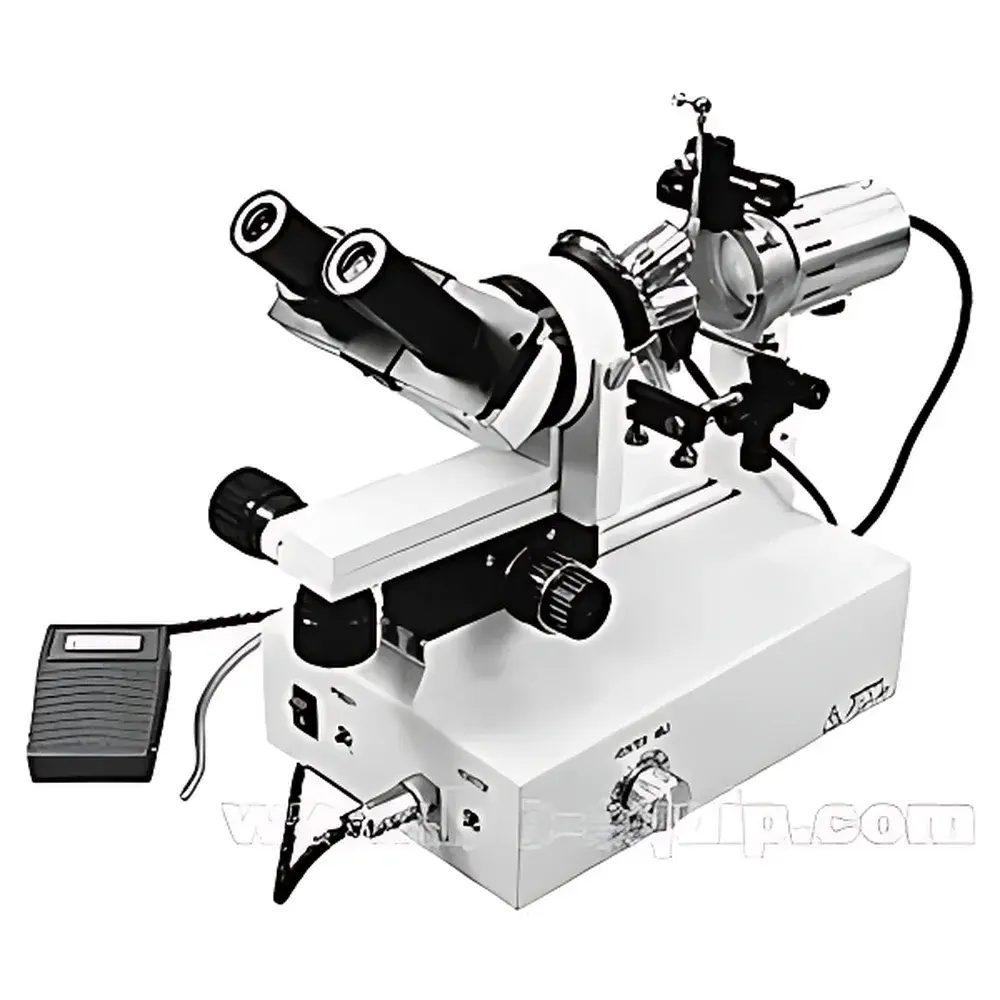
Narishige MF2 Micropipette Puller & Needle Forge System
| Brand | Narishige |
|---|---|
| Model | MF2 |
| Origin | Japan |
| Type | Microelectrode Fabrication Instrument |
| Heating Micro-Positioning Range (X/Y/Z) | 14 mm / 14 mm / 14 mm |
| Microneedle Manipulation Range (X/Z) | 12 mm / 28 mm |
| Microscope Travel (X/Y/Z) | ~7 mm / 30 mm / ~8 mm |
| Magnification | 50× / 100× (10× eyepiece + 5× / 10× objective) |
| Capillary Outer Diameter Compatibility | 1.0 mm |
Overview
The Narishige MF2 Micropipette Puller & Needle Forge System is a precision-engineered benchtop instrument designed for the reproducible fabrication of glass micropipettes, microinjection needles, and fixed-angle tungsten or borosilicate electrodes used in electrophysiology, intracellular recording, microinjection, and patch-clamp applications. Unlike conventional pullers that rely solely on filament heating and gravity-based drawing, the MF2 integrates programmable resistive heating control with high-resolution XYZ micro-manipulation stages—enabling both controlled pipette pulling and post-pull needle forging (bending, bevelling, and tip sharpening) under direct optical supervision. Its dual-function architecture supports two distinct operational modes: thermal capillary pulling (for tapered shank formation) and mechanical needle angling (for custom tip geometry), all performed within the working field of an integrated stereo or compound microscope. The system is optimized for use with standard 1.0 mm outer diameter borosilicate or soda-lime glass capillaries and accommodates interchangeable heating filaments and bending tools calibrated to sub-degree angular resolution.
Key Features
- Integrated dual-stage micro-manipulation: Independent heating stage (14 mm travel in X/Y/Z) for precise filament positioning and thermal gradient control; separate needle manipulation stage (12 mm X, 28 mm Z) for post-pull bending and angle adjustment.
- Real-time visual metrology: Equipped with a high-stability microscope mount supporting 50× and 100× total magnification (10× wide-field eyepiece + 5×/10× achromatic objectives); includes calibrated reticle for in-situ measurement of bend angles, tip taper, and bevel orientation.
- Footswitch-compatible operation: Optional foot pedal enables hands-free initiation of heating cycles and bending steps—critical for maintaining sterility and minimizing hand tremor during fine adjustments.
- Thermal profile reproducibility: Digital temperature controller with PID regulation ensures consistent filament heating across repeated cycles, reducing inter-run variability in tip geometry and wall thickness.
- Rigid mechanical architecture: All-positioning stages utilize precision-machined brass and stainless-steel components with low-backlash micrometer drives, ensuring long-term dimensional stability and resistance to thermal drift.
Sample Compatibility & Compliance
The MF2 accepts standard 1.0 mm OD glass capillaries (e.g., Narishige GD-1, Sutter BF150-110-10, or equivalent borosilicate tubing) and is compatible with common electrode materials including platinum-iridium wire, tungsten rods (up to 100 µm), and carbon fibers. No consumables beyond capillaries and replacement filaments are required. The instrument complies with IEC 61010-1:2010 safety standards for laboratory electrical equipment and meets electromagnetic compatibility requirements per EN 61326-1. While not classified as a medical device, its output electrodes are routinely validated for use in GLP-compliant neurophysiology and developmental biology studies adhering to ISO/IEC 17025 documentation practices.
Software & Data Management
The MF2 operates via analog-digital hybrid control—no embedded firmware or proprietary software is required. All parameter settings (heating duration, filament current, stage offsets) are adjusted manually using calibrated dials and vernier scales, ensuring full traceability and eliminating software validation overhead. Users maintain procedural records manually or integrate MF2 protocols into LIMS or ELN systems via standardized SOP templates. Audit trails for electrode fabrication—including date, operator ID, capillary lot number, and measured tip geometry—are recommended per institutional QA guidelines for electrophysiological experiments.
Applications
- Intracellular microelectrode fabrication for sharp-electrode recordings in neurons, oocytes, and plant cells.
- Custom-bevelled injection needles for zygote microinjection, CRISPR-Cas9 delivery, and pronuclear transfer.
- Fabrication of high-resistance (>100 MΩ) patch pipettes for single-channel recording.
- Production of angled recording probes for chronic implantation or laminar cortical mapping.
- Calibration reference needle production for atomic force microscopy (AFM) and scanning ion conductance microscopy (SICM).
FAQ
Can the MF2 fabricate patch pipettes with fire-polished tips?
Yes—by combining controlled heating with post-pull tip exposure to a secondary low-power filament or micro-flame source (not included), users routinely achieve smooth, symmetric fire-polished geometries. Polishing parameters must be optimized empirically per glass type.
Is the microscope included with the MF2 system?
No—the MF2 is supplied without a microscope; it features standardized mounting interfaces compatible with common upright or inverted research-grade microscopes (e.g., Nikon Eclipse Ci, Olympus BX53, Zeiss Axio Imager). Users select optics based on required working distance and depth of field.
What is the minimum achievable tip opening diameter?
Under optimal conditions with 1.0 mm OD capillaries and appropriate pull parameters, tip openings of 0.1–0.3 µm are attainable for single-channel recording; reproducibility depends on glass batch homogeneity and environmental humidity control.
Does Narishige provide calibration certificates for the MF2?
Narishige does not issue factory calibration certificates for the MF2, as it is a mechanical/thermal fabrication tool rather than a metrological instrument. Users perform in-house verification using certified gauge blocks, optical micrometers, and reference capillaries per internal SOPs.
Related Products



