
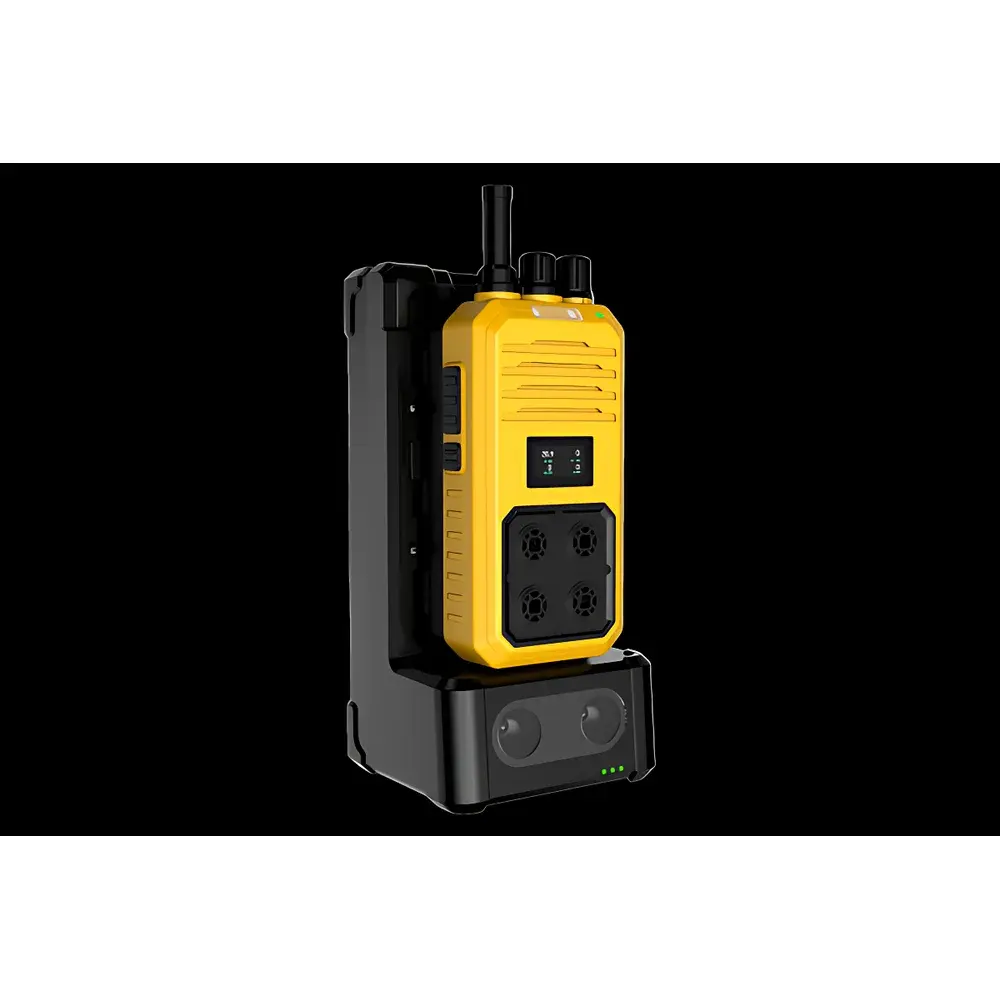
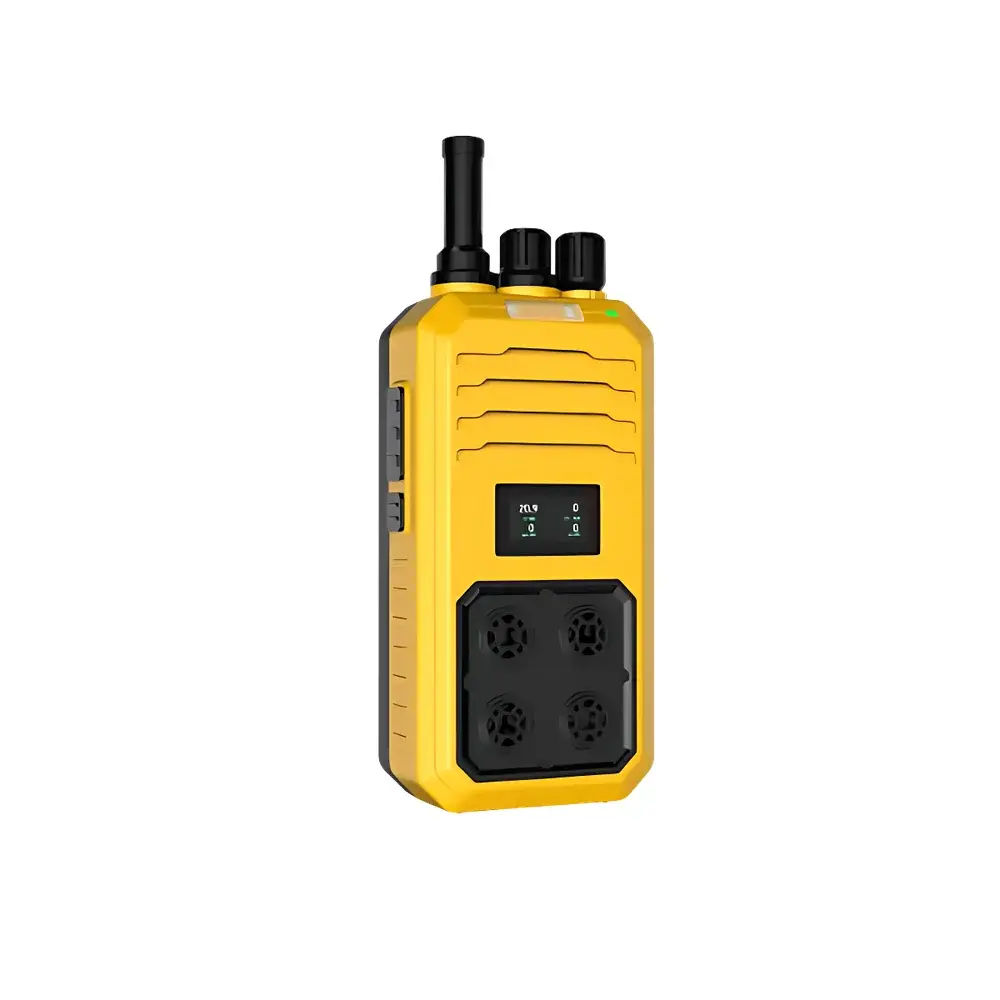
PERIC GHB-X4 Magnetic Wireless Quad-Gas Detector with LoRa Communication and Intrinsic Safety Certification
| Brand | PERIC |
|---|---|
| Model | GHB-X4 |
| Gas Detection Channels | O₂, CO, H₂S, Combustible Gas (CH₄-calibrated) |
| Measurement Principle | Electrochemical (CO, H₂S), Catalytic Bead (Combustible), Zirconia/Galvanic (O₂) |
| Power Supply | 3.7 V Li-ion (Detector: 5000 mAh |
| Magnetic Battery Pack | 27,000 mAh) |
| Intrinsic Safety Rating | Ex ib IIC T3 Gb per GB/T 3836.1–2021 & GB/T 3836.4–2021 |
| Operating Frequency Band | 410.15–493.125 MHz (default 430.125 MHz) |
| Max Transmit Power | 22.0 dBm |
| Receiver Sensitivity | −147 dBm (typ.) |
| LoRa Modem | SX1262-based |
| Network Topology | Self-organizing multi-hop mesh via repeaters |
| Default Upload Interval | 5 min |
| Standby Duration | ≥24 h (detector only), ≥7 days (with magnetic battery pack) |
| Charging Protocol Support | QC3.0 / FCP / SCP / VOOC / AFC (18 W fast charge) |
| Alarm Output | Dual-tone voice alert + dual-color LED flash + local buzzer |
| Environmental Rating | IP65 (detector unit) |
| Compliance | Meets GB/T 3836 series for intrinsic safety |
Overview
The PERIC GHB-X4 Magnetic Wireless Quad-Gas Detector is an intrinsically safe, field-deployable instrument engineered for continuous, real-time monitoring of four critical atmospheric hazards—oxygen (O₂), carbon monoxide (CO), hydrogen sulfide (H₂S), and combustible gases (calibrated to methane, CH₄)—in hazardous industrial environments. Designed in strict accordance with GB/T 3836.1–2021 and GB/T 3836.4–2021, the device carries the Ex ib IIC T3 Gb certification, confirming its suitability for use in Zone 1 and Zone 2 classified areas where flammable gas mixtures of Groups IIA–IIC and temperature classes T1–T3 may be present. Its core measurement architecture integrates electrochemical sensors for CO and H₂S, a catalytic bead sensor for combustible gas detection, and a zirconia-based or galvanic cell for oxygen quantification—each selected for long-term stability, low cross-sensitivity, and calibrated traceability under variable humidity and temperature conditions. Unlike conventional wired or battery-limited detectors, the GHB-X4 employs a modular design: the wireless detection terminal interfaces magnetically with a high-capacity, explosion-proof battery pack featuring integrated overcurrent, overvoltage, short-circuit, overcharge, over-discharge, and overtemperature protection circuits. This architecture enables >7 days of uninterrupted operation at standard 5-minute telemetry intervals—eliminating routine battery swaps and reducing maintenance overhead in confined or elevated workspaces.
Key Features
- Magnetic mounting system with high-strength neodymium magnets—enables rapid, tool-free attachment to ferromagnetic surfaces (e.g., steel bulkheads, pipelines, structural frames) without drilling or adhesives.
- SX1262-based LoRa transceiver delivering extended range (>2 km line-of-sight, >500 m indoor with repeater support) and robust interference immunity in electrically noisy industrial settings.
- Self-healing, multi-hop LoRa mesh networking: automatic repeater discovery and path optimization ensure reliable data delivery even in signal-shadowed zones (e.g., tank interiors, substructure compartments).
- Real-time RSSI monitoring and on-device signal quality feedback—supports empirical network tuning and predictive maintenance of gateway/repeater placement.
- Dual-stage alarm system: audible bilingual voice prompts (English/Chinese), synchronized dual-color (red/amber) high-intensity LED strobes, and local piezoelectric buzzer—all triggered within ≤60 s of threshold breach per gas channel.
- Intelligent power management: load-aware sleep mode activation, adaptive transmission duty cycling, and 18 W fast charging compliant with QC3.0, FCP, SCP, VOOC, and AFC protocols.
- Modular serviceability: detector head and magnetic battery pack are independently replaceable and field-upgradable—minimizing downtime during calibration or battery replacement cycles.
Sample Compatibility & Compliance
The GHB-X4 is validated for ambient air sampling under ISO 16000-23 (indoor air—determination of formaldehyde and other carbonyls) and ASTM D6792 (standard practice for calibration of fixed gas detectors). It complies with the fundamental safety requirements of GB/T 3836.1–2021 (Equipment for Explosive Atmospheres—Part 1: General Requirements) and GB/T 3836.4–2021 (Equipment for Explosive Atmospheres—Part 4: Equipment Protection by Intrinsic Safety “i”). The Ex ib IIC T3 Gb marking confirms conformity to international equivalency standards including IEC 60079-0 and IEC 60079-11. The instrument is not intended for use in mining (Group I), dust-explosion environments (IEC 61241), or Class I, Division 1 locations under NEC 500 unless re-certified by a Nationally Recognized Testing Laboratory (NRTL). All sensor modules undergo factory calibration traceable to NIM (National Institute of Metrology, China) reference standards, with optional user-accessible zero and span adjustment via encrypted Bluetooth interface.
Software & Data Management
Data from the GHB-X4 is transmitted via secure LoRa telemetry to a configurable gateway, then forwarded to a cloud-hosted or on-premise industrial monitoring platform supporting MQTT or HTTP(S) APIs. The platform provides time-synchronized historical trend visualization, geotagged event logging, customizable alarm escalation workflows (SMS/email/webhook), and audit-ready reports compliant with GLP and internal QA documentation requirements. Firmware updates are delivered over-the-air (OTA) with cryptographic signature verification. All configuration changes—including alarm thresholds, upload intervals, and sensor calibration dates—are recorded in an immutable audit trail meeting the record retention provisions of ISO/IEC 17025:2017 Clause 7.10. Platform access supports role-based permissions (admin, operator, viewer), SSO integration, and optional 21 CFR Part 11-compliant electronic signatures when deployed in regulated manufacturing or pharmaceutical facilities.
Applications
The GHB-X4 serves as a primary or secondary gas safety layer across diverse operational contexts: confined space entry monitoring in petrochemical refineries and offshore platforms; continuous atmosphere surveillance in LNG storage tanks, ballast water treatment chambers, and shipboard engine rooms; perimeter leak detection around compressor stations and gas distribution manifolds; and temporary hazard mapping during pipeline pigging, hot work, or emergency response operations. Its magnetic form factor and extended battery life make it especially suitable for intermittent deployment scenarios—such as pre-entry verification prior to lockout/tagout procedures—or permanent installation in hard-to-wire locations where conduit routing is impractical or cost-prohibitive. Integration with SCADA systems via Modbus TCP or OPC UA gateways enables centralized oversight alongside pressure, temperature, and flow instrumentation.
FAQ
Is the GHB-X4 certified for use in ATEX or IECEx zones?
No—the device holds GB/T 3836 certification for Chinese domestic markets only. For ATEX or IECEx compliance, third-party re-certification by an EU Notified Body or IECEx CB Scheme laboratory is required.
Can the detector be calibrated in the field without specialized equipment?
Yes—zero calibration is supported using certified zero air; span calibration requires certified span gas (O₂ 18% v/v, CO 100 ppm, H₂S 25 ppm, CH₄ 50% LEL) and a calibrated regulator; both procedures are guided via the companion mobile app.
What is the maximum number of repeaters supported in a single LoRa network?
Up to 7 repeater hops are supported per end-device path, enabling coverage across multi-compartment vessels or sprawling industrial sites exceeding 50,000 m².
Does the magnetic battery pack require grounding or static-dissipative handling?
Yes—per safety instructions, operators must wear ESD-safe gloves and use the supplied anti-static sleeve when handling or attaching the battery pack in explosive atmospheres.
How is firmware integrity verified during OTA updates?
Each firmware image is signed using ECDSA P-256; the detector validates the signature before committing any update, rejecting unsigned or tampered binaries.







