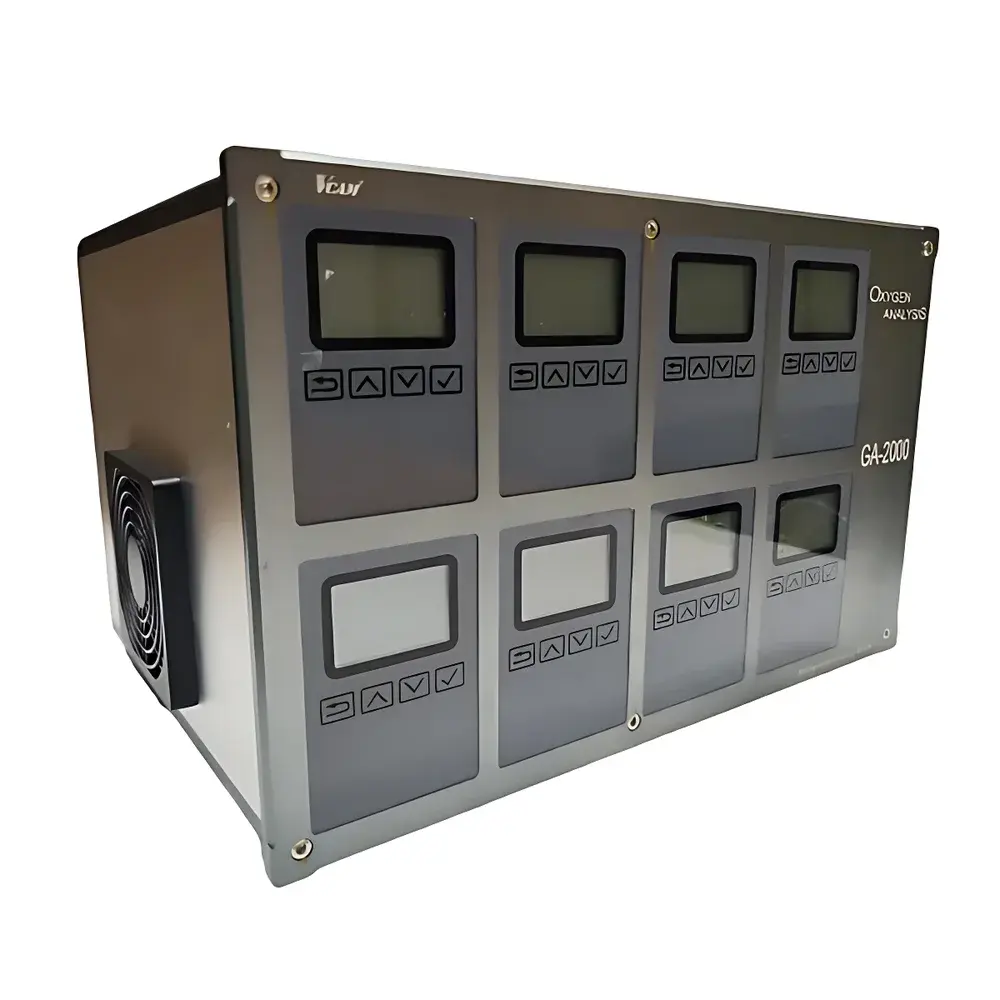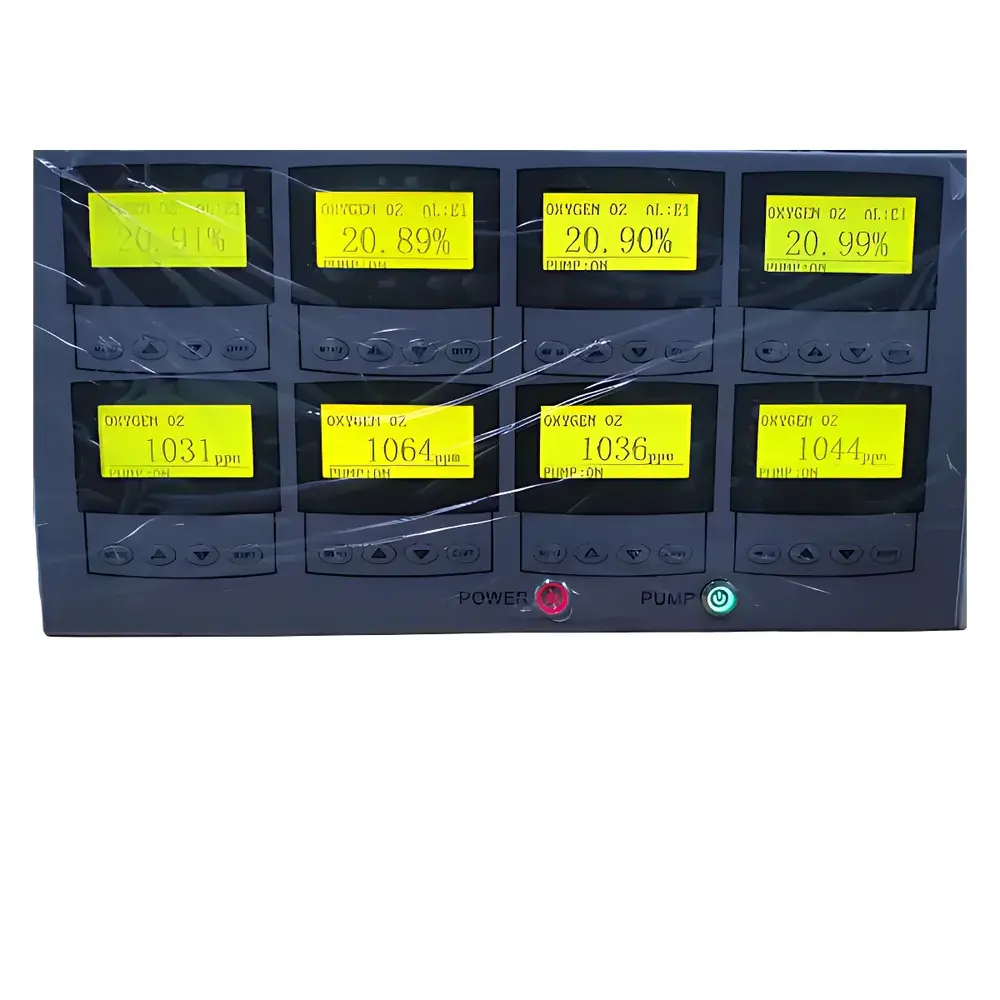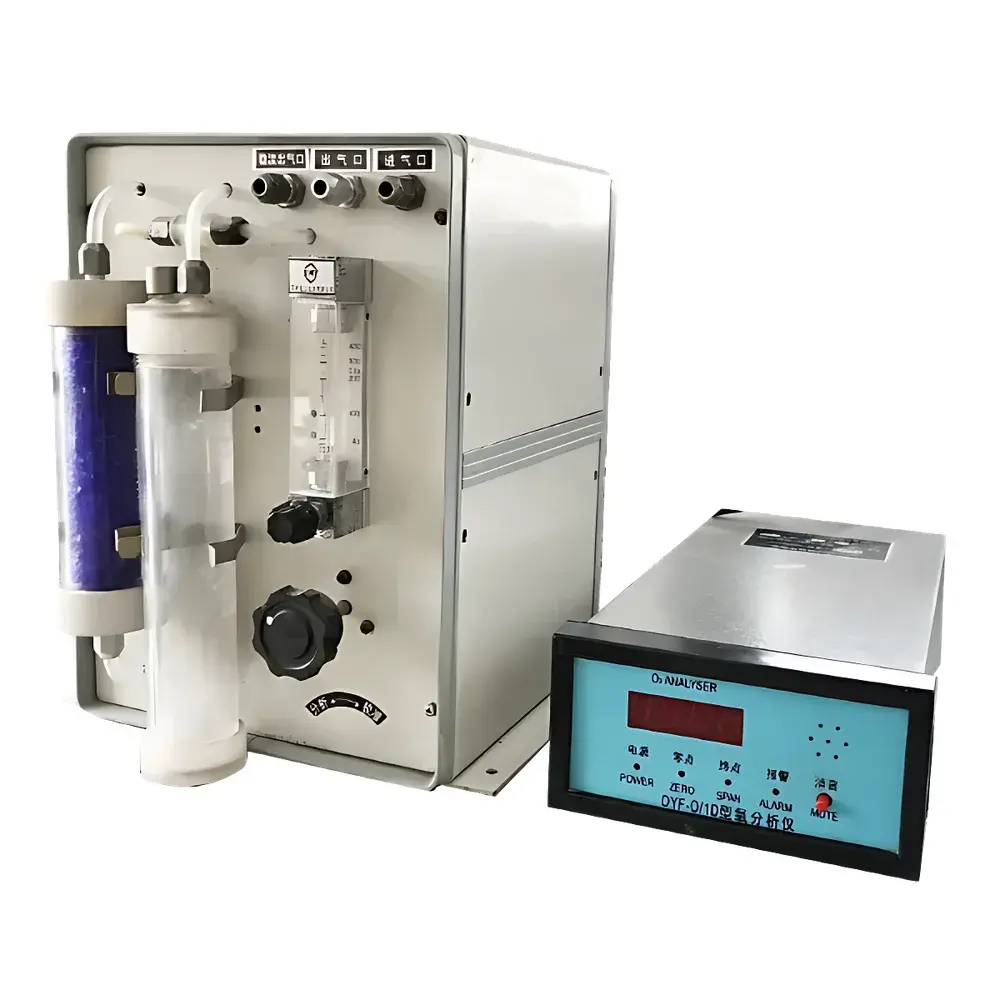
PERIC DYF Fixed-Mount Thermal Conductivity Oxygen Analyzer
| Brand | PERIC |
|---|---|
| Model | DYF |
| Measurement Principle | Catalytic Combustion (Pd-Catalyzed Exothermic Reaction) |
| Measurement Range | 0–1% O₂ |
| Resolution | 0.01% O₂ |
| Response Time (T₉₀) | ≤2.5 min |
| Accuracy | ±5% FS |
| Alarm Threshold | >0.75% O₂ |
| Output Signals | 1–5 V DC, 4–20 mA |
| Display | LED Digital Panel |
| Power Supply | AC 220 V ±10%, 50 Hz ±2.5 Hz |
| Power Consumption | ≤10 W |
| Environmental Operating Range | 0–40 °C, <95% RH |
| Enclosure Rating | Ex d II CT6 (IEC 60079-1 & IEC 60079-2 compliant) |
| Compliance | GB/T 11606–2007, JB/T 8279–1999, GB 3836.1–2010, GB 3836.2–2010 |
Overview
The PERIC DYF Fixed-Mount Thermal Conductivity Oxygen Analyzer is an intrinsically robust, continuous-process gas analyzer engineered for precise and reliable quantification of trace oxygen (0–1% O₂) in hydrogen-rich process streams—primarily those generated by water electrolysis systems used in on-site hydrogen or oxygen production facilities. Unlike paramagnetic or electrochemical sensors, the DYF employs a catalytic combustion principle: oxygen in the sample gas reacts exothermically with excess hydrogen over a palladium (Pd) catalyst bed housed within the sensor’s working arm. This reaction generates heat proportional to the O₂ concentration, inducing a measurable resistance change in a platinum wire element. A Wheatstone bridge configuration compares this signal against a reference arm, enabling high-stability analog output and digital readout. Designed for 24/7 operation in demanding industrial environments, the analyzer meets stringent safety requirements for use in potentially explosive atmospheres (Ex d II CT6), making it suitable for deployment in hydrogen generation skids, power plant auxiliary systems, steel mill purge gas monitoring, and meteorological calibration labs.
Key Features
- Fixed-mount, panel-integrated design optimized for permanent installation in control rooms or process cabinets
- Pd-catalyzed thermal detection mechanism ensures long-term stability and immunity to CO₂, moisture (within spec), and non-reactive background gases
- Ex d II CT6 certified explosion-proof housing compliant with IEC 60079-1 and IEC 60079-2, validated per GB 3836.1–2010 and GB 3836.2–2010
- Dual analog outputs: isolated 4–20 mA current loop and 1–5 V DC voltage signal, both linearly scaled to 0–1% O₂ range
- Configurable visual and audible alarm relay (dry contact) triggered at user-set threshold (factory default: >0.75% O₂)
- LED digital display with 0.01% resolution provides real-time O₂ concentration readout without external interface
- Low power consumption (≤10 W) and wide input tolerance (AC 220 V ±10%, 50 Hz ±2.5 Hz) support stable operation across fluctuating utility grids
- Validated per JB/T 8279–1999 (Industrial Gas Analyzers Test Methods) and GB/T 11606–2007 (Environmental Testing for Analytical Instruments)
Sample Compatibility & Compliance
The DYF analyzer is specifically calibrated and validated for use with high-purity hydrogen streams containing up to 1% residual oxygen. It is not intended for ambient air analysis, hydrocarbon-containing mixtures, or corrosive gas matrices (e.g., Cl₂, H₂S, NH₃). Sample gas must be free of particulates and condensable vapors; optional inline particulate filters and coalescing traps are recommended upstream of the analyzer inlet. The instrument complies with Chinese national standards governing safety, electromagnetic compatibility, and environmental durability—including GB 3836.1–2010 (Explosive Atmospheres – Part 1: General Requirements), GB 3836.2–2010 (Explosive Atmospheres – Part 2: Equipment Protection by Flameproof Enclosures “d”), and GB/T 191–2008 (Packaging – Pictorial Markings for Handling of Goods). While not FDA 21 CFR Part 11 or ISO/IEC 17025 accredited out-of-the-box, its deterministic analog architecture and deterministic alarm logic support integration into GMP/GLP-aligned process control systems where audit trails are managed at the DCS/SCADA level.
Software & Data Management
The PERIC DYF operates as a standalone hardware analyzer with no embedded firmware, microprocessor-based configuration, or network connectivity. All operational parameters—including alarm setpoint, zero calibration offset (via manual potentiometer), and output scaling—are fixed at factory or adjusted via physical trimmers during commissioning. Data acquisition and logging are performed externally via the 4–20 mA or 1–5 V analog outputs, compatible with standard PLCs, DCS I/O modules, and data historians. No proprietary software, drivers, or cloud services are required or supported. This architecture eliminates cybersecurity vulnerabilities, reduces validation burden in regulated environments, and ensures deterministic response behavior under electromagnetic interference (EMI) conditions common in steel mills and power substations.
Applications
- Real-time monitoring of O₂ impurity in PEM or alkaline electrolyzer hydrogen output (critical for fuel cell feedstock purity)
- Quality assurance in on-site oxygen generation plants serving medical or industrial users
- Leak detection and purge verification in hydrogen storage and distribution infrastructure
- Process safety interlocks in coal gasification and syngas conditioning units
- Environmental compliance monitoring in metallurgical off-gas recovery loops (e.g., BOF, EAF furnace purge gas)
- Reference-grade calibration support for meteorological laboratories requiring stable O₂-in-H₂ standards
FAQ
What measurement principle does the PERIC DYF employ?
It uses catalytic combustion thermometry: O₂ reacts with excess H₂ over a palladium catalyst, generating heat proportional to O₂ concentration, which alters the resistance of a platinum sensing element.
Is the analyzer suitable for ambient air or nitrogen blanketing applications?
No. It is calibrated exclusively for H₂ matrices with 0–1% O₂. Performance in N₂, air, or mixed industrial gases is not characterized or warranted.
Does the DYF require periodic recalibration with certified gas standards?
Yes. Initial calibration and routine verification (recommended every 3–6 months) require traceable O₂-in-H₂ calibration gases per JB/T 8279–1999 guidelines.
Can the alarm threshold be adjusted onsite?
Yes, via front-panel potentiometer; however, adjustment requires physical access and adherence to site-specific safety lockout procedures.
Is remote diagnostics or firmware update capability available?
No. The DYF is an analog-only, hardwired instrument with no digital communication interface or upgradable firmware.
Related Products