
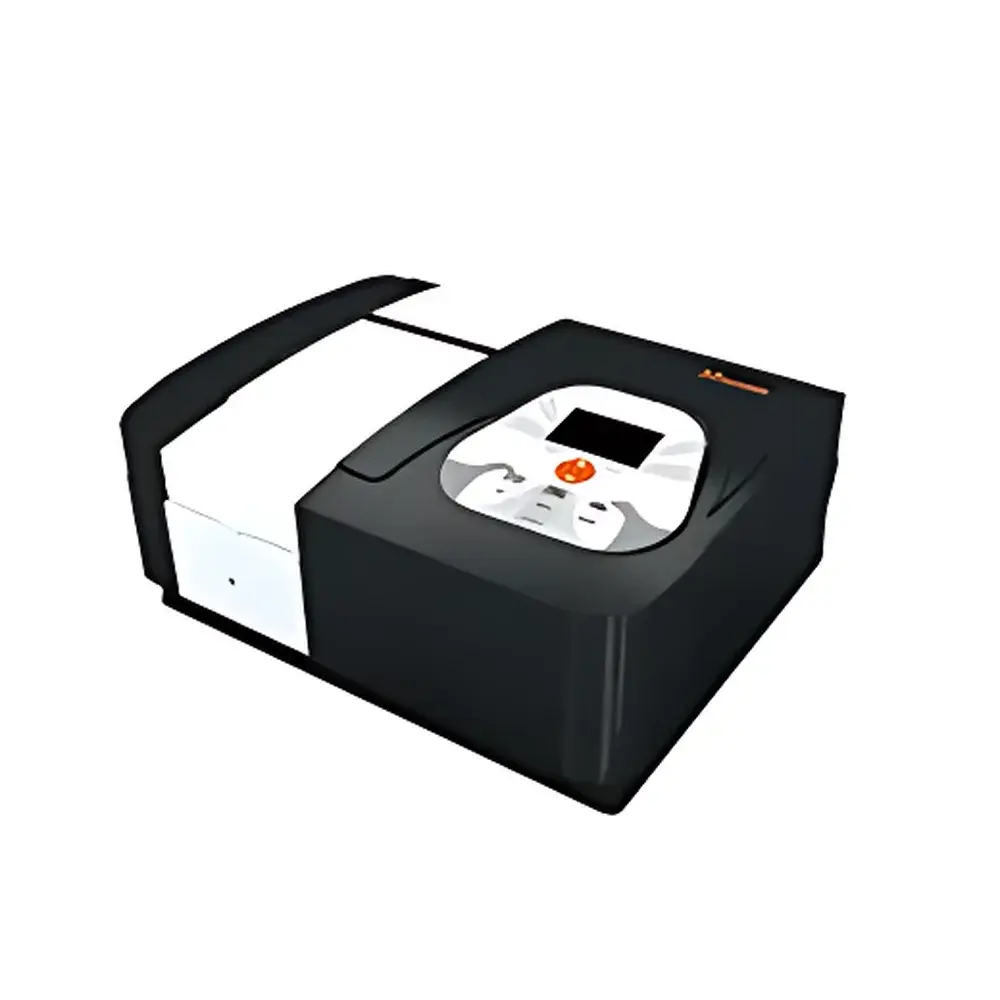
Hanon i3 UV-Vis Spectrophotometer
| Brand | Hanon |
|---|---|
| Origin | Shandong, China |
| Model | i3 |
| Optical Design | Double-beam |
| Detector | Photodiode Array (PDA) |
| Wavelength Range | 190–1100 nm |
| Spectral Bandwidth | 0.5 / 1 / 2 / 4 / 5.0 nm |
| Wavelength Accuracy | ±0.1 nm (at D₂ line, 656.1 nm), ±0.3 nm across full range |
| Wavelength Repeatability | ≤0.3 nm |
| Stray Light | ≤0.03% T |
| Wavelength Setting | Automatic |
| Photometric Range | 0–200% T, –0.3–3 A, 0–9999 C |
| Photometric Accuracy | ±0.5% T |
| Photometric Repeatability | ≤0.2% T |
| Baseline Stability | ±0.001 A/h at 500 nm |
| Display | 128×64 dot-matrix LCD |
| Data Interface | USB |
| Printer Interface | Parallel port |
| Light Sources | Imported deuterium and tungsten lamps |
| Power Supply | AC 220 V/50 Hz or 110 V/60 Hz |
| Dimensions | 420 × 300 × 160 mm |
| Weight | 13 kg |
Overview
The Hanon i3 UV-Vis Spectrophotometer is a double-beam, microprocessor-controlled analytical instrument engineered for precision absorbance, transmittance, and concentration measurements across the ultraviolet, visible, and near-infrared spectral regions (190–1100 nm). Its optical architecture employs a high-stability dual-beam configuration with real-time reference beam compensation, minimizing drift caused by source intensity fluctuations or environmental temperature variations. The system integrates a photodiode array (PDA) detector for rapid spectral acquisition and high signal-to-noise ratio performance. Designed for routine QC/QA laboratories, academic research, and pharmaceutical development workflows, the i3 delivers reproducible photometric data compliant with fundamental requirements of ISO 8579, ASTM E275, and USP for spectrophotometric instrumentation validation.
Key Features
- Double-beam optical path with automatic beam balancing ensures long-term baseline stability and eliminates manual zeroing between samples.
- Five selectable slit widths (0.5, 1, 2, 4, and 5.0 nm) enable optimization of resolution versus sensitivity for diverse sample matrices—from clear aqueous standards to turbid biological suspensions.
- Automated wavelength calibration using internal deuterium and tungsten lamp references supports traceable alignment without external standards or service intervention.
- Pre-installed quantitative analysis software enables immediate execution of fixed-wavelength photometry, multi-point standard curve generation (up to 200 curves), and coefficient-based concentration calculation.
- Internal memory stores up to 200 measurement datasets and 200 calibration curves—sufficient for batch-oriented workflows in regulated environments requiring audit-ready data retention.
- Tool-free lamp replacement design allows rapid swapping of imported deuterium and tungsten sources without optical realignment or recalibration procedures.
- Robust mechanical housing and thermally stabilized optical bench minimize vibration- and temperature-induced wavelength drift, supporting compliance with GLP documentation practices.
Sample Compatibility & Compliance
The i3 accommodates standard 10-mm rectangular cuvettes (glass, quartz, or plastic), as well as optional micro-volume adapters and flow cells for specialized applications. Its spectral fidelity and stray light performance (≤0.03% T at 220 nm) meet minimum acceptance criteria for method transfer in pharmaceutical dissolution testing per USP and for assay validation under ICH Q2(R2). While not pre-certified for 21 CFR Part 11, the instrument’s software architecture supports integration with third-party electronic lab notebook (ELN) systems that provide audit trail, user access control, and electronic signature capabilities required in GMP-regulated settings.
Software & Data Management
The embedded firmware includes a dedicated quantitative module supporting both standard curve and coefficient-based quantitation modes. All measurement parameters—including slit width, scan speed, averaging cycles, and wavelength step size—are fully configurable via intuitive menu navigation on the 128×64 LCD interface. Raw spectral data and processed results export directly via USB to CSV or TXT formats for downstream analysis in Excel, MATLAB, or statistical process control (SPC) platforms. No proprietary drivers or cloud dependencies are required; local data persistence ensures operational continuity during network outages or IT policy restrictions.
Applications
- Pharmaceutical: Active pharmaceutical ingredient (API) assay, excipient compatibility screening, and cleaning validation swab extract analysis.
- Environmental: Nitrate/nitrite quantification in wastewater, COD estimation, and heavy metal complexation studies using colorimetric reagents.
- Food & Beverage: Color index determination (e.g., AOAC methods), antioxidant capacity assays (e.g., DPPH, FRAP), and preservative concentration monitoring.
- Academic Research: Kinetic reaction monitoring, equilibrium constant determination, and ligand-binding stoichiometry via titration spectroscopy.
- Materials Science: Thin-film thickness estimation from interference fringes and bandgap energy calculation for semiconductor nanomaterials.
FAQ
Does the i3 support spectral scanning and kinetic time-course measurements?
Yes—the instrument performs full-spectrum scans (190–1100 nm) with user-defined start/stop wavelengths, step size, and scan speed. Kinetic mode captures absorbance changes at a single wavelength over user-specified intervals (100 ms to 999 s per point), with up to 10,000 data points per run.
Is the photodiode array detector cooled?
No—the PDA operates at ambient temperature. Thermal management is achieved via passive heat dissipation and low-noise analog front-end circuitry optimized for stability over 8-hour continuous operation.
Can the i3 be integrated into a LIMS environment?
Direct LIMS integration is not natively supported; however, exported CSV files conform to ASTM E1382-compliant data formatting, enabling automated ingestion via middleware or custom script-based pipelines.
What validation documentation is provided with the instrument?
Each unit ships with a factory calibration certificate referencing NIST-traceable standards for wavelength and photometric accuracy, along with a complete set of operational qualification (OQ) test protocols aligned with ISO/IEC 17025 guidance.
Is firmware upgrade capability available?
Yes—firmware updates are delivered via USB flash drive and installed through the instrument’s maintenance menu, preserving all user-stored methods and calibration data.




