
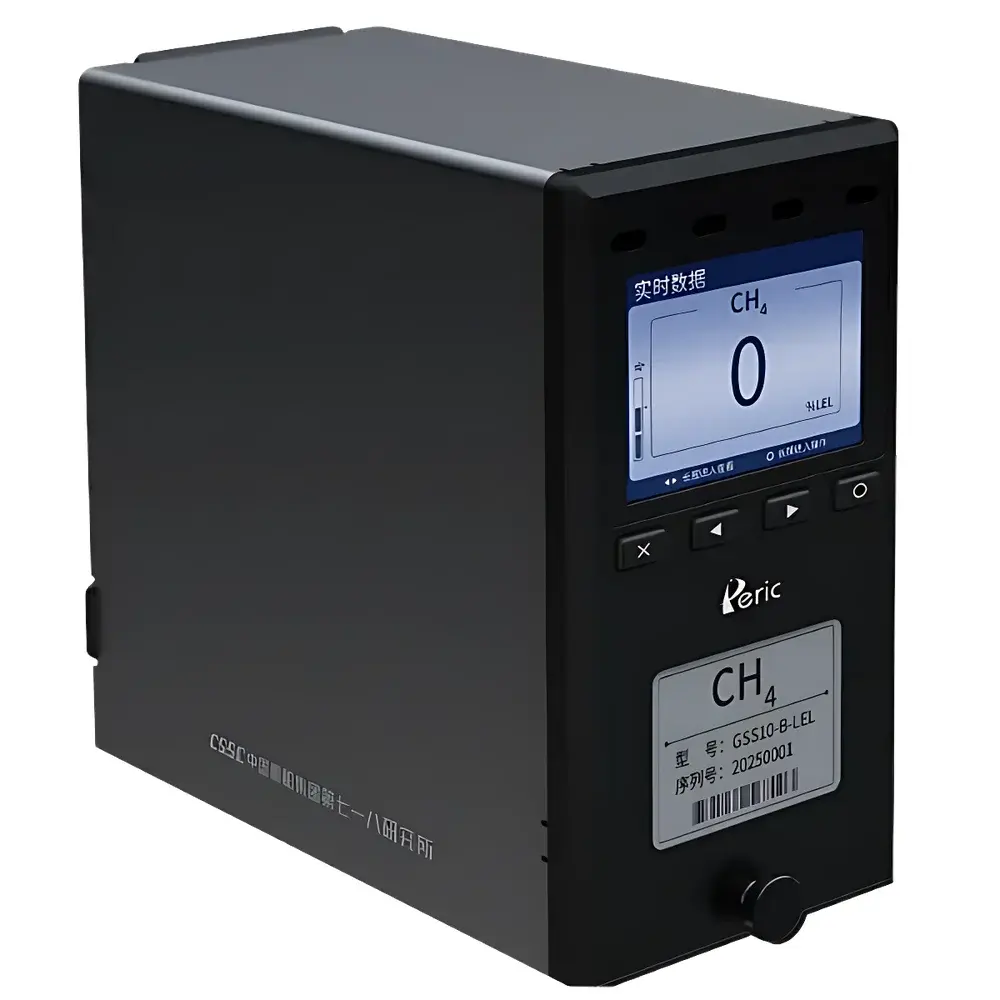
PERIC G-WA10 Multi-Principle Gas Detector
| Brand | PERIC |
|---|---|
| Origin | Hebei, China |
| Manufacturer Type | OEM/ODM Producer |
| Country of Origin | China |
| Model | G-WA10 |
| Pricing | Upon Request |
| Detection Principles | Electrochemical, Infrared (IR), Catalytic Combustion, Thermal Cracking + IR |
| Supported Gases | >30 toxic, flammable, and corrosive gases including NH₃, NF₃, SiH₄, AsH₃, B₂H₆, PH₃, H₂S, Cl₂, HF, HCl, HBr, SO₂, O₃, CO, NO, O₂, CH₄, C₂H₂, C₂H₄, C₃H₆, H₂, D₂, C₄F₆, CH₃F, CH₂F₂, COS, IPA, TEOS, GeH₄, ClO₂, CH₃ClO₂S |
| Sampling | Integrated diaphragm pump with flow & pressure monitoring and auto-adaptive regulation |
| Sensor Architecture | Modular, hot-swap intelligent sensors with offline calibration capability |
Overview
The PERIC G-WA10 Multi-Principle Gas Detector is an engineered safety instrumentation platform designed for high-integrity gas monitoring in semiconductor fabrication facilities (FABs), cleanrooms, and advanced materials manufacturing environments. It operates on a hybrid detection architecture—integrating electrochemical (EC), non-dispersive infrared (NDIR), catalytic combustion (CC), and thermal cracking coupled with infrared spectroscopy—to deliver selective, stable, and cross-interference-resistant measurement across more than 30 critical process and hazardous gases. Unlike single-principle detectors, the G-WA10 dynamically selects or combines optimal sensing modalities per target analyte, enabling reliable quantification of chemically diverse species—from highly reactive silanes (SiH₄) and arsine (AsH₃) to thermally stable perfluorocompounds (C₄F₆) and corrosive halides (HF, HCl, Cl₂). Its design adheres to fundamental requirements of semiconductor process safety: low false-alarm rate, rapid response time (<30 s T₉₀ for most EC/CC channels), and immunity to humidity and background gas fluctuations typical in sub-10 ppb cleanroom ambient conditions.
Key Features
- Fully domesticated core subsystems—including thermal cracking module, NDIR optical path assembly, and electrochemical sensor cartridges—ensuring supply chain resilience and compliance with national technology autonomy initiatives;
- Modular sensor architecture supporting hot-swap replacement and offline two-point calibration without system downtime; each sensor carries embedded calibration memory and lifetime tracking;
- Integrated micro-diaphragm sampling pump with real-time flow rate (50–500 mL/min) and differential pressure monitoring, enabling adaptive suction control for leak localization and consistent sample delivery under variable duct static pressure;
- Multi-layer interference compensation algorithms trained on >15,000 laboratory-generated cross-sensitivity matrices, minimizing false positives from co-eluting gases (e.g., distinguishing NH₃ from H₂O vapor or CO from CH₄ in catalytic channels);
- Ruggedized industrial enclosure rated IP65, compliant with SEMI S2-0215 electrical safety and ESD protection standards for cleanroom deployment;
- Configurable alarm hierarchy with dual-stage thresholds (warning/pre-alarm and critical shutdown), relay outputs (SPDT, 250 VAC/3 A), and optional 4–20 mA analog output with HART protocol support.
Sample Compatibility & Compliance
The G-WA10 is validated for continuous monitoring of ultra-high-purity (UHP) process gases used in etching, deposition, and cleaning steps—including NF₃, C₄F₆, CHF₃, SiH₄, PH₃, B₂H₆, AsH₃, NH₃, Cl₂, HCl, HBr, HF, O₂, N₂, Ar, and specialty blends. It meets functional safety requirements aligned with IEC 61508 SIL 2 for safety-related systems and supports traceability per ISO/IEC 17025 for calibration records. While not certified to UL 2075 or EN 45544-1 out-of-the-box, its hardware architecture and firmware logging structure are pre-engineered for third-party certification pathways. All sensor modules undergo accelerated life testing per ASTM D618 and thermal shock cycling per MIL-STD-810G. The device supports audit-ready data retention (≥90 days internal storage) and complies with GLP-aligned electronic record integrity principles, including write-once calibration logs and tamper-evident event timestamps.
Software & Data Management
The G-WA10 interfaces via RS-485 Modbus RTU or optional Ethernet TCP/IP with centralized Building Management Systems (BMS) or Semiconductor Manufacturing Execution Systems (MES). Its embedded firmware includes configurable data logging (1-second to 1-hour intervals), CSV export via USB-C, and encrypted remote diagnostics via TLS 1.2. The companion PC software—PERIC GasView Suite—provides real-time multi-channel trending, alarm correlation mapping, sensor health analytics (including drift rate estimation and zero-span deviation alerts), and automated report generation compliant with internal QA templates. All configuration changes and calibration events are logged with user ID, timestamp, and cryptographic hash—supporting FDA 21 CFR Part 11 readiness when deployed with external identity management infrastructure.
Applications
- Point-of-use (POU) monitoring at gas cabinets, abatement system inlets, and tool exhaust manifolds in 300 mm and advanced packaging FABs;
- Area surveillance in gas delivery rooms, cylinder storage zones, and wafer handling corridors where accumulation of undetected leaks poses acute inhalation or explosion risk;
- Integration into local exhaust ventilation (LEV) interlocks for automatic airflow ramp-up upon threshold exceedance;
- Support for Process Safety Management (PSM) programs under OSHA 1910.119 by providing auditable, time-stamped gas exposure history for incident root-cause analysis;
- Validation of gas purity specifications during cylinder changeover and purge verification prior to chamber opening.
FAQ
Does the G-WA10 support third-party sensor integration?
No—only PERIC-certified modular sensors are supported to ensure metrological traceability, interference modeling consistency, and firmware-level diagnostic alignment.
What is the recommended calibration frequency for electrochemical sensors?
Every 6 months under continuous operation; quarterly if exposed to >10 ppm of target gas or high-humidity environments (>80% RH).
Can the thermal cracking module detect NF₃ without supplemental IR detection?
No—the thermal cracker alone generates multiple fluorinated fragments; quantitative NF₃ measurement requires post-crack NDIR analysis of characteristic 1120 cm⁻¹ absorption bands.
Is the device suitable for Class 1 Div 1 hazardous locations?
Not intrinsically safe by default; explosion-proof enclosures (NEC Class I, Div 1, Group B/C/D) require custom housing and barrier certification—available as an engineering option.
How is sensor cross-sensitivity managed across mixed-gas environments?
Through factory-characterized multi-gas interference matrices, dynamic baseline correction using reference channels, and firmware-based weighted least-squares regression during signal processing.
Related Products







