
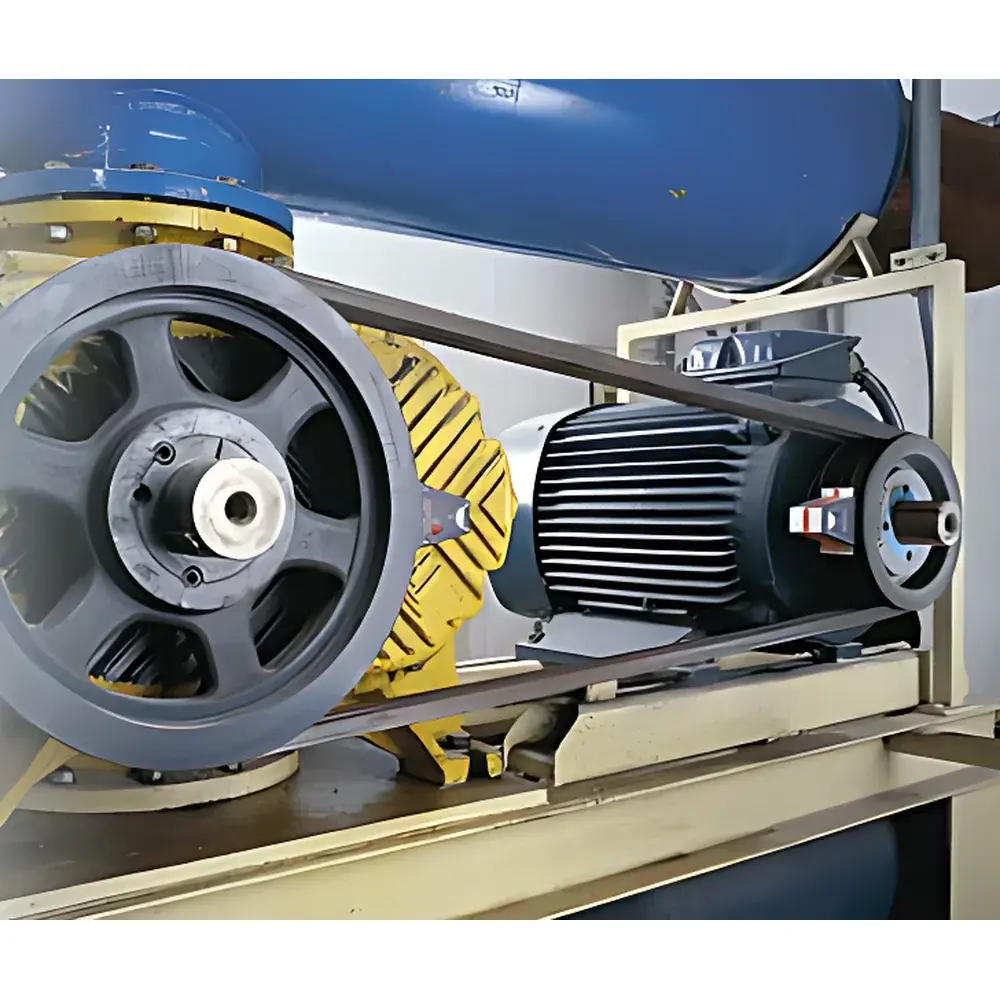
SKF TMEB 2 Belt Pulley Laser Alignment System
| Origin | Imported |
|---|---|
| Manufacturer Type | Authorized Distributor |
| Model | TMEB 2 |
| Laser Class | Class 2 Semiconductor Diode, 632 nm, 1 mW |
| Measurement Distance Range | 50 mm – 6 m |
| Angular Accuracy | < 0.2° |
| Power Supply | Two 1.5 V LR14 Alkaline Batteries (20 h continuous operation) |
| Total Weight | 3.7 kg |
Overview
The SKF TMEB 2 Belt Pulley Laser Alignment System is a precision-engineered optical alignment instrument designed specifically for rapid, non-contact verification and correction of belt-driven pulley systems in industrial maintenance and rotating equipment reliability programs. Operating on the principle of visible red laser beam projection and dual-axis photodetector-based angular displacement sensing, the TMEB 2 delivers real-time visual feedback on three critical misalignment modes: parallel offset, angular (or “cross”) misalignment, and combined angular/offset conditions. Unlike general-purpose shaft alignment tools, the TMEB 2 integrates purpose-built V-groove mounting rails that interface directly with standard V-belt pulley grooves—ensuring mechanical registration at the functional contact surface rather than on shaft extensions or coupling faces. This design eliminates cumulative error from shaft runout, bearing clearance, or adapter inaccuracies, making it especially suitable for legacy belt-driven fans, blowers, compressors, conveyors, and HVAC systems where couplings are absent or inaccessible.
Key Features
- Class 2 visible red laser (632 nm, ≤1 mW) ensures operator safety while providing high-contrast beam visibility under typical plant lighting conditions.
- Dual-axis angular measurement capability with resolution better than 0.2° enables quantitative assessment of both horizontal and vertical plane misalignment simultaneously.
- V-groove rail system provides repeatable, zero-reference mounting directly onto standard A–E section V-belt pulleys—no custom fixtures or calibration required.
- Compact, self-contained architecture with integrated laser emitter and receiver units, eliminating external cabling or signal processing hardware.
- Long-duration battery operation (up to 20 hours on two LR14 cells) supports full-shift field use without recharging infrastructure.
- Ergonomic handheld design (3.7 kg total system weight) facilitates single-technician operation across elevated, confined, or overhead installations.
Sample Compatibility & Compliance
The TMEB 2 is compatible with all standard V-belt pulleys conforming to ISO 4183, DIN 2211, and ANSI B50.1 specifications—including single- and multi-groove sheaves with pitch diameters ranging from 50 mm to 1,200 mm. It requires no physical modification to the machine or pulley surfaces and introduces no mechanical load during measurement. The device complies with IEC 60825-1:2014 for Class 2 laser product safety and meets CE marking requirements for electromagnetic compatibility (EMC Directive 2014/30/EU) and low-voltage safety (LVD Directive 2014/35/EU). Its operational methodology aligns with best practices outlined in ISO 5348:2019 (Mechanical vibration — Guidelines for the mechanical vibration of rotating machinery) and supports preventive maintenance documentation traceability per ISO 55001 asset management standards.
Software & Data Management
The TMEB 2 operates as a standalone, firmware-based instrument with no embedded software, PC interface, or digital data logging capability. All alignment decisions are made via direct visual interpretation of laser spot position relative to calibrated receiver targets—a design choice prioritizing robustness, speed, and immunity to IT infrastructure dependencies in harsh industrial environments. While it does not generate electronic reports or support FDA 21 CFR Part 11-compliant audit trails, its analog readout method satisfies GLP/GMP-aligned maintenance record requirements when paired with standardized paper-based work orders (e.g., ISO 17020-compliant inspection forms) and photographic documentation of final laser alignment states.
Applications
- Predictive and corrective maintenance of belt-driven HVAC blowers and chillers in commercial and institutional facilities.
- Routine alignment verification during commissioning or overhaul of reciprocating compressors, centrifugal pumps, and industrial fans.
- Root cause analysis of premature belt wear, slippage, noise, or vibration in legacy machinery lacking modern coupling-based alignment references.
- Training and competency assessment for maintenance technicians performing ISO 18436-2 Category II vibration and alignment tasks.
- Integration into Reliability-Centered Maintenance (RCM) programs where belt drive integrity is a critical failure mode (e.g., power generation auxiliary systems).
FAQ
Is the TMEB 2 suitable for timing belt or flat belt systems?
No—the V-groove rail design and laser targeting geometry are optimized exclusively for classical V-belt pulleys. Timing belts require toothed sprocket alignment methods; flat belts demand different reference planes and are not supported.
Can the TMEB 2 measure shaft runout or radial play?
No—it measures only geometric misalignment between pulley faces. Shaft runout must be assessed separately using dial indicators or laser shaft alignment tools such as the SKF TKSA series.
Does the system require annual recalibration?
SKF specifies no routine recalibration interval; however, users should verify beam alignment against a known reference (e.g., mirror reflection test) before each critical job per manufacturer’s recommended pre-use check procedure.
What environmental conditions limit its use?
Operation is rated for ambient temperatures from –10 °C to +50 °C and relative humidity up to 85% non-condensing. Direct exposure to steam, heavy oil mist, or intense UV radiation may degrade optical component longevity and is not recommended.
Is technical support available outside the EU and North America?
Yes—authorized SKF distribution partners provide local application engineering support, training, and spare parts logistics in over 130 countries, subject to regional regulatory approvals and service agreements.



